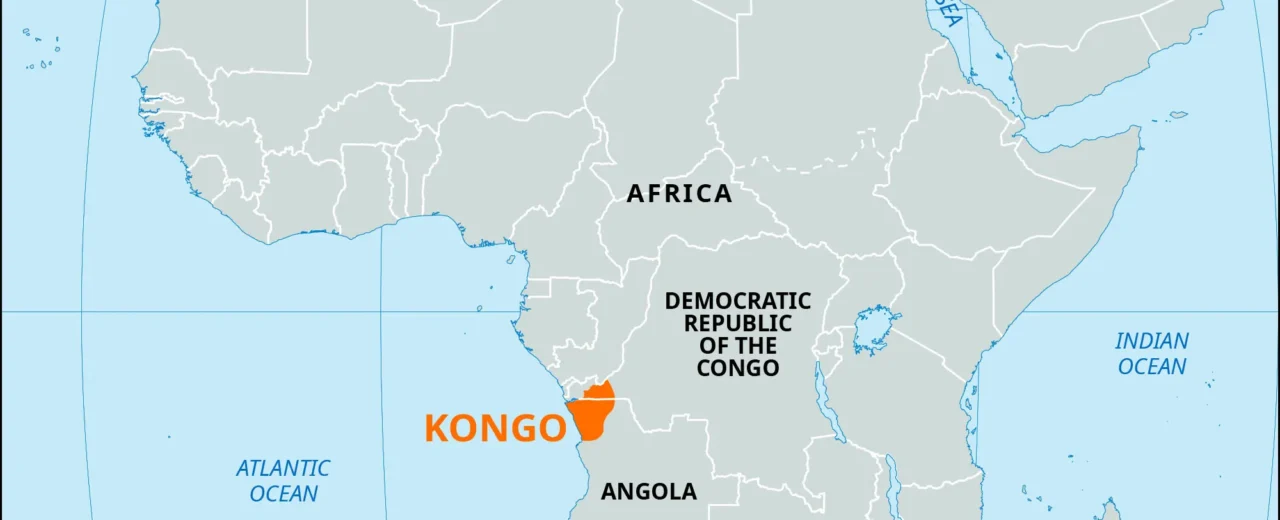
When Portuguese ships reached the mouth of the Congo River in the 1480s, they did not discover an isolated people waiting to be organized from abroad. Their envoys encountered a capital on a high plateau, provincial governors, titled nobles, tribute networks, specialized crafts, and a monarchy able to send its own diplomats across the Atlantic. Within a generation, the ruler of this African state was corresponding with the king of Portugal as a fellow Christian sovereign.
The Kingdom of Kongo would become one of the best-documented states in early modern Africa. Its rulers adopted Christianity, sponsored schools, exchanged embassies, and commissioned art that joined Catholic imagery to Kongo ideas of authority. They also entered an Atlantic economy increasingly dominated by the trade in enslaved people—a system they tried to control, profited from, protested, and ultimately could not contain. Kongo’s history is neither a simple story of European conquest nor a romantic tale of harmonious cultural exchange. It is the history of an African power making strategic choices in a rapidly changing world.
A Kingdom Before Portuguese Contact
The Kingdom of Kongo emerged around the fourteenth century in west-central Africa, south of the lower Congo River. Its territory and influence crossed borders that did not yet exist, covering areas now divided among northern Angola, the Democratic Republic of the Congo, the Republic of the Congo, and parts of Gabon. The core state was centered on Mbanza Kongo, in present-day Angola.
Later traditions identify Lukeni lua Nimi as a founding ruler who crossed the Congo River or conquered the plateau of Mpemba. Such accounts preserve political memory but cannot be treated as exact contemporary records. They were written down after Portuguese contact and shaped by later dynastic claims. Archaeology, historical linguistics, and early documents nevertheless support the existence of political centralization before Europeans arrived.
Mbanza Kongo Was a Political and Sacred Capital
Mbanza Kongo stood on a plateau that offered commanding views and symbolic separation from the surrounding countryside. It contained the royal compound, elite residences, public spaces, ritual sites, and later churches and schools. Portuguese visitors eventually called it São Salvador, but the older capital remained central to Kongo ideas of kingship.
Modern archaeology has identified layers belonging to both pre-Christian and Christian phases. UNESCO placed Mbanza Kongo on the World Heritage List in 2017 because its remains document the political and religious transformation that followed contact with Portugal. The site challenges the assumption that impressive African capitals must resemble European stone cities. Much Kongo architecture used earth, wood, thatch, and other materials whose political importance exceeded their chances of survival.
How Kongo’s Political System Worked
The ruler is often called the Manikongo in European sources, a rendering connected to the Kikongo title Mwene Kongo, meaning lord or ruler of Kongo. He governed through provincial and local authorities, court officials, military leaders, and titled nobles. Major provinces included regions such as Mpemba, Mbata, Mbamba, Nsundi, Mpangu, and coastal Soyo, though their status and boundaries changed.
The monarchy was elective within a restricted royal elite rather than automatically passing from father to eldest son. Competing kin groups—often discussed through the concept of kanda—built coalitions and promoted candidates. Maternal connections could be politically crucial, and elite women influenced succession, property, diplomacy, and provincial networks even when men held most formal titles.
Wealth Came From Farming, Craft, and Regional Trade
Fine raffia textiles became especially admired. European collectors compared their softness and complex patterns to silk, although the cloth grew from Central African techniques and social meanings. Copper, ivory, and crafted goods also moved through long-distance networks. Nzimbu shells collected from coastal areas served as a recognized currency in important transactions and helped the monarchy regulate value.
Kongo’s economic system was not created by Atlantic commerce. Portuguese contact added new routes, imported goods, and sources of military and religious prestige to existing institutions. The court sought to manage foreign trade by controlling ports, merchants, and access to royal markets. That control became increasingly difficult when Portuguese settlers on São Tomé and later in Angola developed interests that did not match those of either the Kongo or Portuguese crowns.
Diogo Cão Opened a Two-Way Encounter
The Portuguese navigator Diogo Cão reached the Congo estuary in 1482 or 1483 and erected a stone marker claiming discovery for King João II. From a European perspective, this was an episode in Atlantic exploration. From Kongo’s perspective, the strangers were new diplomatic and commercial visitors entering an already organized political landscape.
Initial contacts included cautious exchanges of people. Kongolese envoys traveled to Portugal, learned Portuguese, encountered Christianity, and returned with missionaries and artisans. Portuguese representatives traveled inland to the royal court. Each side tried to understand the other through its own concepts of kingship, religion, gift exchange, and alliance.
Conversion Was a Royal Choice, Not Instant Conquest
King Nzinga a Nkuwu accepted baptism in 1491 and took the name João I. Members of the court were also baptized, and a church was constructed at the capital. Yet the first royal conversion did not mean that the entire population suddenly abandoned older religious practices. João later reduced his support for the new faith, while factions at court disagreed about its political and ritual consequences.
His son Nzinga Mbemba, known as Afonso I, remained an energetic Christian. After João’s death, Afonso fought a succession struggle against his brother Mpanzu a Kitima and gained the throne around 1506–1509. Later Christian accounts described a miraculous appearance of Saint James and heavenly warriors assisting Afonso’s smaller army. The story became powerful royal symbolism, but historians cannot verify it as a battlefield event.
Afonso used victory to present Christianity as a source of legitimate kingship. This was not simply submission to Portuguese missionaries. He studied doctrine, supported churches, and sought to control how the faith operated within his kingdom. Conversion gave Kongo’s monarchy a new language of sacred authority while leaving many older assumptions about ancestors, healing, protection, and political power in place.
Afonso I Built an African Christian State
Afonso sponsored schools for elite children, requested priests and teachers, and maintained correspondence in Portuguese. Literate Kongolese secretaries and interpreters became essential to government. The court used letters to negotiate trade, request specialists, report misconduct, and assert Kongo’s status to rulers abroad.
The king’s son Henrique studied in Europe, entered the clergy, and was appointed a bishop in 1518. His career demonstrated the monarchy’s ambition to create a locally rooted church, although shortages of ordained clergy remained a persistent problem. Lay teachers performed much everyday instruction and helped Christianity spread beyond the small number of European missionaries.
Kongo Christians translated unfamiliar concepts into Kikongo and interpreted Catholic teaching through local categories. Churches, crosses, saints, and sacraments acquired meanings shaped by Kongo society. This process resembles other centers where imported writing and belief were made locally meaningful; the region’s experience belongs beside histories such as the Timbuktu manuscripts, which likewise reveal African communities as producers rather than passive recipients of intellectual culture.
Christian Art Became Kongo Art
Artists did not merely copy objects brought from Europe. Kongo crucifixes, staffs, textiles, ivory carvings, and prestige objects combined Atlantic motifs with local techniques and ideas of power. Cross-shaped imagery could resonate with both Christian belief and existing concepts of boundaries between worlds.
Royal insignia helped make foreign connections visible. Coats of arms, banners, clothing, and Christian names placed Kongo’s monarch among a wider community of Catholic rulers. At the same time, the materials and performances surrounding those symbols were distinctly Central African. A crucifix made by a Kongo artist was not a failed European imitation; it belonged to a developing African Christian tradition.
Kongo Practiced Atlantic Diplomacy
Kongo’s rulers sent and received ambassadors, corresponded with Portugal and the papacy, and sought craftsmen, teachers, physicians, and clergy. Elite Kongolese traveled to Lisbon and Rome. Diplomatic letters addressed European monarchs through the language of Christian fraternity, even when actual relations were unequal.
The kingdom’s international position was therefore more complex than that of a colony. Afonso expected Portuguese kings to restrain their subjects, honor agreements, and cooperate with his officials. He made requests as an allied sovereign, not as a colonial governor. Portugal sometimes recognized that status while merchants and settlers ignored royal policy whenever profit encouraged them.
The Slave Trade Exposed the Limits of Royal Control
Forms of slavery existed in Kongo before Portuguese contact. War captives, judicial dependents, and other unfree people could be transferred or incorporated into households. Early Kongo rulers participated in the sale of captives and attempted to make overseas trade a royal monopoly. The growth of sugar plantations on São Tomé sharply increased external demand.
That demand transformed incentives. Kongolese officials, provincial elites, raiders, and Portuguese merchants could profit by capturing or falsely classifying people as enslaveable. Smuggling bypassed royal inspection. The trade reached beyond those taken in warfare and threatened free subjects, nobles, and even members of the king’s extended family.
In letters written in 1526, Afonso complained to João III of Portugal that merchants and corrupt people were kidnapping Kongolese and depopulating the realm. He asked for tighter licensing and royal review of captives. These letters are powerful evidence of resistance to uncontrolled trafficking, but calling Afonso an abolitionist imposes a later position on him. He sought to regulate trade, protect free subjects, and preserve royal authority; he did not reject every form of slavery or every export of captives.
Portugal Was Both Partner and Growing Threat
Portuguese expansion farther south intensified the problem. The colony of Angola, established around Luanda from 1575, became a base for warfare and slave trading involving Ndongo and other African states. Kongo and Portuguese Angola alternated between alliance, rivalry, and armed conflict. Neither side followed a single consistent policy across generations.
It is inaccurate to describe fifteenth-century contact as the beginning of immediate Portuguese rule over Kongo. The kingdom remained independent for centuries. It is equally inaccurate to portray the relationship as an equal partnership untouched by imperial pressure. Atlantic trade increasingly rewarded violence, strengthened external settlements, and narrowed the monarchy’s ability to enforce its decisions.
War, Dutch Alliance, and Shifting Atlantic Rivalries
In 1622, Portuguese forces from Angola invaded Kongo territory and defeated local forces at Mbumbi, creating a serious crisis. King Pedro II sought allies and opened discussions with the Dutch, Portugal’s commercial and military rivals. Kongo hoped to use European competition to remove Portuguese power from Angola.
The Dutch captured Luanda in 1641 with assistance from African allies, including forces associated with Kongo. The occupation disrupted Portuguese control but did not end the slave trade or produce a stable anti-Portuguese order. Portugal recaptured Luanda in 1648 using forces from Brazil, revealing how closely South Atlantic warfare connected Africa, Europe, and the Americas.
The Battle of Mbwila Became a Turning Point
Disputes over frontier territories and political allegiance led to war between King António I and Portuguese Angola. On 29 October 1665, their armies met at Mbwila. Portuguese forces and African auxiliaries defeated the Kongo army. António was killed, along with many senior nobles, and his severed head was taken as a trophy.
The loss was devastating because so many potential officeholders and claimants died together. Rival royal factions competed for the throne, provincial leaders increased their autonomy, and the kingdom entered a long civil war. Mbanza Kongo was repeatedly contested and at times largely abandoned.
Mbwila did not instantly erase Kongo. The kingdom’s institutions, Christian identity, royal titles, and regional loyalties survived. Powerful Soyo defeated a Portuguese invasion at Kitombo in 1670, proving that the Portuguese victory had not produced automatic colonial control. The more accurate interpretation is that Mbwila broke the balance holding the central monarchy together and opened decades of factional warfare.
Civil War Changed Who Could Exercise Power
After 1665, rival houses and provincial coalitions installed competing kings. Control of the old capital no longer guaranteed authority across the former realm. Warfare displaced communities and supplied captives to Atlantic slave traders, making political fragmentation economically profitable for some participants and catastrophic for many others.
Regionalization did not mean cultural disappearance. Kongo Christianity, titles, symbols, and collective memory continued across rival territories. Competing rulers claimed to restore legitimate order rather than invent entirely new states. The idea of Kongo remained politically useful even when no monarch could command the whole kingdom.
Dona Beatriz Reimagined Christian Restoration
Around 1704, a young woman named Kimpa Vita—known by the Christian name Dona Beatriz—began preaching that Saint Anthony spoke through her. Her Antonian movement taught that sacred history belonged to Kongo as well as Europe and called for the restoration and reunification of the capital.
Beatriz attracted followers among ordinary people and elites exhausted by civil war. She challenged missionary authority and the interests of rival claimants while speaking in unmistakably Christian terms. Accounts written by Capuchin missionaries are essential sources, but they were hostile to her teachings and must be read critically.
King Pedro IV eventually ordered her arrest. She was tried for heresy and burned in 1706 with her companion. Her movement was suppressed, yet many followers were reintegrated into the restored kingdom. Beatriz is sometimes portrayed as a modern nationalist or anticolonial revolutionary. Those labels capture part of her later significance but can obscure her immediate goal: a Christian and political renewal of Kongo within an eighteenth-century religious world.
Restoration Did Not Restore the Old Balance
Provincial powers remained strong, succession arrangements reflected civil-war compromises, and Atlantic commerce continued to reshape the region. The export of enslaved people endured on a vast scale. Kongo rulers sometimes negotiated, resisted, or participated, but no central authority could recreate an effective monopoly.
The kingdom persisted into the nineteenth century, contradicting accounts that end it in 1665 or 1700. Portugal gradually imposed unequal treaties and claimed vassalage, particularly in the later nineteenth century. After further colonial expansion, Portuguese authorities abolished the remaining royal institution in 1914, although Kongo identity and claims to traditional authority survived.
Common Myths About the Kingdom of Kongo
The first myth is that Portuguese explorers created the kingdom. Kongo’s capital, monarchy, provinces, economy, and political traditions predated contact. The Portuguese added new opportunities and dangers; they did not build the state from nothing.
The second myth is that Christianity was simply imposed at gunpoint. Royal conversion was strategic and contested, but Kongo rulers and believers actively developed schools, clergy, theology, and art. Their Christianity was neither fake nor merely European. Conversely, voluntary royal adoption does not mean later missionary and colonial pressure was harmless.
A third myth turns Afonso’s letters into a complete rejection of slavery. They condemned kidnapping, corruption, and the loss of free subjects while proposing regulation. Finally, Mbwila was a disastrous turning point, not the kingdom’s immediate end. Kongo survived through civil war, restoration, and centuries of changing sovereignty.
Why Kongo’s History Still Matters
Kongo offers a powerful case study in African agency without requiring a story of uninterrupted success. Its rulers recognized opportunities in Atlantic contact, used foreign literacy and religion, and negotiated with distant powers. Some decisions strengthened the monarchy; others tied it to forces that became impossible to control.
The kingdom’s experience also reveals that Christianity, diplomacy, and modern statecraft did not travel in one direction. Kongolese envoys, clergy, artists, and writers shaped Atlantic Catholic culture. Their descendants carried Kongo religious and political ideas into the Americas through forced migration, influencing communities in Brazil, the Caribbean, and beyond.
Later resistance to European conquest elsewhere in Africa—including the War of the Golden Stool—unfolded under different conditions, but Kongo’s history warns against reducing African-European encounters to a single moment of conquest. Relationships moved through bargaining, alliance, conversion, commerce, coercion, warfare, and memory.
Conclusion: An African Power in an Atlantic World
The Kingdom of Kongo entered the Atlantic age as an established Central African state. It did not remain unchanged. Christianity altered royal legitimacy, literacy expanded diplomacy, foreign trade redistributed wealth, and demand for captives damaged the monarchy’s ability to protect its people. Kongo leaders were actors in those transformations, but agency did not guarantee control over their consequences.
Afonso I’s reign captures the contradiction. He built schools and churches, sent a bishop to serve his kingdom, and wrote as a sovereign to another king. He also participated in slave trading while protesting the kidnapping of free Kongolese and the erosion of royal law. Treating him only as a heroic abolitionist or a collaborator flattens a difficult historical reality.
Kongo endured Portuguese pressure, civil war, religious conflict, and political fragmentation far longer than simplified timelines suggest. Its art, Catholic traditions, political memory, and diaspora survived the formal monarchy itself. The kingdom’s deepest lesson is not that African rulers welcomed or rejected Europe. It is that they interpreted, negotiated, and remade a new Atlantic world—even as that world imposed costs they could not escape.