In the fourth century CE, a ruler in the northern Ethiopian highlands issued a gold coin bearing a Christian cross. The choice was political as well as religious. Gold currency traveled, and every transaction carried the king’s image and message far beyond his court. The coin belonged to the Kingdom of Aksum, an African power connected to the Mediterranean, Arabia, and the Indian Ocean.
Aksum is often introduced through its towering stone stelae or the tradition that the Ark of the Covenant rests there. Those subjects matter, but neither explains how the kingdom worked. Its strength came from highland agriculture, regional authority, control of routes to the Red Sea port of Adulis, and rulers who communicated in multiple languages and minted gold, silver, and copper coins.
The evidence is substantial but uneven. Archaeology, inscriptions, coinage, Roman and Byzantine texts, and a first-century maritime handbook illuminate different moments. Later Ethiopian traditions preserve another kind of historical memory. Reading these sources together reveals an adaptable state, while keeping confirmed history separate from claims that cannot be independently verified.
Aksum grew from an older highland world
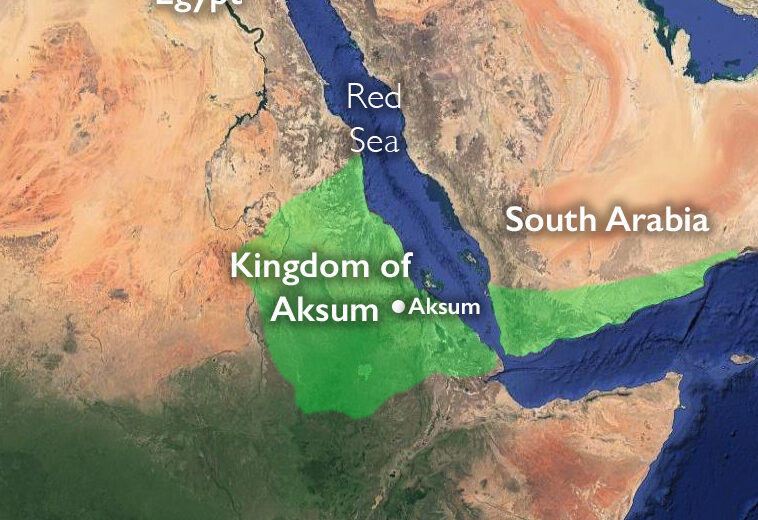
The Kingdom of Aksum developed in what is now northern Ethiopia and Eritrea. Its history did not begin with a sudden migration or a single founding king. Communities in the northern Horn of Africa had farmed, traded, built settlements, and maintained contacts across the Red Sea for centuries before Aksum became a major state.
At Yeha, southwest of modern Aksum, a monumental stone building dating to the first millennium BCE demonstrates close connections with southern Arabia. Inscriptions, religious imagery, and architectural techniques also show exchange across the sea. Older scholarship sometimes treated these similarities as proof that outsiders created civilization in the Ethiopian highlands. Archaeology now supports a more balanced interpretation: local African societies selectively adopted and transformed ideas moving through a long-connected region.
The settlement at Aksum expanded during the late centuries BCE and early centuries CE. Its location offered access to fertile uplands, seasonal rainfall, and routes running east toward the Red Sea and west or south into the African interior. The capital was inland rather than directly on the coast, allowing royal power to draw on agricultural production as well as maritime commerce.
Dates for the kingdom’s emergence vary because political centralization leaves no single archaeological signature. The Metropolitan Museum of Art’s survey places the formation of the kingdom within a long development from the mid-second century BCE to the mid-second century CE. What is clear is that by the first centuries CE, Aksumite rulers commanded resources sufficient for monumental building, war, diplomacy, and international trade.
Adulis connected the highlands to the Red Sea
Aksum’s principal maritime outlet was Adulis, a port on the Eritrean coast. Aksum and Adulis were not neighboring districts: caravans had to cross difficult terrain between the highlands and the sea. Their connection nevertheless allowed inland rulers to participate in one of antiquity’s most active commercial systems.
The Periplus of the Erythraean Sea, a Greek-language sailing and trading guide usually dated to the first century CE, describes Adulis and a ruler of the interior. It lists ivory, rhinoceros horn, tortoiseshell, and other goods moving outward, while cloth, metalware, wine, and manufactured products arrived from abroad. The text was written for merchants, not as a history of Aksum, so its geographical and political statements require cautious interpretation.
Red Sea shipping connected Roman Egypt with Arabia and ports farther east. Sailors used knowledge of monsoon winds to cross the Arabian Sea, linking the Mediterranean to India. Aksum occupied neither end of that route, but its position enabled rulers and merchants to channel African products toward it and tax exchange passing through their territory.
Long-distance commerce did not replace local production. Grain, livestock, pottery, iron tools, and textiles supported daily life, while farmers sustained the court and towns. Describing Aksum solely as a trading empire makes its prosperity seem dependent on ships controlled by foreigners. Maritime exchange amplified a political economy rooted in African land, labor, and regional networks.
This combination resembles other ancient commercial centers, including the Egyptian port examined in the site’s article on Naukratis archaeology: imported objects illuminate connections, but the port cannot be understood apart from its inland society.
Coins made royal authority portable
Aksum began issuing its own coins around the late third century CE. It was the first sub-Saharan African state known to mint coinage in gold, silver, and bronze on a sustained basis. The denominations served different purposes. Gold pieces suited high-value exchange and diplomacy; silver and copper circulated closer to home, although archaeologists continue to debate the reach of monetized transactions within the kingdom.
Early coins followed some Mediterranean conventions. They carried a royal portrait, inscriptions, and standardized weights, often using Greek because it was widely understood in international commerce. Yet the coins were not imitations without local meaning. Royal names, titles, symbols, and later Geʿez inscriptions asserted an Aksumite identity.
Numismatics is especially valuable because coins can be ordered by rulers, designs, metal content, and changing religious signs. They help reconstruct a political sequence where continuous written chronicles are absent. Their findspots also reveal movement, although a coin discovered abroad does not by itself prove direct state-to-state trade; money could pass through many hands.
Coins were propaganda in a compact form. A ruler’s face and title presented sovereignty to people who might never see the capital. Changes in gold purity could respond to economic conditions, while the use of several metals linked royal imagery to transactions at different levels. The mint transformed access to precious metal into a claim that Aksum belonged among the major powers issuing recognized currency.
The famous cross on later issues is therefore more than a decorative religious emblem. It shows a royal conversion becoming public policy and material culture. Because coin types can be compared across a reign, they provide evidence for a transition that literary accounts describe from a different perspective.
Ezana’s reign transformed the kingdom
King Ezana, who ruled during the fourth century, is the best documented Aksumite monarch. Inscriptions describe military campaigns and victories, while coins issued in his name change from pre-Christian symbols to the cross. Together, these materials provide strong evidence that the court adopted Christianity during his reign.
A later account by the church historian Rufinus tells how Frumentius, a Christian from the eastern Mediterranean, reached the Aksumite court after a shipwreck and eventually influenced the royal household. Frumentius later became bishop through Athanasius of Alexandria. The story was written within a Christian historical tradition, but its broad outline fits Aksum’s commercial contacts and relationship with the Alexandrian church.
Conversion was not necessarily instantaneous throughout the population. A king could adopt a religion before rural communities abandoned older practices, and archaeological evidence points to gradual change. Christianity offered the monarchy new ties to Roman and Byzantine Christian worlds, but reducing Ezana’s decision to trade strategy alone would ignore genuine religious conviction and internal politics.
Royal Christianity could help unite subjects across linguistic and regional differences. Churches created institutions, clerical networks, and new forms of patronage. Geʿez developed as a major written language, while Greek remained useful in some official and international settings. Aksum’s Christianity was African from its early institutional life, even as its church maintained a relationship with Alexandria.
The transition also demonstrates why claims that Christianity arrived in Ethiopia only through later European missionaries are false. Aksum adopted the faith centuries before most of northern Europe. The Ethiopian Orthodox Tewahedo tradition grew from this ancient foundation and survived political changes long after Aksum ceased to be an imperial capital.
Stelae turned elite burial into public architecture
Aksum’s most visible monuments are monolithic stelae: enormous stones quarried, transported, carved, and raised near elite tombs. Some imitate multi-story buildings, complete with false doors and rows of windows. Their architectural decoration made stone appear inhabited and transformed burial grounds into statements of rank.
The tallest surviving standing stela rises more than 20 meters. An even larger example, often called the Great Stela, fell in antiquity and broke into sections. Its collapse may have occurred while it was being erected or soon afterward, but no contemporary account settles the question. The engineering required for any of the giant monuments testifies to quarrying knowledge, organized labor, ropes, timber, and careful planning.
The stelae are commonly called obelisks, though that term invites comparison with Egyptian monuments that had different shapes and functions. At Aksum, the largest decorated stones were associated with underground elite tombs. Looting and disturbance make it difficult to reconstruct the original burials or ceremonies in detail.
Monument building changed after the court embraced Christianity. Elite commemoration increasingly centered on churches, inscriptions, and Christian forms rather than the largest funerary stelae. This does not mean every older practice ended at once. Religious change altered the language of power over generations.
Modern history added another layer. Italian forces removed one major stela after the 1935–1936 invasion of Ethiopia and erected it in Rome. It was returned and re-erected in Aksum in the twenty-first century. The episode links archaeological heritage to colonial conquest, restitution, and the continuing importance of the site to Ethiopians.
Aksum fought and negotiated across the Red Sea
Aksumite rulers did not simply wait for caravans at the capital. Inscriptions claim campaigns in neighboring regions, and foreign sources place the kingdom in diplomatic and military affairs around the Red Sea. The extent of direct control varied, and royal victory texts naturally exaggerate success, but they show a monarchy able to mobilize forces beyond its core.
During the sixth century, King Kaleb intervened in Himyar, in present-day Yemen, after the killing of Christians at Najran under the Himyarite ruler Yusuf Asʾar Yathʾar, often called Dhu Nuwas. Byzantine interests, Christian solidarity, commercial strategy, and regional rivalry all formed part of the crisis. Explaining the expedition as either a purely religious rescue or a simple trade war is too narrow.
Aksumite forces crossed the sea and overthrew Yusuf. Aksum then tried to maintain authority in southern Arabia, but its position did not remain secure. Abraha, initially connected to the occupying forces, established his own rule, while the Sasanian Persian Empire later intervened in Yemen. These events show both Aksum’s reach and the limits of projecting power across water.
Relations with Byzantium were based on shared religion and overlapping interests rather than Aksumite subordination. Diplomatic descriptions placed the kingdom within a world of competing Christian and non-Christian powers. The Red Sea was not a peripheral margin between “real” civilizations. It was a political arena in which African, Arabian, Roman, Byzantine, and Persian states pursued their own agendas.
The Ark tradition belongs to a different body of evidence
Aksum’s Church of Saint Mary of Zion is associated with the Ethiopian tradition that the Ark of the Covenant is kept there. According to the Kebra Nagast, or “Glory of Kings,” Menelik I, son of the Queen of Sheba and King Solomon, brought the Ark to Ethiopia. The text became central to later Ethiopian ideas of sacred kingship.
The Kebra Nagast survives as a medieval work compiled many centuries after the early Aksumite kingdom and long after the era traditionally assigned to Solomon. It is essential evidence for Ethiopian political theology and historical memory, but it is not contemporary documentation of the Ark’s journey. No independent archaeological evidence verifies that the biblical object is in Aksum.
This does not make the tradition historically irrelevant. Belief shaped coronation, pilgrimage, church patronage, and royal legitimacy. Replicas known as tabotat remain central to Ethiopian Orthodox religious life. A historian can therefore recognize the tradition’s living significance while distinguishing it from an archaeologically confirmed event.
The same distinction applies to claims that Aksum was the direct kingdom of the Queen of Sheba. Connections between the Horn of Africa and southern Arabia are firmly documented, and later Ethiopian rulers drew power from Solomonic ancestry. The specific genealogy, however, belongs to sacred and dynastic tradition rather than demonstrable first-millennium BCE political history.
Aksum’s decline was a transition, not a sudden fall
Aksum’s international prominence weakened between the seventh and eighth centuries, but no single event destroyed the kingdom. The rise of Islamic powers changed the political geography of the Red Sea, and Persian conquest had already disrupted Aksumite ambitions in Arabia. Trade routes shifted, coin production diminished, and royal activity moved away from the old capital.
Older summaries often state that Muslim control simply cut Christian Aksum off from commerce. That formulation is too absolute. Trade across the Red Sea continued, and relations between early Muslim communities and Ethiopia included remembered episodes of refuge as well as later competition. Archaeological evidence points to changing connections rather than an instant blockade.
Internal factors also mattered. Soil pressure, climatic variability, political fragmentation, and the cost of maintaining distant networks may all have contributed. The evidence is not strong enough to rank one universal cause. Even the chronology differs depending on whether decline means reduced coinage, contraction at the capital, loss of overseas influence, or the end of a ruling dynasty.
The city of Aksum remained sacred and politically meaningful after it ceased to dominate international exchange. Later Ethiopian rulers looked back to it, and coronation traditions reinforced its prestige. The Zagwe and Solomonic eras inherited Christian institutions and artistic forms whose roots reached into Aksumite history.
It is therefore more accurate to describe transformation and relocation than civilizational disappearance. States lose capitals and trade advantages, while languages, faiths, communities, and political memories persist. Aksum’s legacy survived because it was embedded in institutions deeper than one port or dynasty.
Why Aksum belongs in global ancient history
Aksum unsettles maps that place Africa outside the connected history of late antiquity. Its rulers negotiated with neighboring African societies, participated in Red Sea politics, communicated with Mediterranean powers, and drew wealth from trade reaching toward India. These connections did not make Aksum less African. They show that African states helped create the networks usually narrated from Roman, Persian, or Arabian viewpoints.
The kingdom also offers unusually varied evidence. Coins record rulers and religious change; inscriptions announce campaigns; stelae reveal labor and elite commemoration; ports and imported objects trace exchange. None of these sources is complete. Royal inscriptions boast, foreign authors misunderstand local conditions, and spectacular monuments overrepresent elites. Their strengths emerge through comparison.
Aksum should not be reduced to a checklist of “firsts,” although its early coinage and Christian monarchy are important. Its deeper significance lies in adaptation. Highland agriculture supported urban and royal life. A port connected inland routes to maritime trade. Kings adopted foreign forms—Greek inscriptions, coin conventions, Christianity—without surrendering local authority.
The confirmed history is compelling enough without turning tradition into proof. Aksum was a major African power from the early centuries CE, the center of a sophisticated monetary and monumental culture, and a formative home of Ethiopian Christianity. Its stones and coins do not describe a lost civilization. They document foundations that continued to shape the region long after the ancient kingdom changed.
Sources for further study
UNESCO World Heritage Centre, “Aksum”
Metropolitan Museum of Art, “Foundations of Aksumite Civilization and Its Christian Legacy”
Metropolitan Museum of Art, “African Christianity in Ethiopia”