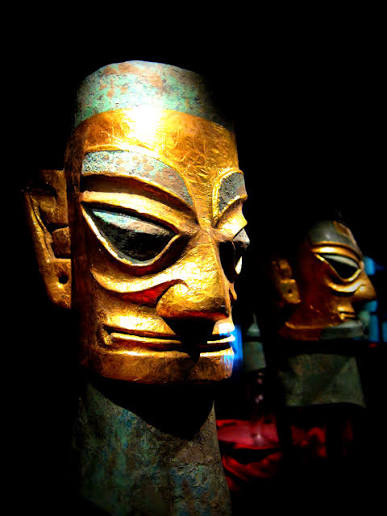
In 1986, workers digging clay near the Chinese city of Guanghan exposed a rectangular pit filled with objects that seemed to belong to a visual world no standard history of Bronze Age China had prepared them to expect. Bronze heads wore sheets of gold. Monumental masks stared through projecting eyes. A human figure stood taller than a living person on an elaborate pedestal, while fragments of a bronze tree suggested a structure nearly four meters high. Many objects had been burned, broken, and buried with elephant tusks.
The discoveries at Sanxingdui, in Sichuan Province, did not reveal an alien civilization or a vanished race. They did something historically more important: they overturned the assumption that the political centers of the Yellow River valley represented the only major path to complex Bronze Age society in China. Sanxingdui belonged to a sophisticated culture of the Sichuan Basin that developed its own ritual art while participating in wider networks of technology and exchange. Its objects are spectacular, but their real value comes from context—the city, workshops, pits, materials, and unanswered questions that surround them.
The Archaeological Site Behind the Famous Masks
Sanxingdui lies on the Chengdu Plain, a fertile region enclosed by mountains and watered by rivers. The archaeological zone covers hundreds of hectares and includes the remains of a large walled settlement, residential areas, production spaces, foundations, and ritual deposits. Occupation changed over a long period; the celebrated bronzes represent only one phase within a much deeper local history.
Researchers generally place the height of the Sanxingdui culture in the second millennium BCE. The major ritual deposits are commonly dated around the twelfth to eleventh centuries BCE, broadly contemporary with the late Shang dynasty farther east. These dates are built from stratigraphy, artifact comparison, and radiocarbon evidence. They should not be collapsed into a single “day of destruction,” because the site developed and its deposits formed through more than one event.
UNESCO’s World Heritage Centre includes Sanxingdui with Jinsha and boat-coffin burials on China’s Tentative List as archaeological sites of the ancient Shu state. “Tentative” is important: the site has been proposed for future consideration, not inscribed as a World Heritage Site. The listing emphasizes a regional Bronze Age tradition that cannot be understood as a provincial imitation of the Central Plains.
From a Jade Find to the 1986 Discovery
Interest in the area began before 1986. In the late 1920s, a local family encountered a cache of jade and stone objects while working the land. Some artifacts entered collections and attracted scholarly attention, and archaeological work followed in the 1930s. Later surveys and excavations revealed occupation layers and traces of a substantial settlement, although the site’s scale and character remained unclear.
The turning point came in the summer of 1986, when workers at a brick factory exposed what became known as Pit 1. Archaeologists excavated it under urgent conditions. A second pit, found nearby soon afterward, contained an even larger concentration of bronze, gold, jade, stone, pottery, burned bone, and elephant tusks. Together they yielded hundreds of objects and fragments.
The finds were not arranged like ordinary household refuse or a royal tomb. Valuable things had often been deliberately damaged before burial. Some were burned; others were broken into pieces and deposited in layers. The shared pattern points to organized ceremonies, but the exact sequence and purpose remain debated. Calling them “sacrificial pits” is a useful convention, not proof that every object was offered to a specific named deity.
Faces That Do Not Explain Themselves
Sanxingdui’s bronze heads and masks are famous for angular faces, immense ears, broad noses, almond-shaped eyes, and, in several cases, pupils projecting like cylinders. Some heads once carried gold foil, while traces of pigment and surface treatment suggest that the objects looked different when new. They may also have been mounted, dressed, or combined with perishable materials that did not survive.
No readable inscription explains whose faces these are. They have been interpreted as ancestors, gods, ritual specialists, political founders, or supernatural beings. Later texts about ancient Shu rulers include a legendary king named Cancong, sometimes described as having unusual eyes, and this tradition is frequently connected to the projecting pupils. The comparison is intriguing but separated from the bronzes by many centuries. It cannot identify a particular mask with certainty.
Internet claims that the faces portray extraterrestrials rely on modern visual association rather than archaeological evidence. Exaggerated features are common in ritual art because the aim is not necessarily portrait realism. Eyes can signify perception, divine power, transformation, or ritual presence without depicting a biological population. The responsible historical conclusion is narrower: vision and the face held unusual importance in Sanxingdui imagery, while their precise meanings remain lost.
The Standing Figure and the Mystery in Its Hands
One of the most remarkable finds is a bronze human figure standing on a high pedestal. The complete object rises about 2.6 meters and weighs roughly 180 kilograms. Its body is narrow, its clothing richly patterned, and its hands form large, offset circles in front of the torso. No comparable life-sized bronze statue survives from the contemporary Central Plains.
The hands probably held an object, but that object is missing. Proposals include an elephant tusk, a ritual implement, a jade tube, or a bundle made from wood or another perishable substance. The pose shows that the absent item mattered to the composition, yet no candidate fits every detail securely. Modern restorations that place a particular object in the grip should therefore be labeled hypothetical.
The figure’s scale and elevated position suggest authority, performance, or mediation between human and supernatural worlds. It may portray a ruler, a priest, a deity, or an idealized ritual participant. Those categories might not have been separate in Sanxingdui society. Without texts, naming the figure “king” or “high priest” says more than the evidence allows.
A Bronze Tree Reassembled From Fragments
Pit 2 also contained pieces of several bronze trees. The largest reconstructed example reaches nearly four meters in height when its base, trunk, branches, birds, flowers, and ornaments are assembled. It demonstrates both ambitious design and extraordinary technical planning. Such an object could not have been cast casually as a single piece.
Scholars have compared the tree with later Chinese traditions about sacred trees, the sun, birds, and a cosmic axis linking levels of the universe. Some identify it with the mythic Fusang tree, on which solar birds were said to rest. Similarity does not establish identity. The surviving written versions are later, and the reconstructed tree is incomplete. Its imagery supports a ritual or cosmological interpretation, but not one definitive myth.
The reconstruction itself deserves attention. Archaeologists and conservators joined thousands of fragments, using breaks, surface patterns, casting evidence, and symmetry to determine placement. The result is evidence-based but not untouched antiquity. Missing branches and ornaments mean that any image of the “complete” tree contains modern decisions alongside ancient bronze.
How Sanxingdui Bronze Workers Built the Impossible
Bronze production required access to copper, tin or other alloying materials, fuel, clay, skilled labor, and institutions capable of supporting specialists. Sanxingdui artisans used casting traditions related to those seen elsewhere in Bronze Age China, including piece-mold techniques, but adapted them for objects with unusual scale and form. Large works were produced in sections and joined or cast together through carefully planned sequences.
The masks reveal control over thin walls, projecting components, and broad surfaces. The standing figure combines separately conceived elements into a stable monument. The tree required modular branches and decorative attachments. Technical analysis shows neither primitive experimentation nor mysterious technology beyond human capability. It shows trained craftspeople solving difficult engineering problems with the materials and methods available to them.
Some vessel forms resemble Shang ritual bronzes from the Central Plains, while the giant masks, heads, trees, and human sculpture express a strongly local visual program. Shared techniques and forms point to contact; differences point to selection and innovation. Sanxingdui was connected without being culturally absorbed.
Gold, Jade, Elephant Tusks, and Long-Distance Networks
Bronze dominates popular images of the site, but the deposits contained a wider material world. Gold sheets were shaped into masks and ornaments. Jade objects included blades, tubes, and ritual forms, some recalling traditions known elsewhere in China. Large quantities of elephant tusks were placed in the pits, though whether the animals lived locally, arrived through exchange, or both remains under study.
These materials required extensive networks. Metal ores and jade did not all come from one workshop’s immediate surroundings. Scientific analysis can compare chemical and isotopic signatures, but routes remain difficult to reconstruct because objects could be recycled and ores from different sources mixed. A matching material signature does not automatically reveal who transported it or under what political arrangement.
The evidence nevertheless contradicts the idea of an isolated basin civilization. Sichuan’s mountains shaped movement but did not seal the region. Sanxingdui participated in exchanges reaching the middle Yangtze, the Central Plains, and potentially farther south and west. The society’s originality emerged through connection, not separation.
Sanxingdui, the Shang Dynasty, and “Ancient China”
When the pits were excavated, histories of the Chinese Bronze Age often centered on the Shang royal capitals and their inscribed oracle bones and ritual vessels. Those sources remain indispensable, but they describe the world of particular courts. Sanxingdui demonstrated that another powerful center could command labor, fortify a city, obtain distant materials, and sponsor monumental ritual art at the same time.
The discovery did not prove that the Shang and Sanxingdui were enemies, colonies, or members of a single state. Similar vessel types and technologies indicate interaction, while the absence of Shang-style writing and the distinct iconography argue against simple political identity. Archaeologists increasingly describe a mosaic of regional societies whose elites exchanged objects and ideas while building different institutions.
This wider perspective resembles what discoveries elsewhere have done for other regions. The Nebra Sky Disc and Bronze Age Europe, for example, challenged assumptions about where complex astronomical knowledge could develop. Such comparisons should not flatten major differences; they show how archaeology repeatedly replaces single-center stories with evidence for multiple connected traditions.
Can the Site Be Identified With the Ancient Shu Kingdom?
Later Chinese texts describe a state called Shu in the Sichuan Basin and preserve traditions about early rulers. Qin conquered Shu in 316 BCE, many centuries after the main Sanxingdui deposits. Because the site was a major regional center and later histories remember ancient Shu, linking the archaeology with that broader cultural lineage is reasonable.
The problem is precision. No contemporary inscription at Sanxingdui gives the name of the polity, its rulers, or its language. Later legends cannot be read as direct eyewitness chronicles of the twelfth century BCE. They may contain transformed memories, political genealogy, mythology, or all three. Calling Sanxingdui “ancient Shu” is a useful historical model, not the decipherment of a native archive.
This limitation makes material evidence especially important. Settlement layout, workshops, food remains, burials, bronzes, jades, and ritual deposits reveal organization without supplying a king list. The site has a history even when its inhabitants’ own name for their community is unknown.
Why Were the Objects Broken, Burned, and Buried?
The condition of the finds is central to interpretation. Many prestigious objects were damaged before deposition, exposed to fire, and layered with tusks and other materials. Deliberate destruction could release sacred power, close a ritual cycle, mark political transition, dispose of objects made dangerous by ceremony, or follow violence and conquest. Each possibility has parallels, but no single explanation has been proven.
The old phrase “sacrificial pits” can imply a recurring temple practice. Some researchers instead prefer “ritual pits” or “burial pits for ritual objects,” leaving open whether the ceremonies involved offerings, decommissioning, crisis, or several stages. Human sacrifice is sometimes mentioned in popular accounts, yet the deposits are not straightforward mass graves. Burned bone must be identified and contextualized before such claims are made.
The pits also may not all be contemporary. The two excavated in 1986 shared major features but differed in contents and arrangement. New discoveries have made the sequence more complicated rather than reducing it to one dramatic night. Archaeology often advances by turning a simple story into a better-supported set of questions.
The New Pits and a Second Archaeological Revolution
Beginning in 2019 and publicly announced during excavations in 2020–2021, archaeologists identified six additional pits near the original two. Carefully controlled work used laboratories built over the excavation areas, environmental monitoring, digital recording, and conservation teams prepared to stabilize fragile material as it emerged. This approach differed sharply from the emergency conditions of 1986.
The new pits produced more gold, bronze, jade, ivory, and organic traces, including objects assembled from several materials. Some bronzes combine human and animal forms or support vessels in ways that make isolated museum categories inadequate. Broken pieces from different pits can sometimes be joined, suggesting that the ceremonies and deposits were related.
Scientific dating continues to refine chronology, while residue, soil, metallurgy, textile, and plant studies ask questions impossible to answer from style alone. Preliminary announcements often attract spectacular headlines before full reports appear. The discoveries are genuine, but interpretations should remain provisional until excavation data and laboratory analyses are published in detail.
Did Sanxingdui Collapse or Move?
The monumental ritual system represented by the pits did not continue indefinitely at Sanxingdui. Around the transition to the first millennium BCE, the main center lost its earlier prominence. The nearby Jinsha site, discovered in Chengdu, contains related bronze, gold, jade, ivory, and ritual imagery and became a major center afterward. This continuity suggests transformation and relocation rather than the total disappearance of a people.
Explanations have included flooding, changes in river courses, earthquake damage, warfare, political reorganization, or shifts in trade. Environmental change is plausible on the Chengdu Plain, but viral claims that one earthquake suddenly “destroyed Sanxingdui” outrun the evidence. Cities can decline through interacting causes over generations.
Jinsha makes the word “lost” especially misleading. Institutions and populations may have moved, merged, or reorganized while preserving selected symbols and practices. The archaeological record shows a changing regional tradition, not a civilization that vanished without descendants at the moment the pits were filled.
What Sanxingdui Has—and Has Not—Changed
Sanxingdui transformed the history of ancient China by making regional diversity impossible to dismiss. Its city and workshops show organized power; its bronzes show technical mastery; its materials show wide connections; and its ritual deposits show a religious system that cannot be reconstructed solely from Shang texts. The site broadened the map of early Chinese civilization.
It has not revealed the names of its rulers, decoded the masks, or proven stories about extraterrestrials, lost global super-civilizations, or direct contact with every culture possessing vaguely similar eyes or trees. Visual resemblance across distant societies is not evidence of migration. Strong conclusions require shared chronology, materials, techniques, context, and routes of contact.
The enduring importance of Sanxingdui lies precisely in what disciplined uncertainty allows us to see. These were human achievements created by a society whose written voice has not survived. Archaeology can recover much of its labor, technology, networks, and ceremonial choices without pretending to translate every face. The masks do not need a sensational solution. Their power comes from forcing history to recognize a Bronze Age world more varied than the old narratives imagined.
Sources and Further Reading
- The Metropolitan Museum of Art, “Treasures from a Lost Civilization: Ancient Chinese Art from Sichuan”.
- The Metropolitan Museum of Art, Sanxingdui exhibition object catalogue.
- UNESCO World Heritage Centre, Archaeological Sites of the Ancient Shu State.
- National Gallery of Art, The Golden Age of Chinese Archaeology.
- Hong Kong Palace Museum, Gazing at Sanxingdui: New Archaeological Discoveries in Sichuan.