Some discoveries arrive in the ground with their meaning already attached: a temple, a burial, a tool clearly shaped by use. Others begin as accidents of survival, pulled from the earth by luck, greed, and a chain of events that archaeology would normally rather avoid. The Nebra Sky Disc belongs to the second category. Found illegally in central Germany in 1999, damaged in the process, and nearly lost to the antiquities market, it has become one of the most discussed objects from Bronze Age Europe. Today it is celebrated not only for its age and beauty, but for the astonishing questions it raises about prehistoric knowledge, belief, and the human urge to read the heavens.
That tension is what makes the Nebra Sky Disc so compelling. It is at once a crime story, a scientific puzzle, and a reminder that archaeology depends as much on context as on objects themselves. Without the circumstances of its recovery, the disc might have remained a mysterious ornament. With them, it became evidence for long-distance exchange, elite authority, ritual practice, and perhaps even sophisticated astronomical observation. Few artifacts illustrate so vividly how a looted find can still transform history, even while leaving scholars with frustrating gaps in the record.
The 1999 discovery that began as a looting case
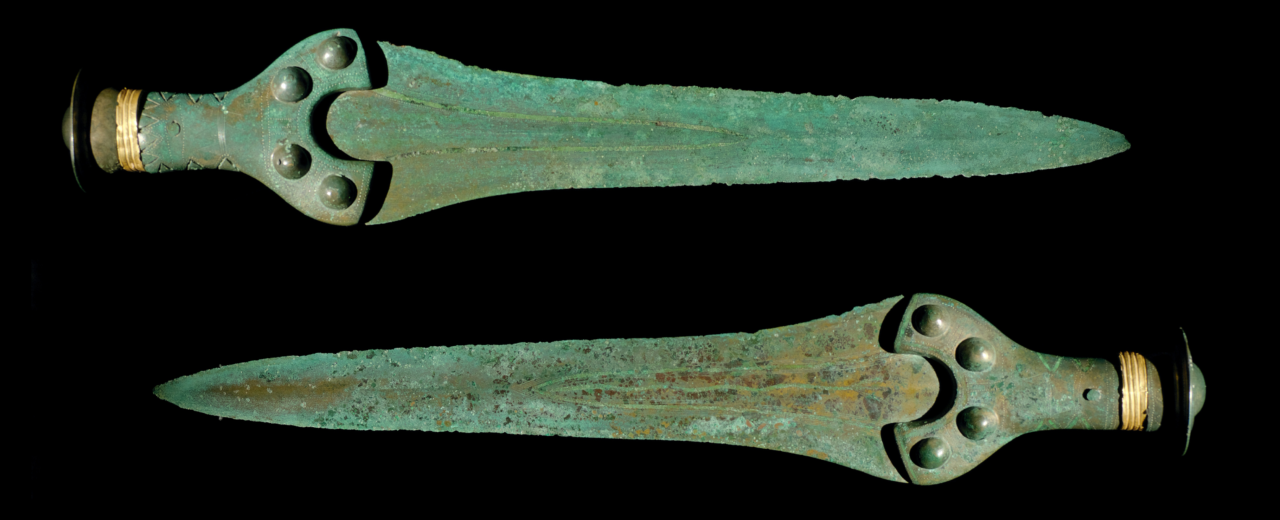
The story of the Nebra Sky Disc starts not in a museum, but in a forested hill near Nebra in Saxony-Anhalt, Germany, where two illegal treasure hunters uncovered a bronze hoard in 1999 using metal detectors and shovels. Their find included weapons, axes, and bronze objects, along with the now-famous circular disc decorated with gold symbols. Instead of reporting it, they tried to sell the collection on the illicit antiquities market. In doing so, they set in motion one of the most important recoveries in modern European archaeology.
The illicit nature of the discovery is not a footnote; it is central to the object’s historical significance. Archaeologists depend on provenance, the precise information about where, when, and how an artifact was found. Provenance provides the framework that allows objects to speak meaningfully about the past. When that information is stripped away, interpretation becomes harder and more uncertain. In the case of the Nebra Sky Disc, the damage was immediate: the findspot was disturbed, the original arrangement of the objects was altered, and some details were permanently lost.
Still, police eventually recovered the hoard after an undercover operation, and the objects entered the custody of the state. The case became a striking example of how law enforcement, archaeology, and public heritage protection can intersect. It also exposed a problem that continues to haunt archaeology worldwide: the market for looted antiquities. A treasure hunter may see only a saleable object, but what is really stolen is knowledge. That is why the Nebra case resonates beyond Germany. It demonstrates that even when an artifact survives, the archaeological story around it may be irreversibly harmed.
At the same time, the recovery gave scholars a chance to examine something extraordinary. Once cleaned and studied, the disc revealed itself as far more than decorative bronze. It was a carefully made, symbolic object with gold appliqués whose meaning was not immediately obvious. The looting case may have been the worst possible beginning, but it also led to a discovery that changed how historians and archaeologists think about Bronze Age Europe.
What the Nebra Sky Disc actually looks like
The first thing that strikes nearly everyone who sees the Nebra Sky Disc is its visual simplicity. It is a bronze disc, roughly the size of a shield but much thinner and more delicate, with gold inlays arranged across its surface. One gold circle is usually interpreted as the sun or full moon, a crescent shape may represent the moon in its waxing or waning phase, and a cluster of smaller dots is commonly read as the Pleiades star group. Later additions along the edges, including curved gold bands, appear to mark horizon arcs, while another element at the bottom has often been linked to a solar boat or some other symbolic vessel.
What matters is not only the imagery, but the way it was applied. The gold is not painted or etched; it is inlaid into the bronze, creating a striking contrast that would have caught the light dramatically. The disc seems designed to be seen, handled, and perhaps displayed in a ceremonial context. Over time, more elements were added to it, suggesting a history of use rather than a single moment of creation. That layered quality gives the object a sense of biography. It was not merely made; it was revised, adapted, and invested with new meanings.
Because the disc came from a looted context, every interpretation must remain cautious. Scholars debate whether it was truly a sky map, a ritual object, a symbol of elite authority, or some combination of all three. It may have functioned as a teaching device, a sacred emblem, or an item that linked earthly power to celestial order. Some researchers argue that it reflects practical astronomical knowledge, especially in relation to the solstices and the seasonal calendar. Others emphasize its ceremonial and political importance, seeing it as a prestige object that communicated the wearer’s or owner’s status and worldview.
That ambiguity is part of its power. Unlike a Roman grave marker, whose inscription may directly identify a person or memorial purpose, the Nebra Sky Disc speaks in symbols rather than words. Its message is broader, less certain, and therefore more intriguing. It is exactly the kind of object that reminds us archaeology is not only about cataloging things, but about learning how ancient people encoded meaning into material forms.
Why scholars think it mattered in Bronze Age Europe
The Nebra Sky Disc has become famous because it suggests that people in Bronze Age Europe possessed a more complex understanding of the sky than many older assumptions allowed. For a long time, prehistory in central Europe was often imagined as materially rich but intellectually limited, especially when compared with the literate civilizations of the Mediterranean and Near East. The disc challenged that view. Its imagery strongly suggests that astronomical observation played a role in the lives of Bronze Age communities, whether for agriculture, ritual, timekeeping, or all three.
One of the most discussed interpretations links the gold arcs on the disc to the positions of the sun at the summer and winter solstices as seen from the place where the hoard was found. If that interpretation is correct, the disc may have encoded a seasonal knowledge system useful for marking key moments in the agricultural calendar. The Pleiades cluster, meanwhile, has long been important in ancient timekeeping traditions across many cultures. Even if the Nebra Sky Disc was not a literal chart in the modern scientific sense, it may still have served as a practical and symbolic guide to the rhythm of the year.
At the same time, the object should not be reduced to astronomy alone. In Bronze Age societies, the sky was often tied to power and religion. Celestial knowledge could legitimize leaders, priests, or specialists who claimed insight into hidden patterns. If the disc belonged to an elite context, it may have functioned as a prestige item that demonstrated access to rare knowledge and distant materials. Bronze itself was part of a wider world of trade and exchange; gold, too, was valuable not only for its beauty but for its symbolic associations with light, divinity, and permanence.
This is why the Nebra Sky Disc matters so much to archaeology. It reveals how a single object can sit at the intersection of science, ritual, and status. It also reminds us that ancient people were not simply pragmatic makers of tools. They were observers of the natural world, interpreters of patterns, and creators of objects that condensed belief into form. In that sense, the disc belongs alongside other major discoveries that reshape our sense of the prehistoric imagination, including the artistic and symbolic traditions explored in studies of the first known artworks date back roughly 100,000 years ago.
How a damaged looted find became a scientific breakthrough
One of the most remarkable aspects of the Nebra Sky Disc is that, despite being illegally recovered and partially disturbed, it still produced enough evidence to inspire serious scientific debate. Archaeologists, conservators, metallurgists, and historians studied the bronze alloy, the corrosion patterns, and the placement of the gold inlays. These analyses helped establish that the disc is genuinely ancient, not a modern forgery, and likely dates to the Bronze Age. They also showed that it was made and altered in more than one phase, suggesting a long working life.
Scientific interpretation of the disc has never been simple. That is partly because the object resists easy classification. It is not a conventional weapon, a household tool, or a straightforward religious idol. Its meaning has to be built from indirect evidence: the materials used, the wear it shows, the object’s likely findspot, and comparisons with other Bronze Age imagery. This is where archaeology becomes both rigorous and interpretive. A damaged looted object may seem compromised, but it can still yield extraordinary insight when examined carefully and in conversation with broader evidence.
The disc also changed how the public sees prehistoric Europe. Instead of imagining Bronze Age societies as remote and rudimentary, people encountered a sophisticated object that seemed to combine cosmology, craftsmanship, and authority. Museums and media coverage helped turn the Nebra Sky Disc into a symbol of European prehistory’s intellectual richness. That public fascination matters, because archaeology depends partly on cultural imagination. The more people understand that the ancient world was populated by observers, experimenters, and meaning-makers, the more support there is for protecting archaeological heritage.
It is worth noting that the disc’s fame also reflects a broader trend in how discoveries are communicated today. When an artifact carries a dramatic backstory, it tends to attract attention far beyond academic circles. The Nebra Sky Disc is therefore not only a scientific case study but also a lesson in heritage storytelling. Its fame shows how a looted find, once recovered, can become a vehicle for public education, even while reminding us that the original crime left an irreplaceable hole in the evidence.
From archaeological controversy to world heritage recognition
Over time, the Nebra Sky Disc moved from being a disputed find to a globally recognized treasure of human history. Its importance was eventually acknowledged by UNESCO, which included it in the Memory of the World register. That recognition is significant because it frames the disc not merely as an attractive artifact, but as documentary evidence of early human thought. In other words, the object is valued not only for what it is, but for what it reveals about the development of knowledge and symbolism.
UNESCO’s recognition also highlights an important truth: heritage is not limited to written records. Objects can preserve forms of understanding that texts never recorded or that time erased. The Nebra Sky Disc may speak to the organization of the sky, seasonal awareness, and social hierarchy in Bronze Age Europe, all without a single word inscribed on its surface. Its value as cultural memory lies in that ability to preserve thought in material form.
At the same time, its story remains a cautionary one. Had the illegal diggers reported the hoard properly, the archaeological record might have been richer and less controversial. We might know more about the arrangement of the associated objects, the precise ritual or depositional context, and the people who buried it. Instead, scholars must work with a compromised find. That limitation is a powerful argument for stronger protection of archaeological sites and more effective public engagement with heritage law.
Yet the broader lesson is not simply that looting is destructive. It is also that archaeology can recover meaning even from damaged circumstances, provided the evidence is handled responsibly. The Nebra Sky Disc survived a criminal beginning to become one of the most important discoveries in European prehistory. Its journey from the black market to UNESCO recognition is unusual, but it captures something essential about archaeology itself: the discipline is constantly repairing broken stories. The best discoveries are not always found in perfect conditions. Sometimes they are rescued from the worst ones.
That is why the Nebra Sky Disc remains a subject of study historians, archaeologists, and the public alike. It is a bronze object with gold stars, yes, but it is also a symbol of everything archaeology can reveal when careful analysis meets stubborn mystery. It tells us that people in the distant past looked upward, measured time, invested objects with cosmic meaning, and used material culture to express ideas about order and power. Even after a looter’s spade disturbed its resting place, the disc still managed to speak. And in doing so, it became not just a famous artifact, but one of archaeology’s most important discoveries.
Research and further reading
For readers who want to verify details or continue researching this subject, these external reference collections provide useful starting points: