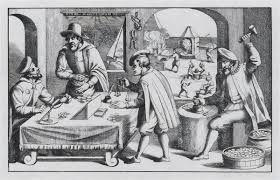
In the early 1620s, the coins of the Holy Roman Empire began to betray the people who used them. A piece might carry a familiar prince’s portrait and an official denomination yet contain far less silver than its predecessors. Prices rose, good money vanished from everyday trade, wages lost purchasing power, and merchants demanded payment in coins they could trust. The crisis became known as Kipper und Wipper.
The strange name refers to people who sorted coins with tipping scales, separating heavier, silver-rich pieces from lighter ones. The good coins could be melted, mixed with cheaper metal, and turned into a larger number of bad coins. Princes, cities, bishops, contractors, money changers, and mint officials joined a competitive debasement that spread across political borders.
Kipper und Wipper was not merely a colorful episode of dishonest coin clipping. It was a systemic monetary crisis at the opening of the Thirty Years’ War. It showed how fragmented authority, fiscal desperation, private incentives, and collapsing trust could turn ordinary coinage into an engine of contagion.
What Kipper und Wipper means
The phrase is often translated as “tipper and see-saw time” or “clippers and tippers,” although no English rendering captures every nuance. Wippen referred to weighing coins on a balance that tipped according to their weight. Kippen referred to sorting or culling the better pieces. The people engaged in the trade became Kipper and Wipper.
Their goal was to exploit the gap between a coin’s official value and the value of the precious metal inside it. Older coins with a high silver content were removed from circulation. Mints then diluted the recovered silver with copper and struck more coins bearing nominal values that exceeded their metallic worth.
The term now describes the broader inflation and coinage breakdown that peaked between 1619 and 1623. Contemporary usage varied, and not every debased coin was made by a wandering money changer. Territorial governments and licensed mints were central participants.
A monetary system divided among hundreds of authorities
The Holy Roman Empire was not a unified nation-state with one central mint. It contained kingdoms, duchies, bishoprics, counties, imperial cities, and smaller lordships whose rulers possessed overlapping rights. Many authorities could issue money, while their coins circulated through trade networks that ignored political boundaries.
Imperial coin ordinances attempted to standardize denominations, weights, and silver content. The Augsburg reforms of the sixteenth century created benchmarks, including systems based on the imperial Reichstaler. Enforcement remained difficult. A ruler could gain by issuing slightly worse coins if neighbors continued to accept them at face value.
This created a structural temptation. The issuing authority captured the difference between production cost and nominal value, known as seigniorage. The losses were dispersed among users who received depreciated money. As long as debasement remained limited and confidence survived, the strategy could appear profitable.
The crisis had roots before the Thirty Years’ War
The war that began in 1618 greatly increased demand for revenue, but it did not create every weakness in the coinage system. Silver supplies, regional exchange rates, earlier debasements, and disputes over minting standards had troubled Central European money for decades. Smaller coins used in daily purchases were especially vulnerable because minting them cost relatively more than producing large silver pieces.
Political fragmentation made cooperation fragile. States wanted neighbors to observe strict standards while retaining flexibility for themselves. Merchants compared coins by weight and reputation, and exchange tables listed changing rates among dozens of issues. Money was already a field of negotiation before wartime finance turned instability into crisis.
Calling Kipper und Wipper simply “inflation caused by the Thirty Years’ War” therefore reverses part of the story. The conflict accelerated a pre-existing monetary race to the bottom, then magnified its economic and social effects.
War finance made debasement irresistible
The revolt in Bohemia and the widening conflict demanded troops, weapons, food, horses, transport, and subsidies. Early modern rulers had limited bureaucracies and could not instantly collect modern income taxes. Estates negotiated levies, taxpayers resisted, and revenue arrived too slowly for armies that expected immediate pay.
Debasing coin offered a faster method. A mint could convert a quantity of good silver into far more coins than established standards allowed. The ruler or mint contractor spent the new money on military and administrative needs before prices fully adjusted. In effect, the issuer obtained resources through a hidden tax on everyone who later accepted the diminished currency.
This did not require a single conspiracy directed from Vienna. Catholic and Protestant territories both participated, as did authorities with different roles in the war. Each faced incentives to issue bad money before rivals did the same. Decentralized competition made restraint costly.
How good coins were hunted and transformed
Money changers and agents traveled through markets searching for older, heavier coins. Portable scales helped them identify pieces with valuable metal. They offered exchanges, exploited differences among regional rates, and sent good money to mints. Some transactions were legal under local licenses; others crossed into fraud, smuggling, or violation of imperial rules.
At the mint, silver-rich coins were melted. Copper or other base metal was added, and the alloy was struck into new pieces. Debasement could involve reduced weight, reduced fineness, inflated denomination, or a combination of all three. The new coin might imitate a respected foreign issue so that the issuer could spend it outside the territory where it was made.
This point matters because “coin clipping” is an incomplete description. Clipping removed metal from the edges of individual coins. Kipper und Wipper more often involved systematic sorting, melting, alloying, and reminting under official or semi-official authority.
Why bad money crossed borders so quickly
A prince gained the most if his inferior coins circulated elsewhere while better foreign coins flowed inward. Issuers therefore copied neighboring designs and pushed new money into distant markets. The victim territory responded by refusing suspect coins, changing exchange rates, or debasing its own currency to avoid losing silver.
The strategy resembled an epidemic. One jurisdiction’s attempt to export loss altered incentives for its neighbors. Officials who maintained standards watched good coins disappear and revenues arrive in bad ones. Joining the debasement could look like self-defense even when it worsened the general crisis.
This behavior is sometimes summarized through Gresham’s law: bad money drives out good when law requires both to circulate at the same nominal value. Yet people were not passive. They weighed, discounted, hoarded, exported, and refused coins when information allowed. The crisis spread precisely because users tried to protect themselves inside a confused multi-currency system.
The expansion of “hedge mints”
The boom produced many temporary mints, sometimes called Heckenmünzen or “hedge mints.” These facilities operated outside older, respected mint centers and could be leased to private contractors. A ruler received fees or a share of output, while the contractor profited by producing large quantities rapidly.
Quality varied dramatically. Some issues were merely below standard; others contained only a small fraction of the silver expected from their denomination. Thousands of surviving types testify to the scale and regional diversity of production. The Berlin Münzkabinett alone acquired a specialized collection of more than 2,000 Kipper-era coins, many from Guelph territories.
The mints were not all literally hidden behind hedges, and the label should not suggest purely secret counterfeit workshops. Many had political protection. The scandal lay partly in the use of sovereign authority to legitimize money that governments knew was deteriorating.
Prices, wages, and contracts lost their anchors
As silver content fell, sellers raised the number of coins demanded for grain, cloth, fuel, and other goods. Exchange rates between small change and stable large coins moved rapidly. A price written in nominal units could become meaningless unless the parties specified the exact coin, mint, date, or metallic value.
People living on fixed wages, pensions, rents, or cash savings suffered. Laborers might be paid in poor coins while landlords and tax collectors demanded better ones. Creditors received repayments worth less than the money originally lent, unless contracts contained protective clauses. Debtors sometimes benefited, at least temporarily, by discharging nominal obligations in depreciated currency.
Economic effects differed by place and social position. Merchants with information and access to bullion could protect themselves better than urban workers or rural sellers. Inflation was not an equal rise in every price; it was a redistribution shaped by bargaining power and knowledge.
The crisis entered sermons, songs, and broadsheets
Contemporaries did not experience the breakdown as an abstract monetary indicator. Pamphlets, sermons, satirical prints, songs, and broadsheets portrayed greedy money changers, corrupt officials, suffering households, and the death of “good money.” The devil frequently appeared as the companion or final judge of the Kipper.
These sources offer vivid evidence of anger, but they are not neutral statistics. Moralists blamed identifiable villains and described economic disorder through Christian ideas of justice, usury, and sin. Images exaggerated recognizable behavior so that audiences would understand the lesson.
The propaganda is valuable precisely because it shows how people interpreted the crisis. Money was imagined as part of a moral community. A ruler who corrupted coinage was not merely choosing a technical policy; he was falsifying the measure that allowed neighbors to trust one another.
Riots, refusals, and the breakdown of acceptance
Communities resisted by refusing debased coins, attacking suspected money changers, petitioning authorities, and demanding payment in older currency. Soldiers and suppliers could reject wages that no longer purchased necessities. Market exchange slowed when buyers and sellers disagreed over what each piece was worth.
Some later stories claim that worthless coins became toys for children in the streets. Such anecdotes capture the contempt directed at bad money but are difficult to verify as representative fact. The documented evidence—price disturbances, complaints, official decrees, exchange tables, and surviving coins—is dramatic without relying on folklore.
Monetary disorder interacted with harvest problems, military disruption, and disease. It would be misleading to attribute every shortage or episode of hunger solely to debasement. Kipper und Wipper intensified a broader crisis by making provisioning, taxation, and contracts harder to manage.
Why the scheme eventually defeated itself
Debasement initially rewarded issuers because they spent new coins before the public fully discounted them. Over time, however, bad coins returned to the authorities that created them. Taxes, tolls, and fees arrived in the same depreciated money governments had tried to export. Real revenue fell even when nominal collections looked larger.
Mints also faced rising costs for good silver. The more they hunted high-quality coins, the scarcer those coins became. Merchants demanded higher exchange rates, foreign partners refused suspect currency, and subjects resisted. Governments discovered that destroying the unit of account undermined their own ability to buy supplies and pay troops.
The crisis thus contained a feedback loop. Each round of debasement created pressure for another, yet every round weakened the fiscal base it was meant to strengthen. What looked like effortless seigniorage became a problem of collapsing credibility.
How authorities restored the coinage
By 1622 and 1623, territories began closing temporary mints, banning Kipper coins, setting conversion rates, and returning to stricter standards. Reforms varied because the empire had no single monetary authority capable of imposing one solution everywhere. Some governments withdrew bad coins; others accepted them only at sharply reduced values.
Stabilization imposed new losses. Anyone forced to exchange depreciated coins bore the difference between old face value and new redemption value. Governments could not simply declare trust restored. They had to demonstrate that new issues contained the promised metal and that mints would follow standards.
The first great Kipper crisis subsided, but debasement did not vanish from European history. Smaller recurrences occurred later in the seventeenth century. The episode left a warning about competitive coinage that numismatists, economists, and monetary officials continued to study.
Was Kipper und Wipper a hyperinflation?
The Deutsche Bundesbank describes the period as the highest inflation in the history of the Holy Roman Empire. Economic historians also use “hyperinflation” to convey its extraordinary speed and severity. The comparison with Germany in 1923, however, must be made carefully.
The seventeenth-century crisis involved metallic coins issued by many authorities, not a national paper currency printed by one state. There was no single empire-wide price index, and regional experiences differed. Debasement altered the silver content behind denominations while exchange rates among coins shifted continually.
Calling it an early hyperinflation is defensible as a broad description, but treating it as mechanically identical to a modern fiat-money collapse erases what made the episode distinctive: competing mints, bullion arbitrage, political fragmentation, and coins whose material content could be weighed in the marketplace.
The crisis and the Thirty Years’ War
Kipper und Wipper unfolded during the early phases of the Thirty Years’ War, which began after the Bohemian revolt and the Defenestration of Prague. Military finance accelerated debasement, while inflation complicated the supply of armies and the lives of civilians.
Yet the monetary crisis should not be treated as a complete explanation for the war’s devastation. The conflict continued for a quarter century after the worst debasement ended. Mass death resulted from campaigning, disease, displacement, hunger, taxation, and the destruction of local economies. Coin instability was one destructive mechanism within a far larger catastrophe.
The chronology nonetheless matters. Kipper und Wipper reveals how states improvised at the beginning of a conflict whose scale they had not anticipated. Their emergency finance shifted costs onto populations before stronger fiscal arrangements could be built.
What the surviving coins prove—and what they do not
Museum collections allow researchers to compare weight, metal content, dies, inscriptions, denominations, and geographic distribution. Coins can identify mints unmentioned in narrative accounts and reveal how closely issuers copied respected designs. Hoards show what people saved or concealed, though a hoard is not a random sample of everyday circulation.
A visibly coppery coin is evidence of debasement, but it does not by itself reveal the motives of every person who handled it. Nor can one specimen establish an empire-wide inflation rate. Historians combine numismatics with mint accounts, legal decrees, price records, correspondence, and printed commentary.
This is why the crisis is more than a tale of “fake money.” Much of the coinage was legally issued. The core problem was the exploitation of law, sovereignty, and public trust by authorities who could define nominal value but could not force confidence indefinitely.
Lessons from a decentralized monetary collapse
Kipper und Wipper is sometimes used as a simple argument either for centralized currency or for market discipline. The history supports neither slogan without qualification. Political fragmentation encouraged authorities to export bad money, but merchants also detected debasement, adjusted rates, and imposed discipline when states failed.
The episode demonstrates that money is both object and institution. Silver content mattered because coins were commodities, yet reputation, law, accounting, taxation, and shared expectations also determined value. A coin could be official and still distrusted; an old foreign coin could be trusted more than a new local one.
Above all, the crisis shows how individually rational choices can produce collective ruin. Each prince, contractor, or trader tried to shift loss elsewhere. Once enough participants followed that logic, everyone faced worse money, higher prices, damaged trade, and weaker public finance.
Conclusion
Kipper und Wipper was the most severe monetary breakdown of the early Holy Roman Empire, but it was not an inexplicable mania. Long-standing weaknesses in a fragmented coinage system met the fiscal shock of war. Authorities and contractors culled good coins, diluted their silver, multiplied mints, and pushed the inferior money across borders.
The scheme worked briefly because new coins could buy real goods before their quality was fully recognized. It failed because trust adjusted. People weighed, discounted, hoarded, protested, and refused. Bad money returned in taxes, good silver disappeared, and the governments profiting from debasement lost the reliable currency they themselves needed.
The surviving coins are small objects from a vast crisis. They record a moment when sovereignty could stamp a value onto metal but could not make that value believable. In that gap between official promise and public confidence, an empire’s money broke down.
Sources and further reading
Deutsche Bundesbank, “The German Economic Crisis of 1618 to 1623”.
Staatliche Museen zu Berlin, Münzkabinett, Kipper und Wipper collection.
Charles P. Kindleberger, “The Economic Crisis of 1619 to 1623,” The Journal of Economic History.
Heidelberg University Numismatic Commission, introduction to the Kipper und Wipper period.