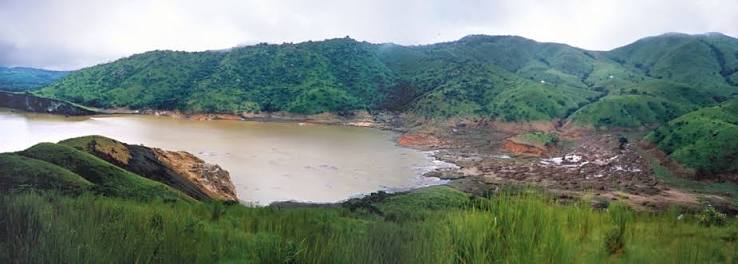
On the evening of 21 August 1986, a remote highland lake in northwestern Cameroon released a disaster almost no one knew a lake could produce. People in villages below Lake Nyos heard a rumble. Some saw mist or a low white cloud. Then families, cattle, birds, and insects collapsed without burns, wounds, or warning from any familiar natural hazard. By the time outside help reached the area, 1,746 people were dead, according to the figure used in later scientific studies, along with thousands of livestock.
The Lake Nyos disaster was neither an ordinary volcanic eruption nor a mysterious poisoning. A vast quantity of carbon dioxide had accumulated under pressure in the lake’s deepest water. When that water rose and the pressure fell, the dissolved gas came out of solution, accelerated the upward flow, and escaped into the air. Because carbon dioxide is denser than ordinary air, a lethal cloud moved down the surrounding valleys and displaced breathable oxygen.
That broad mechanism is now well established. The detail that first disturbed the lake remains unresolved, however, and the history is often flattened into the misleading image of a lake that simply “exploded.” Lake Nyos matters not only because of the night itself, but because scientists, engineers, Cameroonian officials, and displaced communities had to turn an unprecedented catastrophe into a new field of risk management.
A crater lake above inhabited valleys
Lake Nyos lies in the Oku volcanic field along the Cameroon Volcanic Line, a chain of volcanic centers extending through Cameroon and into the Gulf of Guinea. The lake occupies a maar, a steep-sided crater created when rising magma interacted explosively with groundwater in the geological past. Its volcanic origin did not mean that magma was erupting in 1986. Instead, the old crater formed a deep basin capable of storing gas-rich water.
Although only about 1.6 square kilometers in surface area, the lake reaches roughly 210 meters in depth. Its sheltered setting and tropical climate help maintain strong layers within the water column. Relatively fresh surface water sits above deeper water enriched in dissolved minerals and carbon dioxide. Scientists call a lake that does not mix completely from top to bottom “meromictic.” That stable layering was essential to the hazard.
How carbon dioxide accumulated in the depths
Carbon dioxide of deep volcanic or magmatic origin entered Lake Nyos through springs on or near its bottom. Under the high pressure of more than 200 meters of overlying water, large amounts of the gas could dissolve rather than bubble immediately to the surface. The process resembles carbonation in a sealed drink, but the lake was not literally a bottle and the analogy has limits: its water was layered by temperature and dissolved substances, and new gas continued to arrive from below.
The gas-rich bottom water became denser than the water above it. That density structure discouraged ordinary seasonal mixing from ventilating the depths. Carbon dioxide therefore accumulated in the deepest layers while the surface looked unremarkable. Measurements made after the disaster showed that gas and dissolved salts were again entering the lake, confirming that the 1986 release had not exhausted the underground source.
This distinction corrects a common oversimplification. Lake Nyos was dangerous not merely because it stood in a volcanic crater. Many crater lakes release gas harmlessly. Nyos combined a continuing supply of carbon dioxide with sufficient depth, stable stratification, and topography that could channel a dense cloud toward settlements. The disaster required that entire system.
Lake Monoun gave a warning in 1984
Two years before Nyos, another Cameroonian crater lake produced a smaller catastrophe. On 15 August 1984, gas escaped from Lake Monoun and killed 37 people, many found along a road near the shore. Early reports mentioned an explosion, a strange cloud, and possible chemical poisoning. With no widely recognized model for lethal lake degassing, investigators debated whether a volcanic burst had injected gas directly or whether dissolved gas had escaped from the water.
Research at Monoun pointed increasingly toward carbon dioxide released by an overturn of stratified lake water. Yet the event was so unusual, and occurred in such a remote area, that it did not create an effective warning system at Nyos. The connection became undeniable only after the much larger 1986 disaster.
The night of 21 August 1986
The release at Nyos occurred at about 9:00 p.m. Witness accounts collected afterward described one or more loud noises from the direction of the lake. Evidence around the shore showed that the water had surged violently: vegetation was stripped or flattened in places, and a wave washed against the crater walls. Deep, iron-rich water reached the surface and later oxidized, contributing to a reddish-brown change in the lake’s appearance.
A huge volume of carbon dioxide escaped. Estimates vary with the reconstruction, but scientific summaries commonly describe roughly one cubic kilometer of gas at atmospheric pressure. The cloud spilled over the crater rim and descended through low ground. Carbon dioxide is colorless and odorless, so reports of “smoke” or a visible cloud probably involved condensed water droplets, spray, dust, or fog accompanying an otherwise invisible gas.
In the valleys, oxygen concentrations fell to levels that could rapidly cause unconsciousness and death. Victims were found in homes, fields, and roads, often with no sign of struggle. Some survivors recalled losing consciousness and waking many hours later among dead relatives and animals. The absence of widespread heat damage, ash, or traumatic injury became important evidence against a conventional volcanic blast.
Why the gas stayed close to the ground
Pure carbon dioxide is about one and a half times as dense as air under comparable conditions. A large, cool release can therefore flow downhill under gravity, pooling in depressions and following valleys. It does not “remove” oxygen chemically. Instead, it dilutes and displaces the surrounding air, leaving too little oxygen for humans and animals to remain conscious.
Carbon dioxide at high concentration also has direct physiological effects. Rapid breathing, headache, confusion, loss of consciousness, and cardiac consequences can develop quickly. A person entering a dense cloud may receive little useful sensory warning because the gas has no smell. Survival depended on a complicated combination of elevation, distance, ventilation, the changing shape of the cloud, and whether someone remained in or escaped from low terrain.
What the death toll reveals—and conceals
The figure of 1,746 human deaths is frequently cited in modern scientific literature, while contemporary and institutional summaries often say “at least 1,700.” Thousands of cattle also died, devastating household wealth as well as food production. Exact totals were difficult to establish in scattered rural settlements during an emergency, so apparent variation among reputable accounts does not mean the scale of the catastrophe is disputed.
Authorities evacuated tens of thousands from the wider danger zone into resettlement camps. Displacement reduced immediate exposure but created long-term problems involving farming land, livelihoods, family networks, and trust. Some residents later returned despite official restrictions because safer places did not automatically provide viable lives. The history of Nyos is therefore also a history of vulnerability and resettlement, not only of lake chemistry.
How investigators identified carbon dioxide
International teams joined Cameroonian researchers in the weeks and years after the event. Water chemistry revealed extraordinarily high carbon dioxide concentrations at depth. Isotopic and chemical evidence linked the gas to a deep geological source rather than decaying vegetation alone. The distribution of deaths along valleys matched the movement expected from a dense gas, while the lack of widespread burns and blast destruction did not fit a large explosive eruption.
Reports that oil lamps went out, people and animals suffocated, and vegetation remained largely unscorched also supported oxygen displacement. Medical investigators documented survivors with respiratory and neurological symptoms consistent with asphyxiation. Some people had skin lesions, but those injuries did not prove that a hot volcanic cloud had passed through the settlements; pressure sores, coma-related injury, and other mechanisms were considered.
By 1990, an international working group reached unanimous agreement that a massive release of carbon dioxide from Lake Nyos caused the disaster. That conclusion settled the principal cause without resolving every detail of the event. Good historical reporting must preserve both levels of certainty.
The trigger remains disputed
What started the runaway rise of deep water on 21 August? Proposed triggers have included a landslide into the lake, a rockfall, unusually cool rain or surface water that destabilized the layers, an earthquake, internal waves, or the point at which gas-rich water became sufficiently unstable to rise without a dramatic external shock. Investigators found evidence of wave action and disturbed shoreline material, but not a decisive fingerprint identifying one trigger.
A direct volcanic explosion or sudden injection of hot gas was considered seriously in early research. Later work favored the release of carbon dioxide already dissolved in the lake, supplied gradually from below. Even within that framework, researchers debated whether an external disturbance initiated overturn or whether progressive gas loading made spontaneous instability possible.
The phrase “limnic eruption” now describes a sudden release of dissolved gas from a lake, but the label should not be mistaken for proof of the initiating event. At Nyos, the carbon dioxide release is confirmed; the exact trigger is not. Claims that a particular landslide or earthquake has been definitively established go beyond the evidence.
A self-amplifying release
Once gas-rich deep water began rising, decreasing pressure allowed dissolved carbon dioxide to form bubbles. Those bubbles made the water-gas mixture more buoyant, causing it to rise faster and pull more deep water upward. More ascent produced more decompression, more bubbles, and still faster flow. This positive feedback could transform a local disturbance into a lake-scale discharge.
The event did not empty the lake or release all of its dissolved gas. That fact became urgent after measurements showed carbon dioxide accumulating again. Nyos was a rechargeable natural hazard, and waiting for certainty about every past detail would have meant accepting the possibility of another mass release.
Engineering a controlled escape for the gas
The proposed remedy was conceptually simple: draw gas-rich water from near the bottom through a vertical pipe and release its carbon dioxide gradually at the surface. Once pumping lifted the water high enough for bubbles to form, the expanding gas reduced the density of the fluid in the pipe. The rising mixture then sustained its own flow, producing a fountain without continuous external power.
Teams tested the concept at Lake Monoun in 1992 and at Nyos in 1995. A permanent degassing pipe began operating at Nyos in 2001. Two additional pipes were installed in 2011, greatly increasing removal from the deep layer. The work depended on cooperation among Cameroonian institutions and scientists and engineers from several countries, including specialists from France, Japan, and the United States.
Degassing had to be managed carefully. Removing or discharging water too aggressively could disturb stratification, alter lake level, or create new instability. Scientists therefore combined engineering with repeated profiles of temperature, conductivity, gas pressure, and water chemistry. A 2021 study emphasized that the lake continues to receive carbon dioxide and recommended regular, affordable monitoring even after most of the dangerous deep inventory had been removed.
The natural dam created a second hazard
Lake Nyos drains across a narrow natural dam of volcanic material. Investigators found that the barrier was undercut and vulnerable to erosion. Its failure could release a destructive flood downstream and rapidly change the pressure on gas-bearing water. Thus, disaster prevention had to address both gas accumulation and the physical stability of the lake’s outlet.
Communities also needed alarms, evacuation planning, accessible information, and confidence that equipment would be maintained. A pipe can remove carbon dioxide, but it cannot by itself settle questions about resettlement, land rights, roads, medical access, or responsibility for monitoring.
Nyos changed the science of hazardous lakes
Before 1984, the idea that a lake could suddenly release enough carbon dioxide to kill whole communities was not part of mainstream disaster planning. Monoun and Nyos forced volcanologists, limnologists, geochemists, engineers, physicians, and disaster officials to work across disciplinary boundaries. Deep-water gas pressure became a practical public-safety measurement rather than an obscure research topic.
The response also demonstrated the value of long-term measurements. A single expedition could identify dissolved gas, but only repeated profiles could show recharge rates, stratification changes, and whether degassing was succeeding. New techniques—including estimates of carbon dioxide based partly on sound-speed measurements—were developed to make surveillance of remote lakes more feasible.
Nyos belongs beside environmental disasters such as the Great Smog of London, where an invisible atmospheric threat became undeniable through mass mortality. The causes differed completely, yet both events show how hazards that leave little conventional wreckage can be misunderstood until medicine, chemistry, geography, and public policy are considered together.
Lake Kivu is not simply a larger Nyos
After 1986, attention turned to other gas-rich lakes, especially Lake Kivu on the border of Rwanda and the Democratic Republic of the Congo. Kivu contains far more dissolved gas, including both carbon dioxide and methane, and millions of people live nearby. The comparison is important, but describing Kivu merely as “Nyos on a giant scale” erases major differences in size, structure, gas sources, mixing, and human use.
The same restraint applies to volcanic disasters generally. The Laki eruption of 1783 spread sulfur-rich haze across distant regions through a sustained fissure eruption; Nyos released carbon dioxide from lake water in a rapid, topographically confined flow. Both involved volcanic gases, but treating them as the same kind of eruption would obscure why their impacts and warning strategies differed.
Myths and oversimplifications about the disaster
One persistent description calls Nyos a “killer lake,” a memorable phrase that can make the water seem malevolent or permanently explosive. The hazard came from a specific interaction of geology, lake physics, and settlement patterns. Controlled degassing has substantially reduced the stored gas, while continuing monitoring recognizes that the underground supply has not vanished.
Another claim says the lake “erupted like a volcano.” There was violent water movement and a huge gas discharge, but no confirmed magmatic eruption sending lava or ash from a new vent that night. The carbon dioxide was ultimately associated with deep volcanic processes, yet it accumulated in water before release. That difference explains both the catastrophe and the successful pipe-based mitigation.
The human legacy of Lake Nyos
The most durable success after Nyos was not a single discovery but the conversion of knowledge into a maintained safety system. Cameroonian researchers remained central to sampling and operations while international partnerships supplied equipment, specialist analysis, and funding. The degassing fountains became visible evidence that an invisible hazard could be reduced.
Yet the social aftermath has lasted far longer than the dramatic night. Survivors carried grief, health concerns, lost livelihoods, and years of displacement. Resettlement policy sometimes separated people from fertile land or left them dependent on inadequate services. When residents returned toward restricted areas, the decision could reflect economic necessity rather than ignorance of scientific advice.
Remembering those choices prevents a technological triumph narrative from swallowing the people most affected. Effective hazard management must make safe behavior realistically possible. Monitoring data, functioning pipes, secure land, trusted communication, and local participation are parts of the same system.
Conclusion: a disaster made understandable
The Lake Nyos disaster was extraordinary, but it was not supernatural and it is no longer scientifically inexplicable. Deep volcanic carbon dioxide entered a stratified crater lake, accumulated under pressure, and on 21 August 1986 escaped in a self-amplifying release. The resulting dense cloud descended into inhabited valleys and killed at least 1,700 people. That sequence is supported by chemical evidence, field observations, medical findings, and decades of monitoring.
History also requires honesty about what is unknown. No proposed landslide, storm, earthquake, or spontaneous instability has been proved to be the unique trigger. The most responsible account separates that open question from the confirmed cause rather than using uncertainty to manufacture mystery.
Nyos transformed a barely recognized phenomenon into a manageable hazard. Degassing pipes, repeated measurements, spillway work, and community planning have reduced the risk, though continuing carbon dioxide recharge means vigilance must continue. Its lasting lesson is both scientific and political: rare hazards become less deadly when institutions preserve memory, measurements, maintenance, and the ability of exposed communities to act on warnings.
Sources and further reading
- Smithsonian Institution, Global Volcanism Program: Oku Volcanic Field and Lake Nyos reports
- Smithsonian Global Volcanism Program: 1990 international working group conclusions
- Boehrer et al., “Carbon Dioxide in Lake Nyos, Cameroon, Estimated Quantitatively From Sound Speed Measurements”
- Kling et al., “Degassing Lakes Nyos and Monoun: Defusing Certain Disaster,” Proceedings of the National Academy of Sciences
- U.S. Geological Survey: Evolution of CO2 in Lakes Monoun and Nyos during controlled degassing
- International Working Group on Crater Lakes, “Conclusions from Lake Nyos Disaster,” Nature