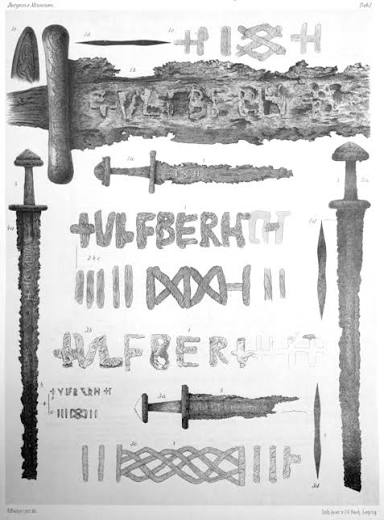
A name appears in iron along the fuller of an early medieval sword: +VLFBERH+T. To modern eyes it looks almost like a logo. To the people who saw the blade a thousand years ago, the letters may have promised origin, quality, authority, or all three. Today the weapons carrying that name are usually called Ulfberht swords, and they have acquired a reputation as the “super swords” of the Viking Age.
The real history is more interesting than that label. Ulfberht swords were not a single weapon type made from one miraculous recipe. They form a varied family of blades produced over roughly two or three centuries, bearing many versions of the same Latin-letter inscription. Some were made from unusually clean, high-carbon steel. Others used more familiar European techniques, and a few were technically poor. Their hilts changed with fashion, their owners lived across a wide region, and their journeys connected Frankish workshops with Scandinavian graves, Baltic trade routes, and perhaps steel made far beyond Europe.
That mixture of evidence and uncertainty makes the Ulfberht story valuable. It reveals what archaeology can recover from corroded metal, while warning against turning one metallurgical result into a legend about every surviving sword.
What Is an Ulfberht Sword?
An Ulfberht sword is identified primarily by an inscription inlaid into its blade. The best-known form is written +VLFBERH+T, although surviving swords carry many variants: crosses may move or disappear, letters may be reversed, omitted, added, or rendered almost illegibly. Medieval Latin script used V where modern readers might expect U, so the name is conventionally written “Ulfberht” or “Vlfberht.”
These are straight, double-edged, one-handed swords of the broad family often associated with the Viking Age and the Carolingian world. Most have a wide groove, or fuller, running along the blade. The fuller reduced mass without making the weapon a hollow or fragile “blood groove,” as an enduring modern myth claims. It was a structural feature that helped produce a comparatively light and manageable blade.
Scholars’ catalogues differ because damaged inscriptions are difficult to classify and new finds continue to appear. A figure of roughly 170 known examples is often quoted, but it should be treated as an approximation rather than a final census. The group is united by its name, not by identical dimensions, hilts, chemistry, or workmanship.
A Name Written in Iron
The inscription was not simply scratched into a finished weapon. A smith cut channels into the surface of the blade, arranged thin rods or strips of contrasting iron in the shape of letters, and forge-welded them into place. After grinding and polishing, the word became part of the blade itself. On the reverse, many examples carry geometric designs such as vertical strokes, crosses, lattices, or interlaced patterns.
That process demanded careful control of heat. Too little would prevent a sound weld; too much could damage the blade or blur the design. The inscription therefore represented labor and competence even when the metal around it was not exceptional. It also remained visible after the handle, scabbard, and organic fittings decayed, allowing a name to outlive the workshop that used it.
Whether Ulfberht began as the personal name of a smith is unknown. It is a Frankish personal name, and an individual craftsman may stand at the beginning of the tradition. Yet the inscriptions span far longer than one working life. The most plausible interpretations therefore involve continuity: a workshop, a group of associated workshops, successors using a respected mark, or later makers deliberately imitating a name whose prestige had already been established.
Not One Standardized Viking Weapon
The phrase “the Ulfberht sword” encourages a misleading picture of a single regulated product. The blades were fitted with many types of guards and pommels, and their dates extend from the early or middle Viking Age into the eleventh century, with disputed examples possibly later. A hilt could also be replaced during a weapon’s lifetime. The inscription tells us about the blade more directly than it tells us about the completed sword.
Nor does the label mean that the swords were manufactured by Vikings. “Viking” describes people, activities, and a historical setting; it is not a reliable place-of-manufacture stamp. Many Ulfberht blades were probably produced in the Frankish or Rhine region and then traveled north and east. Scandinavian owners could acquire imported blades and have them mounted locally, just as elite consumers in later centuries bought prestigious weapons made abroad.
This distinction resembles the evidence surrounding the Sutton Hoo ship burial: objects found in a northern European elite context can embody materials, styles, and connections extending across several cultural zones. Burial location does not automatically equal workshop location.
The Case for a Frankish Origin
Several lines of evidence point toward the Frankish heartlands, especially the Middle or Lower Rhine, as an important source of Ulfberht blades. The name itself is Frankish. The region had established ironworking centers, access to river transport, and workshops capable of serving aristocratic and military markets. The Metropolitan Museum of Art describes its example as Germanic or Scandinavian but notes that the swordsmith or tradition behind the name is thought to have operated in the Middle Rhine region.
This remains a strong hypothesis rather than a signed medieval factory record. No document identifies a single “Ulfberht workshop,” and no excavated forge has yielded a ledger matching particular inscriptions to particular blades. Finds cluster heavily outside the supposed production region because depositional customs affect the archaeological map. Scandinavian communities placed weapons in graves more often than Christian communities in much of the Carolingian world, where burial practices increasingly discouraged grave goods.
Survival therefore distorts distribution. The many northern finds may reflect where swords were buried and preserved, not where most were made or used. River finds add another bias: waterways were routes of travel, battle, ritual deposition, loss, and modern discovery.
How the Blades Reached Scandinavia and the East
Ulfberht swords appear across northern and eastern Europe, including Scandinavia, the Baltic region, and routes leading toward the Volga. They could have moved through trade, diplomatic gifts, military service, ransom, inheritance, raiding, or the redistribution of loot. No single mechanism explains every blade.
Frankish rulers repeatedly worried about weapons reaching enemies. Carolingian legislation is often cited as evidence of restrictions on selling arms beyond the empire. Those rules demonstrate concern, but they do not prove that every Ulfberht sword was contraband. Medieval borders were permeable, enforcement was uneven, and swords could cross them through channels that written bans did not control.
A high-quality imported blade was valuable for more than combat. It could announce wealth, long-distance contacts, and membership in a warrior elite. A sword might be carried for decades, repaired, rehilted, inherited, and eventually buried. Its biography was not the same as the date when its last owner died.
Pattern Welding and Early Medieval Sword Making
To understand claims about Ulfberht steel, it helps to separate two ideas often confused in popular accounts: pattern welding and crucible steel. Pattern welding combined rods of iron and steel, frequently twisted and forge-welded together. When ground and etched, the resulting surface could display flowing or serpentine patterns. The method helped smiths manage materials with different properties and could create a blade that balanced toughness with harder edges.
Pattern welding was not a crude substitute for “real steel.” It was an accomplished response to variable bloomery iron. Bloomery furnaces produced solid masses containing slag and regions of differing carbon content. Smiths repeatedly heated, hammered, folded, and welded the material to consolidate it. Skilled selection and arrangement could make an effective weapon from imperfect starting stock.
By the Ulfberht period, European sword manufacture was changing. Some blades retained pattern-welded construction; others were forged from more homogeneous pieces of iron or steel, sometimes with harder cutting edges welded to a softer core. The transition was uneven. A single inscription tradition could therefore coexist with several metallurgical solutions.
What Metallography Revealed
Metallography examines a polished sample under a microscope to identify structures created by carbon content, heating, cooling, and mechanical work. Alan Williams’s influential study assembled results for dozens of Viking-period swords, including 44 bearing Ulfberht or related inscriptions. The results did not reveal one universal material.
Some examined blades contained relatively clean, high-carbon steel with few slag inclusions. In certain specimens, the carbon level and microstructure were consistent with hypereutectoid crucible steel: steel containing more carbon than the eutectoid composition, requiring great care during forging. Such metal differed significantly from ordinary bloomery products.
Other inscribed swords were made from lower-carbon metal, heterogeneous material, welded components, or pattern-welded structures. Their performance would have depended on construction and heat treatment as much as on any brand name. The inscription alone cannot tell a conservator exactly what lies beneath corrosion; that requires technical examination of the individual blade.
Crucible Steel and the Long-Distance Trade Hypothesis
Crucible steel is produced by heating iron with carbon-bearing material in a closed vessel until a highly carbonized and relatively homogeneous steel forms, often through melting or partial melting. South and Central Asian craftspeople had made sophisticated crucible steels long before the Viking Age. They were not waiting for medieval Europe to invent advanced metallurgy.
The presence of exceptionally clean, high-carbon steel in some Ulfberht blades has encouraged a compelling hypothesis: ingots traveled westward through networks linking Central Asia, the Islamic world, the Volga, the Baltic, and northern Europe. Frankish smiths may then have forged imported material into swords. The geography of eastern trade routes makes the idea plausible, and Scandinavian travelers were deeply involved in the river systems leading toward the Caspian and Black Sea worlds.
But chemistry rarely supplies a shipping label. “Crucible steel” identifies a production family, not a single mine, city, or caravan. The exact origin of the metal in each sword remains difficult to demonstrate. Claims that every genuine Ulfberht blade was made from Indian wootz, smuggled through Russia, or supplied by one distant source go beyond the evidence.
Were Ulfberht Swords Really Superior?
Some certainly used excellent material. Clean high-carbon steel could hold a hard edge, while careful heat treatment and blade geometry could produce a strong, responsive weapon. An elite sword made by an expert from costly steel would have offered real advantages over a badly consolidated iron blade.
Yet “stronger” does not mean unbreakable. High-carbon steel can become brittle if improperly forged or quenched. A softer blade may bend rather than snap. The qualities desired in a sword involve trade-offs among hardness, toughness, flexibility, weight, balance, edge geometry, and resistance to impact. Carbon percentage alone does not decide the outcome.
Popular descriptions sometimes claim Ulfberht swords were centuries or even a millennium ahead of all other weapons. That exaggeration erases both Asian crucible-steel traditions and European technical variety. It also treats the best-tested examples as representative of the whole group. The archaeological record instead shows exceptional blades, ordinary blades, and poor blades carrying related names.
Medieval Branding, Imitation, and “Fakes”
Because the name persisted across generations and appears in many spellings, historians often compare Ulfberht to a brand. The analogy is helpful if used cautiously. A recognized inscription could communicate reputation in a market where buyers could not perform metallographic analysis. It could also be copied.
Misspelled or garbled inscriptions have therefore been described as medieval counterfeits. Some may indeed have been attempts to borrow a prestigious mark. A customer who recognized the general shape but could not read Latin letters might still be persuaded. However, spelling alone cannot divide authentic blades neatly from fraudulent ones. Literacy was uneven, workshop traditions varied, letters changed over time, and even a copied inscription could be placed on a well-made weapon.
Nor were all apparently “correct” inscriptions attached to the same steel. Studies comparing spelling with metallurgy have found patterns worth investigating, but no simple rule turns one placement of the cross into a universal certificate of crucible steel. The term counterfeit is a modern legal and commercial category imposed on a medieval practice we only partly understand.
The Sword as a Status Object
A sword was expensive because it concentrated skilled work and valuable material. It also required a scabbard, grip, guard, pommel, fittings, and maintenance. Not every fighting man carried one. Spears, axes, bows, and knives were widespread and often more practical. The sword’s social importance exceeded its numerical dominance.
Decoration amplified that role. Silver, copper alloy, patterned surfaces, and a famous inscription made a weapon visible in ceremony as well as battle. The sword could mark rank, commemorate a relationship, or become an heirloom. Its name and appearance mattered before anyone tested its edge.
Archaeological evidence from later medieval violence, such as the mass graves discussed in the Battle of Visby, also cautions against imagining combat as a duel between perfect blades. Armor, formation, reach, exhaustion, wounds, terrain, and collective tactics shaped survival. Even a superb sword did not make its owner invincible.
What Scholars Can Confirm
Several points are well supported. A substantial group of early medieval swords bears Ulfberht-related iron inlays. The blades vary in date, form, spelling, construction, and metal quality. Many were found in northern and eastern Europe, while linguistic and technological arguments favor a Frankish or Rhine-region origin for at least the core tradition. Metallurgical testing proves that some examples used exceptionally clean, high-carbon steel, while others did not.
It is also clear that the swords participated in long-distance systems of exchange. Whether the relevant journey involved a finished blade, a steel ingot, an inscription tradition, or all three differed from case to case. The finds cannot be understood within a sealed “Viking world” separated from Carolingian Europe, the Baltic, and Eurasian commerce.
What Remains Disputed
There is no consensus on who the first Ulfberht was, exactly where the original workshop stood, how many production centers used the name, or which spellings represented authorized manufacture. The sources of the best steel remain debated. So does the relationship between inscription variants and metallurgical quality.
Counts of known swords change as scholars reassess fragments and new discoveries emerge. Some artifacts are inaccessible for destructive sampling, and corrosion can erase structures researchers want to study. Museums must balance scientific questions against preservation: removing a sample from a rare blade is not a neutral act.
The absence of production records forces scholars to combine archaeology, linguistics, typology, metallography, and trade history. These approaches do not always point with equal confidence in the same direction. Responsible interpretation therefore uses words such as “probably,” “possibly,” and “in some examples” rather than converting hypotheses into facts.
Why the “Viking Super-Sword” Myth Persists
The simplified story has all the ingredients of compelling television: a mysterious name, secret technology, distant trade, counterfeits, and modern attempts to recreate a legendary weapon. A metallographic image showing clean high-carbon steel is easier to dramatize than a catalogue full of variations and uncertain dates.
Conclusion: A Name, Not a Miracle
Ulfberht swords deserve their fame, but not because every example was an indestructible weapon forged from a lost formula. Their true importance lies in variety. The same prestigious name appears on blades made through different technical traditions, with metals ranging from ordinary to exceptional. Some may preserve the work of an influential Frankish workshop; others show how that reputation was inherited, adapted, and copied.
In the iron letters, archaeology finds a network. Ore, ingots, blades, craftsmen, warriors, merchants, and ideas moved across boundaries that modern maps make look firmer than they were. A sword buried in Norway could carry a Frankish name and possibly steel connected to routes reaching Central Asia. That possibility is extraordinary enough without claiming certainty where evidence remains incomplete.
The Ulfberht inscription is therefore less a solution to a mystery than an invitation to ask better questions. Who controlled quality? How did buyers recognize value? Which parts of a weapon were imported? How did a maker’s name survive for generations? Every tested blade adds an answer—and often another complication.
Sources and Further Reading
- The Metropolitan Museum of Art, “Sword—Germanic or Scandinavian” — museum catalogue entry for an inscribed Ulfberht sword.
- British Museum, early medieval inscribed sword — collection record and physical description.
- Alan Williams, “A Metallurgical Study of Some Viking Swords,” Gladius — metallographic study including 44 Ulfberht-related swords.
- Ingo Petri, “Material and Properties of VLFBERHT Swords,” in The Sword — academic reassessment of materials and popular claims.
- Anne Stalsberg, “The Vlfberht Sword Blades Reevaluated” — analysis of inscriptions, chronology, and distribution.
- Kiel University, “Ulfberht Swords” — materials-science discussion comparing inscriptions and metallurgical interpretations.