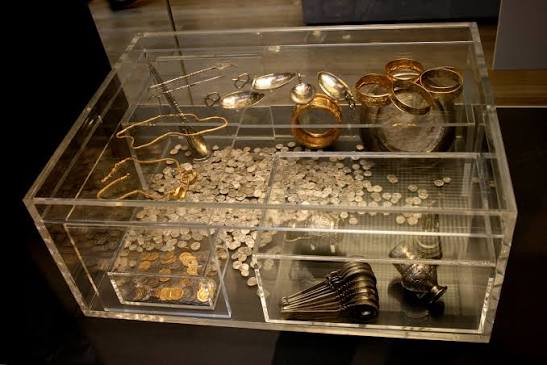
On 16 November 1992, Eric Lawes entered a Suffolk field with a metal detector to help find a farmer’s missing hammer. The signal he heard did not lead first to the tool. It led to silver spoons, gold coins, and the edge of a buried container. Lawes stopped digging, reported the discovery, and gave archaeologists the chance to recover one of the most important Roman finds ever made in Britain.
The Hoxne Hoard—pronounced “Hoxon”—contained almost 15,000 coins and about 200 pieces of jewellery, tableware, and other precious objects. It was carefully packed in a chest near the end of Roman rule in Britain, then never reclaimed. Its gold body chain, bracelets, pepper pots, spoons, coins, and personal inscriptions preserve the wealth of people who lived through a political transformation that written sources describe only imperfectly.
The discovery is often reduced to a neat story: frightened Romans buried their fortune as the empire collapsed and were killed before they could return. That is possible, but it is not proven. The real evidence supports a more careful history of wealth, family identity, changing currency, responsible metal detecting, and a Roman Britain that did not simply vanish on a single date.
What Is the Hoxne Hoard?
The Hoxne Hoard is the richest collection of Roman-period gold and silver found in Britain. It includes roughly 15,000 late Roman coins, 29 pieces of gold jewellery, and numerous silver vessels, spoons, toilet implements, and small objects. The British Museum holds the collection and displays a selection in its Roman Britain gallery.
“Hoard” is an archaeological description, not an explanation. It means that valuable objects were deliberately gathered and deposited together. The word does not tell us whether the deposit was emergency savings, long-term storage, an inheritance, a merchant’s stock, a ritual offering, or property hidden during violence. Those possibilities must be tested against the container, arrangement, dates, landscape, and condition of the material.
Hoxne is unusual because archaeologists recovered much of the deposit in context. The chest had decayed, but its iron fittings, organic remains, and the relative positions of objects survived. This allowed researchers to study not only what was buried but how it was packed.
The Lost Hammer and Eric Lawes’s Discovery
Tenant farmer Peter Whatling had lost a hammer in a field near Hoxne, Suffolk. His friend Eric Lawes, a retired gardener and metal-detector user, agreed to search for it. Instead, Lawes began recovering Roman coins and silver objects. He recognized that the find was larger than an isolated coin spill and contacted the authorities rather than emptying the hole himself.
That decision mattered. An uncontrolled removal would have mixed layers, separated objects, and destroyed evidence about the chest. The Suffolk Archaeological Unit conducted an emergency excavation, lifting the remaining deposit and recording its position. Police secured the site, and a later field survey recovered additional scattered pieces.
The hammer was eventually found as well and later joined the story in the British Museum. It is an ordinary object beside extraordinary treasure, but it explains why the discovery happened. The familiar phrase “a lost hammer found a Roman fortune” is essentially true—provided Lawes’s responsible response receives as much attention as the accident.
A Treasure Chest, Not a Random Coin Spill
The valuables had been placed in a wooden chest, probably oak, reinforced and secured with iron fittings. Within it, objects were sorted into smaller containers, bags, and bundles. Traces of textile, straw, wood, locks, hinges, and other fittings helped reconstruct the packing system after organic materials had largely decomposed.
Coins were grouped rather than poured loosely into one pit. Jewellery and tableware were arranged with care. The organization strongly suggests that whoever packed the chest knew its contents and expected the objects to remain protected. This was not rubbish disposal.
Careful packing also makes a ritual interpretation less immediately persuasive than practical safekeeping, though it does not identify the emergency. A chest could have been household storage before burial. It may have been moved from a nearby residence, and the field’s later appearance need not match its fifth-century use.
Nearly 15,000 Coins and a Changing Economy
The coin assemblage is dominated by silver siliquae, accompanied by hundreds of gold solidi and a small number of bronze coins. The precise published total can vary according to whether later surface finds, fragments, and classifications are counted, so “approximately 15,000” is safer than presenting one number as timeless. What does not change is the scale: this was an immense concentration of portable monetary wealth.
The gold coins represented high-value payments and savings. The thin silver siliquae are especially informative because many had been clipped around their edges. The imperial portraits and central designs were often preserved while silver was shaved away. Clipping appears frequently in late Roman British hoards and probably reflects a currency system adapting after regular supplies of newly minted silver weakened or ceased.
Clipped coins were not necessarily evidence of individual criminal fraud. If reduced coins continued to circulate by accepted weight or convention, clipping could become part of a regional bullion economy. Hoxne therefore records both imperial money and its transformation after Britain’s administrative connection to the western Roman state was breaking down.
Dating the Burial After Roman Rule Began to Fail
Coins provide a terminus post quem—the earliest possible date after which a hoard was buried. Hoxne contains issues from the early fifth century, and numismatic analysis places its concealment after about AD 407. Exactly how long after that point the chest went into the ground remains debated. Proposals range from soon after 408 to later decades of the fifth century.
The traditional date matters because Roman Britain’s political situation changed sharply in the early 400s. Troops and officials were withdrawn or redirected, competing emperors claimed authority, and the imperial government told British communities to look to their own defence. Yet “Rome left Britain in 410” is a classroom shorthand, not a switch flipped across the island.
Local elites, farms, towns, trade, Christian communities, and monetary habits continued in altered forms. Hoxne belongs to that transition. It does not prove that its owners buried the chest on the night Roman government ended, because there was no single such night.
The Gold Jewellery and Lady Juliana
The hoard’s jewellery includes rings, bracelets, necklaces, and an elaborate gold body chain designed to cross the torso. These objects were not merely stores of metal. Their forms, inscriptions, and workmanship expressed status and personal identity.
One bracelet carries the Latin inscription VTERE FELIX DOMINA IVLIANE, usually translated as “Use this happily, Lady Juliana.” The words are a good wish addressed to a named woman, not a label proving that Juliana owned every item in the chest. Other pieces carry different names, including forms associated with Aurelius Ursicinus.
The collection may have accumulated across a household or extended family, through gifts, marriage, inheritance, purchase, and reuse. A 2026 research project on Britain’s last Roman hoards emphasizes that multiple names complicate the picture of a single owner. Catherine Johns argued for a wealthy family collection, while Peter Guest has explored accumulation over time. Both interpretations fit the evidence better than inventing one identified “Hoxne princess.”
The “Empress” Pepper Pot
Among four silver-gilt pepper pots is the famous human-shaped vessel popularly called the Hoxne Empress. It depicts a woman with carefully arranged hair, jewellery, and clothing. A mechanism at the base controlled the opening through which ground spice could be shaken.
The nickname is memorable but not an identification. No inscription names the woman, and her portrait cannot securely be matched to a specific empress. She may represent an idealized aristocratic woman, a goddess, or a generalized image of elite femininity. Calling her “the Empress” should therefore remain in quotation marks.
Pepper was imported from South Asia through complex trade routes. A specialized silver dispenser in eastern Britain illustrates both wealth and the reach of Roman consumption. It does not mean every Romano-British household seasoned food with costly pepper; it shows what an unusually rich household could acquire.
Spoons, a Tigress, and the Missing Vessels
Hoxne contained sets of silver spoons, ladles, small dishes, cosmetic or toilet objects, and a striking silver-gilt handle shaped like a leaping tigress. The tigress probably once belonged to a larger vessel. Because the vessel itself was not in the chest, the handle demonstrates that the hoard is not a complete inventory frozen in place.
Large serving plates and bowls expected in the grandest late Roman silver services are mostly absent. Some possessions may have remained in use, been hidden elsewhere, been lost, or been separated before burial. The hoard was enormous, but it may still represent only one selected portion of a household’s wealth.
This selection problem matters. Archaeologists cannot reconstruct an entire lifestyle simply by treating everything absent as something the owners never possessed. Deposits reflect choices made at one moment, followed by centuries of decay and discovery.
Who Owned the Hoxne Hoard?
No surviving document connects the chest to a named villa or estate. Inscriptions provide personal names but not a complete family tree. Aurelius Ursicinus is prominent enough that writers sometimes call him the owner, while Lady Juliana attracts attention through her bracelet. Neither identification settles ownership of the whole assemblage.
A wealthy family is a reasonable interpretation. The range of jewellery and tableware, repeated names, and accumulated coins fit household wealth built over time. More than one generation may be represented. Some pieces were old when buried, and repairs show continued use rather than a single new purchase.
It is also possible that objects from several people were combined for safekeeping. What can be confirmed is socioeconomic position: whoever controlled the deposit possessed resources far beyond those of an ordinary rural household. The precise relationship among the named individuals remains unknown.
Why Was the Treasure Buried?
The most common explanation is danger. Political fragmentation, military insecurity, raids, local conflict, and disruption of administration made the early fifth century uncertain. Precious metal was portable but vulnerable. Burying it in a marked location could protect family wealth until conditions improved.
The fact that nobody recovered the chest suggests that something prevented a return: death, displacement, loss of access, failure of memory, or a boundary change. But archaeology cannot choose among those stories. The owners may even have returned and failed to locate it.
Hoarding was not unique to moments of invasion. People concealed savings during many kinds of instability, and some buried stores may have been routine. The dramatic statement that the owners were massacred by Anglo-Saxon invaders is unsupported. Hoxne is evidence of non-recovery, not a crime scene with known victims.
What Hoxne Reveals About the End of Roman Britain
The chest was hidden when imperial structures were weakening, but its contents show continuity as much as collapse. People still valued Roman coinage, Latin inscriptions, Mediterranean luxuries, Christian symbols, and inherited silver. They did not wake one morning as culturally “post-Roman.”
Coin clipping and hoarding indicate adaptation to scarcity and political uncertainty. Elite households still commanded substantial wealth, even as the state that had guaranteed taxation, military pay, and long-distance currency supply became less reliable. The economy narrowed and changed unevenly rather than disappearing at once.
This is why Hoxne complements evidence such as the Roman dodecahedrons. Individual objects rarely provide one simple answer, but their contexts reveal regional practices, social networks, and the limits of written history.
Why Archaeological Context Made the Find Exceptional
Many metal hoards are scattered by ploughing, removed piece by piece, or sold before specialists see their original arrangement. Hoxne survived comparatively intact because Lawes reported it quickly and archaeologists excavated the deposit. The chest fittings and organic traces would have been easy to dismiss as worthless beside gold.
Context allowed researchers to reconstruct layers and containers. It showed which objects lay together and how the deposit had been organized. Scientific analysis then examined alloys, gilding, solder, niello, gemstones, adhesives, repairs, and manufacturing traces.
The lesson resembles the carefully recorded excavation of the Lindow Man bog body: spectacular objects gain much of their historical value from controlled recovery. An artifact without context can still be beautiful and datable, but many of its strongest relationships have been lost.
Metal Detecting Done Responsibly
The discovery became a model for cooperation between detector users, landowners, archaeologists, police, museums, and the legal system. Lawes did not continue removing objects until the chest was dispersed. His prompt report preserved information and allowed the collection to remain together.
At the time, English treasure law still depended on the old common-law concept of treasure trove, including whether precious objects had been buried with an intention to recover them. An inquest declared Hoxne treasure trove. The hoard was valued at £1.75 million, and Lawes shared the reward with landowner Peter Whatling.
Hoxne is often said to have “created” the Treasure Act 1996. That is too simple. Reform had broader causes and a longer legislative history. However, the case became a highly visible example of responsible reporting and of the public benefits that clear procedures and fair rewards could produce. The Act replaced the old system in 1997 and defined treasure more systematically.
The Hoard’s Conservation and Scientific Study
Coin specialists recorded rulers, mints, issues, clipping, imitation, and wear. Because the hoard is so large, its value is statistical as well as spectacular: thousands of coins allow patterns to emerge that one isolated specimen could never establish.
Common Myths About the Hoxne Hoard
The first myth is that Eric Lawes was seeking treasure. He was helping search for a lost hammer. The second is that archaeologists know the exact owner. Personal names survive, but no single name is a secure title to every object.
The third is that the hoard was buried precisely in AD 410 as Rome “abandoned” Britain. Coin evidence places burial after about 407, not on a documented day, and the end of Roman government was a process. The fourth is that the “Empress” pot depicts a known empress; that identification is a nickname, not established portraiture.
Finally, the hoard’s careful burial does not prove a specific invasion or murder. Political danger is plausible, perhaps likely, but the owner’s fate is unrecorded. Responsible history preserves uncertainty instead of using it as space for a cinematic ending.
Why the Hoxne Hoard Still Matters
Hoxne transforms an abstract phrase—the end of Roman Britain—into personal material. A bracelet wished happiness to Juliana. Someone repaired silver, sorted coins, wrapped objects, closed a chest, and expected the act to make sense. The chest outlasted the plan.
The hoard also demonstrates that discovery ethics affect knowledge. Gold attracted attention, but iron fittings, textiles, coin positions, and field records supplied much of the history. Lawes’s restraint ensured that specialists could read those relationships.
Finally, Hoxne resists a clean boundary between Roman and post-Roman Britain. Its clipped coins and inherited luxuries belonged to people adapting old systems to new conditions. The empire’s institutions weakened, while Roman habits and identities continued in households that still understood the value of a solidus, a Latin blessing, and a pepper pot.
Conclusion: The Fortune Its Owners Never Recovered
The Hoxne Hoard is extraordinary not merely because it contains gold and silver, but because it preserves choices. Its owners selected objects, organized them, and hid them. Eric Lawes recognized another choice fifteen centuries later: to stop, report the find, and let archaeology recover the evidence.
Confirmed facts take the story far. The chest was buried after the opening years of the fifth century; it held almost 15,000 coins and an elite collection of jewellery and silver; multiple names appear; and it was never successfully reclaimed. Beyond that boundary begin interpretations. A wealthy family is likely, insecurity is plausible, and the collapse of Roman government forms essential context. The identity and fate of the people remain unknown.
That uncertainty does not weaken the discovery. It makes Hoxne a more honest window into historical change: a world in which institutions were failing unevenly, wealth still circulated, faith and family were written into objects, and someone believed that the safest place for a fortune was beneath a Suffolk field.
Sources and Further Reading
- British Museum, “Britain’s Last Roman Hoards” — research project on late Roman hoarding, currency, and the end of Roman Britain.
- British Museum, Hoxne “Empress” pepper pot — official catalogue record and object description.
- British Museum, Hoxne gold bracelet — official catalogue entry for inscribed jewellery.
- University of Kent and British Museum, “Inscriptions and Ownership” — current research on names and competing ownership interpretations.
- National Heritage Memorial Fund, “Hoxne Treasure” — acquisition history and collection overview.
- UK Parliament, Treasure Act 1996 — primary legal text replacing the earlier treasure-trove system.