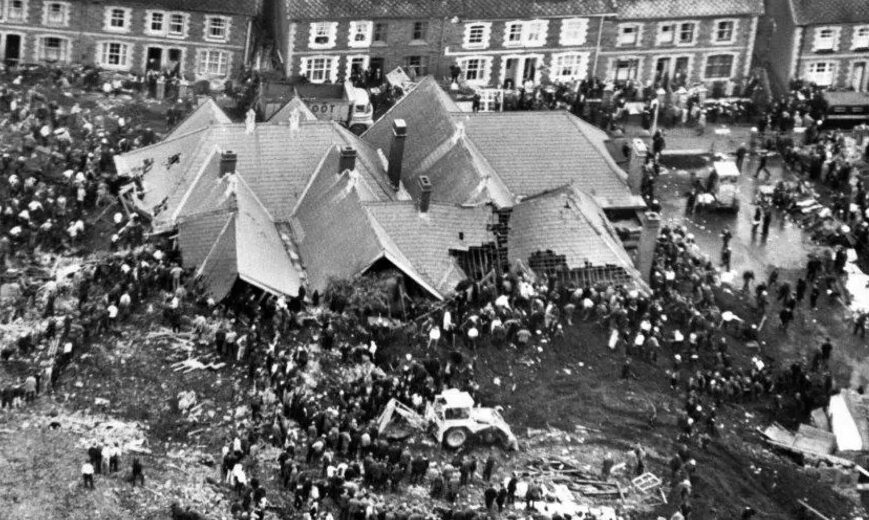
At 9:15 on the morning of 21 October 1966, a moving wall of coal waste reached Pantglas Junior School in Aberfan, South Wales. It smashed through classrooms on the final school day before half-term, burying children and teachers beneath black slurry. The disaster killed 144 people: 116 children and 28 adults. Of those, 109 children and five teachers died at the school.
Aberfan is sometimes remembered as a freak landslide caused by exceptional rain. The official inquiry reached a far harsher conclusion. The collapse was foreseeable, clear warnings had gone unheeded, and responsibility rested with the state-owned National Coal Board. Tip No. 7 had been built over water-bearing ground whose springs were known locally and marked on maps. Earlier movements on the hillside had demonstrated the danger.
The catastrophe was therefore not simply a collision between bad weather and bad luck. It was the result of an organization that treated spoil tips as an afterthought, separated technical responsibility from authority, and discounted knowledge held by residents. The injustice continued afterward, when charitable money donated to Aberfan was made to contribute to removing the remaining tips. Understanding the disaster requires following the story from geology and bureaucracy to grief, accountability, and reform.
A mining village beneath the waste tips
Aberfan grew in the Taff Valley south of Merthyr Tydfil, an area transformed by the South Wales coal industry. Merthyr Vale Colliery opened in the nineteenth century, and the village developed close to the mine, railway, canal, and river. Coal provided work and shaped the community, but extracting it also produced enormous quantities of unwanted rock and fine waste.
When tipping space on the valley floor became scarce, colliery waste was carried to the hillside above Aberfan. From 1916 onward, seven tips were created there. Together they contained about 2.1 million cubic meters of material. Tip No. 7, begun in 1958, was the active tip in 1966 and rose high above the village and its schools.
Tip No. 7 stood over springs
The hillside was crossed by springs where permeable sandstone met less permeable layers. Water emerging along these lines had long been familiar to local people. A stream or spring lay beneath the site selected for Tip No. 7, and Ordnance Survey mapping recorded water features in the area. The tribunal later found that the National Coal Board had failed to organize even elementary investigation of the tipping ground.
Water was crucial because it could raise pressure within fine waste and reduce friction between particles. Material that appeared stable could lose strength and begin to flow. The mechanism was not mysterious in 1966. Engineers understood that water threatened spoil-tip stability, and the colliery had practical evidence from previous movements.
In 1944, Tip No. 4 had slipped. In 1963, part of Tip No. 7 moved, and another movement followed in 1964. Those failures did not reach the village, but they revealed that the slope was unstable. Instead of prompting a comprehensive geotechnical review, they were treated locally and tipping continued. The later inquiry described a fragmented system in which information was neither properly recorded nor passed upward.
Warnings existed before the collapse
Residents and local officials did not predict the exact form or date of the 1966 disaster, but they repeatedly expressed concern about the tips and water. In 1963, Pantglas school parents petitioned about slurry flooding from the hillside. Correspondence involving the local council and the colliery raised drainage problems and the threat posed by waste above the village.
The National Coal Board often portrayed the danger as inconvenience from mud or blocked drains rather than a threat of catastrophic collapse. This distinction mattered. Complaints were handled as maintenance issues, while no one with sufficient authority asked whether tipping should continue at all.
Later retellings sometimes suggest that officials received a precise warning that the school would be buried and deliberately ignored it. The evidence is more exact and, in institutional terms, more disturbing: numerous warning signs existed, but the organization had no effective system for assembling them into a risk assessment. Foreseeability did not depend on prophecy. It depended on recognizing springs, earlier slips, drainage failures, and a growing tip directly above homes and schools.
The rain was a trigger, not the root cause
October 1966 was wet in South Wales. Rain infiltrated the waste, and water accumulated within Tip No. 7. On the morning of 21 October, workers noticed movement before 7:00 a.m. The tip initially subsided slowly. Telephone messages passed between the tipping crew and colliery offices, but no warning reached the village below.
At about 9:15, part of the saturated tip failed. Approximately 107,000 cubic meters of debris began moving downhill. The mass crossed farmland, destroyed a farm and cottages, struck the disused canal and a water main, passed over a railway embankment, and entered Aberfan. Accounts often cite around 150,000 tonnes of moving material, although volume and mass estimates vary by source and method.
Heavy rain helped mobilize the waste, but calling the event a rain-caused natural disaster shifts attention from the decisions that created the hazard. Rainfall was expected in the Welsh valleys. The dangerous combination was a saturated spoil tip placed over springs without adequate drainage, investigation, supervision, or emergency planning.
The destruction of Pantglas Junior School
Children at Pantglas had begun morning lessons. The slide struck with a sound survivors compared to thunder or a low-flying aircraft. Slurry, rock, and water smashed into the school and filled rooms almost instantly. Buildings offered little protection from the weight and speed of the flow.
Residents, miners, teachers, police, firefighters, medical staff, and volunteers converged on the site. Many dug with shovels or bare hands. The slurry was dense and unstable; heavy machinery risked injuring people trapped below. The last child recovered alive emerged at about 11:00 a.m., less than two hours after impact. Recovery of the dead continued for days.
The scale of childhood loss shaped every aspect of the disaster’s memory. Most of the children were between seven and ten years old. Entire classes disappeared, siblings died together, and nearly every family in the small community was directly connected to someone killed. The cemetery’s long rows of children’s graves made the collective loss permanently visible.
Why the official response drew anger
The National Coal Board’s initial public posture deepened mistrust. Its chairman, Lord Robens, did not arrive immediately and at first maintained that the presence of a spring beneath the tip had been unknown. Local people knew otherwise. Maps, past incidents, and testimony later showed that water on the hillside could not reasonably be treated as an unforeseeable surprise.
Public grief also collided with the demands of officials, journalists, visitors, and donations. Aberfan became the focus of intense national attention, yet survivors often felt spoken about rather than listened to. The difference between sympathy and accountability became one of the defining tensions of the aftermath.
The Aberfan Tribunal established responsibility
The government appointed a tribunal under Lord Justice Edmund Davies. It heard evidence from 136 witnesses over several months and published its report on 3 August 1967. The report was unusually direct: blame for the disaster rested upon the National Coal Board, shared in varying degrees by its headquarters, its South Western division, and named individuals.
The tribunal rejected the idea that the slide could not have been foreseen. It described a failure to heed warnings, confused lines of responsibility, and people assigned to tasks for which they lacked appropriate training. The Board’s legal liability for deaths, injuries, and property damage was described as incontestable and uncontested.
Importantly, the finding did not mean that every employee had equal knowledge or culpability. The report distributed blame across organizational levels and criticized the absence of direction from the top. Later historians have debated whether some individuals were treated too harshly and some senior figures too gently, but the institutional conclusion remains unambiguous.
No one was prosecuted
Despite the tribunal’s condemnation, no National Coal Board employee was prosecuted, dismissed, or demoted because of Aberfan. Lord Robens remained chairman. This gap between a forceful finding of institutional blame and the absence of personal legal consequences became a lasting source of anger.
It would be inaccurate to say that the tribunal “found everyone innocent.” A tribunal of inquiry was not a criminal court, and its task was to establish causes and make recommendations rather than determine criminal guilt. Civil compensation was paid, but the sums offered to bereaved families appeared painfully small beside the magnitude of the loss.
Aberfan exposed a recurring problem in industrial disasters: an organization may be held responsible in public language while accountability is diffused among procedures, departments, and employees. The pattern can also be seen in later investigations of engineering failures, including the St. Francis Dam disaster, where technical causes could not be separated from decisions about oversight and institutional confidence.
The Disaster Fund and the “second injustice”
Donations arrived from across Britain and the world. The Aberfan Disaster Fund eventually received roughly £1.75 million from tens of thousands of contributors. It supported bereaved families, survivors, memorials, community facilities, and other needs. Yet charitable rules and official attitudes sometimes made assistance intrusive and humiliating.
Trustees faced pressure over payments to parents, including questions about the closeness of their relationship with a dead child. The remaining coal tips above Aberfan caused constant fear, and the community demanded their removal. The dispute over who should pay created an extraordinary outcome: £150,000 was taken from the charitable fund toward clearing a danger created by the coal industry.
The British government repaid the nominal £150,000 in 1997, nearly three decades later. In 2007, the Welsh government provided further money to Aberfan charities in recognition of the lost value. The episode is sometimes called a second disaster because institutions again transferred burdens onto the community that had suffered from their failure.
Removing the remaining tips
For families living beneath the hillside, the other tips were not abstract engineering structures. They were daily reminders of what had happened and sources of continuing fear. The National Coal Board initially resisted complete removal, arguing that some could be made safe. Residents insisted that technical reassurance was insufficient after trust had collapsed.
This conflict shows why post-disaster recovery cannot be defined only by whether engineers consider a structure stable. Safety also has a social dimension. People asked to live beneath a hazard must trust the institutions assessing it, and Aberfan had provided compelling reasons not to do so.
How Aberfan changed tip-safety law
The Mines and Quarries (Tips) Act 1969 created stronger duties for mine and quarry owners and managers. It required notification of tipping operations, expanded inspection and remedial powers, and addressed disused tips that could endanger the public. The law made stability a matter of formal responsibility rather than informal local practice.
Legislation alone did not invent knowledge that water and waste slopes could be dangerous. The change was administrative as much as technical: ownership of risk had to be named, surveys and records had to be maintained, and inspectors needed authority to demand action. Aberfan showed that expertise is ineffective when no institution is obliged to use it coherently.
The disaster also contributed to broader debate about industrial safety and the relationship between regulators and nationalized industries. It belongs to the history of modern risk governance, in which catastrophic failures force hazards previously left at the edge of management into explicit rules.
Trauma was poorly understood
Immediate medical attention focused naturally on physical injury, but many survivors, rescuers, parents, and residents experienced long-lasting psychological effects. Children who lived through the slide reported nightmares, anxiety, guilt, and fear of rain. Adults endured bereavement layered with anger and public scrutiny.
The language and services now associated with post-traumatic stress were not well developed in 1966. Some people received support, but there was no comprehensive, coordinated program matching what modern emergency planning would expect. Silence could be mistaken for resilience, while symptoms were treated as private problems rather than consequences of collective disaster.
Welsh identity, class, and political memory
Aberfan occurred in a Welsh mining community whose labor had powered British industry. Many residents saw a distant bureaucracy profit from coal while leaving waste and danger above the people who produced it. The tribunal confirmed that local knowledge had been discounted by an organization directed from elsewhere.
This experience resonated with broader tensions over class, national power, and economic change. Like the nineteenth-century Rebecca Riots in Wales, Aberfan became part of a longer story about communities challenging systems that imposed costs without adequate local voice. The events differed radically, but each exposed a gap between official authority and lived knowledge.
The disaster should not be reduced to a simple morality tale of Wales against England or workers against managers. Welsh officials and institutions were also involved, and the National Coal Board employed many local people. The deeper issue was how a centralized industrial system distributed benefits, expertise, authority, and risk.
Royal myths and media retellings
Popular dramatizations often focus on Queen Elizabeth II waiting eight days before visiting Aberfan and claim she later regarded the delay as her greatest regret. The delayed visit is documented, but the precise ranking of her regrets rests largely on later recollection and royal commentary rather than a contemporaneous public statement from the Queen.
That story can overshadow the conduct of institutions directly responsible for the tips. Royal symbolism mattered to many residents, but the National Coal Board built and managed Tip No. 7, while government decisions shaped regulation, compensation, and removal. Concentrating memory on whether a monarch showed emotion risks turning a disaster of industrial governance into palace drama.
Television and newspapers brought Aberfan into homes around the world. Their images generated enormous sympathy and donations, yet repeated retelling can simplify the event into a single morning of grief. The archived tribunal papers, letters, maps, and fund records reveal a longer history of warning, struggle, and institutional resistance.
What was confirmed, and what is often misstated
Several core facts are not disputed: Tip No. 7 was under National Coal Board control; it was placed on water-bearing ground; previous slips and drainage problems had occurred; saturated waste moved into the village; and the official tribunal placed blame on the Board. These findings distinguish Aberfan from an unavoidable natural landslide.
Rain contributed to saturation, but it did not absolve the organization that created the tip. The school was not the only structure destroyed, although it accounted for most deaths. The disaster killed 144 people, not 116; 116 was the number of children. And while the collapse is frequently called a coal-slide, the moving mass consisted largely of colliery spoil, mud, rock, and water rather than marketable coal.
The disaster was foreseeable without being predicted in exact detail. This is the most important distinction. No one needed to know the precise minute of failure to recognize that tipping over springs on a slope above a village required competent investigation, drainage, monitoring, and an emergency plan.
The memorial landscape
The site of Pantglas Junior School became the Aberfan Memorial Garden. In Bryntaf Cemetery, the victims’ graves form a powerful visual record of the children and adults lost. Memorial charities continue to maintain these places, linking private bereavement with public history.
Archival projects by the National Library of Wales and Glamorgan Archives preserve committee papers, technical evidence, correspondence, photographs, and records of the Disaster Fund. These collections make it possible to move beyond legend and see how local people organized after institutions failed them.
Conclusion: Aberfan was not an accident without owners
The Aberfan disaster began physically with water and unstable waste, but its historical cause lay in decisions. The National Coal Board placed Tip No. 7 over springs, continued after earlier movements, failed to collect and communicate knowledge, and provided no effective warning to the community below. Rain triggered the collapse; it did not create the organizational failure.
The tribunal’s clarity remains striking. It rejected the comfort of calling the catastrophe unforeseeable and placed responsibility on a powerful public institution. Yet the aftermath showed the limits of inquiry: no one was prosecuted, survivors received inadequate support, and charitable funds were used to help remove the remaining danger.
Aberfan changed law and engineering practice, but its larger lesson is about listening before disaster. Local observation, technical expertise, clear responsibility, and the authority to stop unsafe work must operate together. When institutions separate them, a hazard known in pieces can remain officially unseen until it becomes irreversible.
Sources and further reading
- British Geological Survey: “The Aberfan Disaster, 1966”
- National Library of Wales: Aberfan Disaster 1966 archive
- Glamorgan Archives: The Aberfan Tribunal
- UK Parliament, Hansard: Aberfan Disaster debate, 26 October 1967
- Mines and Quarries (Tips) Act 1969
- British Academy: “Lessons from the Aberfan Disaster and Its Aftermath”