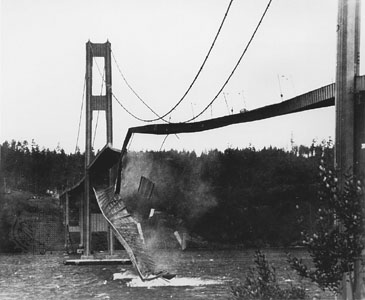
On the morning of November 7, 1940, a bridge that embodied modern engineering began moving like something alive. Its roadway rose and fell in long waves above Washington State’s Tacoma Narrows. Then the motion changed. One side of the deck climbed while the other dropped, reversing every few seconds until concrete broke loose and steel twisted apart. At 11:02 a.m., a 600-foot section plunged into Puget Sound.
The Tacoma Narrows Bridge collapse was caught on film, turning “Galloping Gertie” into the most recognizable structural failure of the twentieth century. The footage is unforgettable, but the explanation often attached to it is wrong. Wind did not simply pulse at the bridge’s natural frequency like a person pushing a swing. The destructive motion was a self-excited aerodynamic instability, usually described as torsional flutter, produced by the interaction of wind and an exceptionally flexible deck.
That correction does not reduce the story to one technical phrase. The bridge met accepted standards, its designers were leading professionals, and its ordinary up-and-down movement had survived stronger gusts. Investigators needed years of wind-tunnel work to understand the disaster. Tacoma changed bridge engineering not because one foolish calculation was exposed, but because an entire profession discovered that its models had left out a force capable of controlling the structure itself.
Why Tacoma Needed a Bridge
The Tacoma Narrows is a constricted channel of Puget Sound separating Tacoma from the Kitsap Peninsula. Before the bridge, travelers relied on ferries to cross water nearly a mile wide. A fixed link promised shorter journeys, economic development, and better access between the peninsula and the state’s urban corridor. The goal was attractive; the location was punishing.
Water in the Narrows exceeded 200 feet in depth, while strong tidal currents swept through the channel several times a day. Any bridge would require unusually deep piers and a main span long enough to leave the navigation channel open. Traffic forecasts created another constraint. Expected use did not justify a wide, multi-lane roadway, so planners sought a bridge that was very long but only two lanes wide.
Clark Eldridge’s Heavier Original Design
Washington State Highway Department engineer Clark Eldridge developed an initial design in 1937 and 1938. His proposal used a 2,600-foot center span supported by stiffening trusses 25 feet deep. Deep open trusses had long been used to resist bending and twisting while allowing wind to pass through the structure.
To finance the project, the Washington State Toll Bridge Authority sought support from the federal Public Works Administration. The PWA offered a grant covering 45 percent of construction costs but required the state to retain a nationally prominent suspension-bridge consultant. The chosen expert was Leon Moisseiff, an influential New York engineer associated with several of America’s great long-span bridges.
Leon Moisseiff and the Slender Bridge
Moisseiff extended the center span to 2,800 feet and replaced Eldridge’s 25-foot open trusses with solid plate girders only eight feet deep. The roadway measured 26 feet across, with the main cables 39 feet apart. The resulting bridge had an unprecedented center-span-to-width ratio of roughly 72 to 1 and a span-to-girder-depth ratio of about 350 to 1.
Moisseiff’s work drew upon “deflection theory,” which treated the deck, cables, suspenders, and loads as an interacting system. The theory was not nonsense; versions of it remain useful. The blind spot was aerodynamic behavior. Designers could calculate static stresses from gravity, traffic, and lateral wind pressure far more confidently than they could predict wind-driven vertical or twisting movement.
Building the Third-Longest Suspension Span
Construction began on November 23, 1938. Contractors completed the bridge in only nineteen months despite the deep water and powerful currents. The caissons supporting the towers reached record-setting depths. Workers erected 425-foot steel towers above the piers, spun two enormous main cables, hung vertical suspenders, and lifted prefabricated deck sections into place.
Yet the warning had appeared before opening day. As workers completed the floor system in May, the deck began forming vertical waves in moderate winds. Men reportedly became seasick while working on it. The motion soon gave the bridge its nickname, “Galloping Gertie,” and motorists came to experience the unusual ride.
The Gallop Engineers Tried to Cure
The bridge’s early motion was primarily vertical. Several waves could travel along the center span, making one section rise while another fell. Engineers recognized the movement as structural instability, but vertical oscillation did not automatically mean collapse was imminent. Gertie had remained standing in winds stronger than those recorded on the day it failed.
Several remedies were attempted. Hydraulic buffers installed at the towers were intended to absorb movement but produced little improvement. Engineers also added temporary tie-down cables to restrain the side spans and diagonal wires between the main cables and deck. A tie-down cable broke during a storm on November 1, and the measures did not control the center span.
The Toll Bridge Authority hired University of Washington engineering professor Frederick Bert Farquharson to study the problem. His team built a 54-foot model of the complete bridge at 1:200 scale and a larger sectional model for wind-tunnel work. Farquharson observed twisting under certain conditions and understood that such movement on the real bridge would be dangerous.
By November 2, he had recommended either opening the solid girders so air could pass through or adding curved fairings that would guide wind around them. Officials were preparing to install deflectors. The collapse came five days later, before the proposed aerodynamic alteration could be tested on the bridge.
November 7, 1940: The Wind Builds
Strong southwesterly winds blew across the Narrows early on November 7, striking the bridge broadside. At 7:30 a.m. the measured wind was about 38 miles per hour; later readings near the east end reached roughly 42 miles per hour, though conditions varied along the crossing. The deck settled into its familiar vertical gallop, with waves estimated at two to five feet.
Farquharson reached the bridge around 9:30 a.m. to photograph and film the motion. Traffic continued for a time. Shortly before 10:00, newspaper editor Leonard Coatsworth drove onto the span on his way to a family cottage. His daughter’s cocker spaniel, Tubby, rode in the back seat.
At approximately 10:03 a.m., the character of the movement abruptly changed. The deck began twisting around its lengthwise axis. Within minutes, one edge rose as much as 28 feet while the opposite edge fell, creating slopes of around 45 degrees. The cycle reversed about every five seconds. Authorities closed the bridge as drivers and passengers struggled to escape.
Coatsworth, Tubby, and the Human Story
Coatsworth’s car struck the curb when the roadway tilted. He climbed through a window and crawled toward the east tower, then staggered along the side span to safety. Two occupants of a delivery van near the west tower also escaped. Workers, police, engineers, photographers, and curious onlookers gathered at the approaches as the deck continued to roll.
Several people tried to reach Tubby, who remained trapped in Coatsworth’s abandoned car. Photographer Howard Clifford turned back when the motion became too violent. Farquharson later approached the vehicle, but the terrified dog bit him and he retreated. When the car finally fell with the deck, Tubby died.
No person was killed in the Tacoma Narrows Bridge collapse. That extraordinary outcome reflected the bridge closure, the relatively light traffic, and difficult escapes made before the main span failed. Accounts that describe “one fatality” without explaining that the victim was a dog create a misleading impression; accounts that treat Tubby as comic trivia overlook the genuine rescue attempts and distress of the people involved.
How the Bridge Came Apart
Concrete began dropping from the roadway as the torsional movement grew. Girders distorted, suspender cables snapped, and bolts and light poles broke loose. The main cables moved violently in their saddles. Witnesses heard the grinding of metal, the cracking of concrete, and sharp reports from failing cables.
At 11:02 a.m., a section about 600 feet long tore away from the eastern portion of the center span and fell roughly 195 feet into Puget Sound. Other deck sections followed toward the towers. By about 11:10, the central roadway was gone, leaving the main cables hanging between battered towers and sagging side spans.
The piers and anchorages largely survived, but the superstructure was ruined. Much of the steel and concrete settled on the seabed. The sunken remains later became habitat for marine life and were added to the National Register of Historic Places in 1992, protecting the wreck from uncontrolled salvage.
Why the Famous Film Matters
Most historical structural failures survive through written testimony and photographs. Tacoma was different. Farquharson filmed for research, while news cameramen and photographers recorded the twisting roadway and the collapse. The moving images allowed engineers to examine the transition from vertical waves to torsional motion long after the bridge disappeared.
The Textbook Resonance Myth
For decades, many physics lessons presented Tacoma as an example of forced resonance. In the familiar analogy, periodic gusts supposedly matched the bridge’s natural frequency, adding energy with each cycle as timed pushes make a swing rise higher. The story is memorable and pedagogically convenient.
It is also an inadequate account of the collapse. The wind on November 7 was comparatively steady, not a metronome delivering external pushes at precisely the torsional frequency. The bridge’s destructive twisting was self-excited: as the deck moved, it changed the airflow around itself, and those aerodynamic forces fed energy back into the motion. No separate gust frequency had to match it.
Torsional Flutter in Plain Language
A bridge deck exposed to wind does not merely receive a fixed sideways load. Air flows above, below, and around it. If the deck tilts slightly, that airflow changes, producing new lift and twisting forces. On a stable design, stiffness and damping remove enough energy for the movement to die away. On Tacoma’s very flexible deck, motion could instead make the aerodynamic force arrive at a moment that strengthened the next motion.
This feedback is called aeroelastic because it couples the elasticity of the structure with the behavior of air. In torsional flutter, the twisting and the aerodynamic force sustain one another. The deck extracts energy from an otherwise steady wind, so each cycle can grow without rhythmic gusts. Once the amplitude exceeded what the girders, floor system, and connections could withstand, progressive structural failure followed.
Researchers have debated the precise pathway into flutter. The 1941 federal investigation associated the change from vertical to torsional motion with a midspan cable band slipping and dividing one main cable into unequal segments. Vortex shedding and the solid plate girders also influenced airflow. Later analyses have refined or challenged parts of the classic sequence. The consensus is stronger about the bridge’s low torsional stiffness and self-excited aerodynamic instability than about one exclusive trigger.
The Design Was Vulnerable, Not Simply “Bad”
It is tempting to blame a single engineer. Moisseiff’s shallow solid girders and extreme proportions plainly left the bridge unusually flexible, and Eldridge’s deeper truss would probably have resisted the wind far better. Yet Moisseiff’s design passed state and federal review and followed an influential direction in contemporary bridge theory.
The 1941 Carmody Board identified three central problems: excessive flexibility; a solid deck-and-girder shape that generated aerodynamic drag and lift; and the profession’s inadequate knowledge of aerodynamic forces. These findings spread responsibility from one calculation to a design culture that treated wind mainly as a static lateral load.
The distinction is important whenever disasters become lessons. The St. Francis Dam disaster likewise shows why historical engineering failures cannot be understood only through the final visible break. Assumptions, institutions, review practices, warning signs, and the limits of contemporary knowledge shape what designers believe is safe.
What the Investigations Found
Washington State, insurers, and the federal government organized investigations after the collapse. The Federal Works Administration appointed Othmar Ammann, Theodore von Kármán, and Glenn Woodruff to a panel whose March 1941 report became known as the Carmody Board report. It described turbulent wind action and emphasized the transition to destructive twisting.
The panel concluded that the bridge’s narrow, shallow, light deck had too little vertical and torsional rigidity. Its eight-foot solid plate girders presented broad surfaces to crosswinds and shaped airflow around the deck. The board’s most consequential recommendation was methodological: long suspension bridges needed aerodynamic model testing, not only conventional stress calculations.
Farquharson continued experimenting with models of the failed span and its proposed replacement. The work made Tacoma the first suspension-bridge failure studied through the combination of direct filmed observation and sustained wind-tunnel research. The investigators did not discover a single magical formula. They established a new way of asking whether a bridge and the surrounding air would remain stable together.
A Forgotten History of Wind Failures
Tacoma’s movement seemed unprecedented to many engineers in 1940, but wind had damaged or destroyed suspension bridges throughout the nineteenth century. In 1941, Columbia University professor J. K. Finch reviewed these earlier cases and argued that the profession had forgotten hard-won lessons after decades without a comparable collapse.
Designing the 1950 Replacement
Plans for a replacement began in 1941, but wartime priorities delayed construction. Farquharson and Washington engineers tested models for years in a specially built structural research laboratory. Their objective was not merely to make the old bridge heavier. They sought a form whose airflow, stiffness, and damping worked together predictably.
The replacement used a 33-foot-deep open Warren truss instead of eight-foot solid plate girders. Wind could pass through open steelwork and grating. Wider cable spacing, lateral bracing, and hydraulic damping devices increased resistance to vertical and torsional movement. Models were exposed to winds arriving at different angles before the design was accepted.
Construction began in 1948, using the surviving original piers and modified anchorages. The new bridge opened on October 14, 1950. Nicknamed “Sturdy Gertie,” it shared the predecessor’s 2,800-foot main-span geometry but not its aerodynamic vulnerability. The contrast demonstrated that span length alone had not doomed the 1940 bridge.
How Tacoma Changed Bridge Engineering
After Tacoma, aerodynamic analysis became integral to long-span bridge design. Engineers tested sectional and full-bridge models in wind tunnels, measured multiple modes of movement, and considered flutter speed, vortex-induced vibration, damping, and torsional stiffness. Computer modeling later expanded these methods, but physical wind-tunnel testing remained indispensable for unusual long spans.
The lesson resembles the history of the first transatlantic telegraph cable: a celebrated failure became valuable because investigators treated it as evidence rather than embarrassment. Tacoma’s wreck forced civil engineering to connect structural mechanics with aerodynamics and to test assumptions before committing them to full scale.
Common Oversimplifications About Galloping Gertie
The bridge was not brought down by an exceptionally violent hurricane. Recorded winds near the east end were around 42 miles per hour, and the span had previously endured stronger gusts without collapse. The danger lay in how its shape and flexibility responded to wind, not wind speed alone.
Nor did engineers ignore all warnings. They observed the vertical gallop, installed damping devices and tie-downs, commissioned model studies, and prepared aerodynamic modifications. Their crucial error was underestimating what the movement could become. Familiar vertical waves had not yet taught them to expect catastrophic torsional flutter.
Conclusion: The Failure That Made Wind Visible
The Tacoma Narrows Bridge collapse remains powerful because the camera made an invisible relationship visible. Viewers can see steel and concrete responding not to a collision or overloaded truck but to moving air. A bridge designed to carry enormous static forces was destroyed by feedback between its own motion and the wind.
Confirmed facts are dramatic enough: the bridge opened on July 1, 1940; galloped from its construction period; entered violent torsional movement on November 7; and lost its main span after only four months of service. No human died, although Tubby the dog was lost. Investigations established excessive flexibility and aerodynamic instability as central causes. The exact sequence remains more contested than the textbook legend admits.
Galloping Gertie’s deepest legacy is not that engineers must make every structure massive. It is that safety depends on asking the right physical question. A bridge is not only a collection of steel members carrying loads; it is a dynamic system embedded in wind, water, traffic, and time. Tacoma failed when theory treated that environment as a secondary stress. Modern bridge engineering began when the environment became part of the design.
Sources and Further Reading
- Washington State Department of Transportation, “Galloping Gertie Collapses”
- Washington State Department of Transportation, “1940 Narrows Bridge: The Machine”
- Washington State Department of Transportation, “Lessons from the Failure of a Great Machine”
- University of Washington Libraries, Tacoma Narrows Bridge Collection
- Library of Congress, Historic American Engineering Record: Tacoma Narrows Bridge
- American Physical Society, “Collapse of the Tacoma Narrows Bridge”