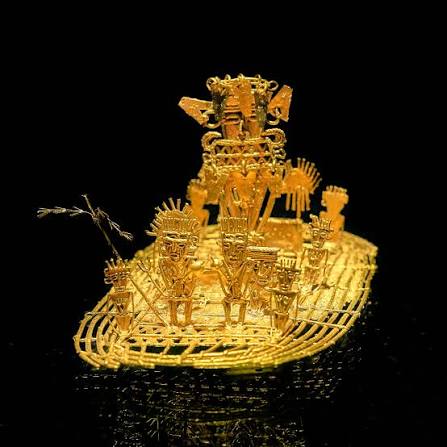
At first glance, the Muisca Raft seems to offer exactly what centuries of treasure hunters wanted: a golden scene of a ruler, attendants, and ritual objects floating across a lake. Yet the small masterpiece is not a map to a vanished city of gold. It is something more revealing—a work made by Indigenous metalworkers whose religious world was transformed into Europe’s most persistent American treasure legend.
Discovered near Pasca, Colombia, in 1969, the raft preserves eleven figures cast together in a single intricate object. Its central person is commonly identified with the newly installed Muisca leader described in colonial accounts of a ceremony at Lake Guatavita. That interpretation is plausible, but it must be handled carefully. The artifact is real; the ritual has documentary support; the fabulous city later called El Dorado was a colonial expansion of those facts.
Understanding the Muisca Raft therefore means working backward through layers of storytelling. Beneath expeditions, drained lakes, and fantasies of limitless bullion lies a different history: of politically independent communities in Colombia’s eastern highlands, long-distance trade, skilled lost-wax casting, and offerings intended to maintain relationships among people, ancestors, deities, and the living landscape.
Who Were the Muisca?
The Muisca inhabited the high plateaus and valleys of the Eastern Cordillera of the Colombian Andes, especially the Altiplano Cundiboyacense. This cool upland region included fertile agricultural zones, salt deposits, lakes, and routes connecting the highlands with warmer lowlands. By the time Spaniards entered the region in the 1530s, Muisca-speaking communities supported dense populations through farming, craft production, exchange, and systems of tribute.
Popular accounts often call this society the “Muisca Empire.” The label is convenient but misleading. The Muisca did not form a single centralized state comparable to the Inca Empire. They lived in numerous communities grouped under local leaders, with larger political networks associated with powerful rulers whom Spaniards called the zipa in the south and the zaque in the north. Alliances, rivalries, tribute obligations, and ritual authority connected these territories without erasing their political differences.
This distinction matters because the El Dorado story tends to reduce an entire society to one wealthy king. Muisca life involved farmers, traders, salt workers, potters, textile makers, ritual specialists, and metalworkers. Their economy linked the Andes to distant regions, and their authority depended as much on ceremonies and reciprocal obligations as on military force. The raft belongs to this complex world, not to an imaginary kingdom organized solely around gold.
What the Muisca Raft Looks Like
The artifact now displayed by Bogotá’s Museo del Oro is approximately 19.5 centimeters long and about 10 centimeters wide and high. Its oval base resembles a log or reed raft. Upon it stand eleven human figures, dominated by a larger central person surrounded by smaller attendants. Some figures carry staffs, banners, or other objects, while those positioned toward the edges appear to propel or guide the vessel.
It is commonly described as “solid gold,” another oversimplification. Muisca metalworkers often used alloys of gold, copper, and sometimes silver broadly known as tumbaga. Varying the mixture changed color, hardness, melting behavior, and surface appearance. For the artisans, the choice was not a failed attempt to maximize bullion value. It was part of a sophisticated technology for producing objects whose color, brilliance, sound, and transformation through fire carried meaning.
The 1969 Discovery at Pasca
The raft was not recovered from Lake Guatavita. It was found in 1969 in a cave or rock shelter on a hill known as La Campana, near the town of Pasca in Cundinamarca, south of Bogotá. A local farmer, Cruz María Dimaté, discovered it inside a ceramic vessel shaped like a seated human figure. The container had protected the metalwork and preserved an offering assemblage far from the lake most closely associated with El Dorado.
The local priest Jaime Hincapié Santamaría helped ensure that the find was reported and remained in Colombia. The Banco de la República acquired the object for the Museo del Oro, where it entered a public archaeological collection rather than disappearing into the international antiquities market. That chain of events is an important part of the artifact’s history. Its survival depended not only on ancient craftsmanship but also on local decisions made in 1969.
The original context changes how the object should be read. A cave deposit suggests that the raft itself was an offering, not a model casually lost by its owner or a royal ornament buried for safekeeping. Muisca offerings were placed in lakes, caves, crevices, fields, and constructed spaces. The sacred landscape extended beyond a single celebrated lagoon.
A Masterpiece Made by Lost-Wax Casting
The Muisca Raft was cast by the lost-wax process. An artisan first modeled the entire scene in beeswax, including the figures, ornaments, and delicate connecting elements. The wax model was encased in a clay-based mould and heated so that the wax drained or burned away. Molten metal was then poured into the empty channels. Once it cooled, the mould had to be broken, leaving a unique casting that could not be reproduced from the same mould.
Technical study has shown that the raft was made in one casting rather than assembled from separately cast people and a base. That achievement demanded exact control over alloy, temperature, mould preparation, and the pathways through which metal and gases moved. A failure in any narrow channel could have left a figure incomplete; cracking or trapped gas could have ruined the entire work.
The process itself may have had significance beyond engineering. Wax became empty space; molten metal took its place; a fragile model emerged as a durable, luminous object. Across ancient Colombia, metalworking turned materials through heat, mixture, and skilled action. Museums rightly celebrate the raft’s virtuosity, but “technology” and “religion” should not be treated as separate realms. The maker’s technical choices created the object’s ritual power.
Gold Was Not Simply Muisca Money
To sixteenth-century Europeans, gold was portable wealth, coinage material, and a measure of imperial success. Muisca people valued it differently. They certainly understood scarcity, prestige, and exchange, but gold objects were not merely accumulated as private treasure. Their brightness linked them to powerful forces, especially the sun, and made them suitable for bodily display, political ceremony, and communication with nonhuman beings.
Much of the raw gold used by Muisca craftspeople came through trade with lower and warmer regions, including areas along the Magdalena River. The highlands were rich in salt and emeralds, while textiles and agricultural products also moved through exchange networks. Goldwork therefore testifies not to a mountain full of inexhaustible metal but to regional relationships and specialist knowledge.
Spanish invaders frequently melted Indigenous objects into standardized ingots. In doing so they converted works with distinct histories and purposes into taxable bullion. Modern viewers repeat part of that violence when they judge an artifact chiefly by its weight or market price. The raft’s historical value lies in the social world it materialized, not in how many coins its metal might have produced.
Tunjos and the Practice of Offering
The raft belongs to a broader Muisca tradition of metal votive objects often called tunjos. Many are small, flat or three-dimensional figures showing people, animals, weapons, litters, houses, or ritual scenes. They were deposited in ceramic containers or placed directly in caves, lakes, springs, fields, and other meaningful locations. Thousands survived because they were deliberately removed from everyday circulation.
An offering was not simply wealth thrown away. It could request protection, acknowledge a sacred being, mark a political act, respond to illness, or sustain balance in the world. The object, the ceremony, the person commissioning it, and the place of deposition formed a relationship. Its apparent economic loss was precisely what made the act meaningful, although reducing sacrifice to “cost” still imposes a modern accounting logic.
What Ceremony Does the Raft Depict?
The usual interpretation connects the scene with the installation of a Muisca leader at Lake Guatavita. Colonial writers described a ruler traveling on a raft, his body covered with gold dust, accompanied by attendants and offerings. At the center of the lake, valuables were cast into the water. The Spanish phrase el dorado—“the gilded one”—originally referred to a person, not a city.
The raft is strong archaeological support for a ceremonial voyage involving an eminent figure. Its boat, central leader, attendants, and ritual equipment align broadly with the written descriptions. The image shows that raft ceremonies belonged to Muisca visual thought before Spaniards turned the story into a continental obsession. It is therefore reasonable to discuss the object as evidence behind the El Dorado tradition.
Yet the identification is not an inscription. No text on the artifact names Guatavita, a particular leader, or an accession ceremony. The raft was found at Pasca, and its figures may condense several ritual ideas rather than record one event like a photograph. Archaeologists compare imagery, context, technology, and written testimony; they do not possess a caption supplied by its maker.
Why the Colonial Chronicles Require Caution
Accounts of the gilded ruler were written by Europeans after conquest. One of the most detailed versions appears in Juan Rodríguez Freyle’s El Carnero, completed around 1636—roughly a century after the first Spanish incursions into Muisca territory. Other chroniclers, including Fray Pedro Simón, preserved related stories. These texts are invaluable, but they are late, literary, and shaped by colonial interests.
Chroniclers relied on oral testimony, earlier writings, personal observation, rumor, and familiar European narrative forms. They described Indigenous government and religion through concepts their readers understood, sometimes merging separate places or practices. Freyle was not an eyewitness to a pre-conquest investiture at Guatavita. His vivid details cannot automatically be treated as a verbatim report.
The most responsible reconstruction therefore uses the raft and chronicles together without forcing either to prove too much. Their broad convergence supports the existence of important aquatic ceremonies and offerings. It does not confirm every dramatic detail—such as the exact coating of dust, the frequency of the rite, or the claim that the ceremony continued unchanged for generations.
How “The Gilded One” Became a City of Gold
El Dorado changed as the story traveled. A report about a gilded person became a rumor about an immensely rich ruler; the ruler became a place; the place expanded into a city, a kingdom, or an entire landscape of treasure. Each failed expedition pushed the imagined destination farther away, from the Colombian highlands toward the Orinoco basin, the Guianas, and beyond.
This transformation was driven by more than innocent misunderstanding. Conquistadors had already seen and seized remarkable metalwork. Indigenous objects made stories of abundance credible, while colonial institutions rewarded conquerors who claimed new territories and precious-metal resources. Rumor could attract investors, soldiers, and royal favor. Failure encouraged new exaggeration because the treasure always remained just beyond the explored frontier.
Treasure Hunting at Lake Guatavita
Lake Guatavita’s near-circular basin made it a compelling focus for treasure seekers. Spaniards attempted to lower its waters in the sixteenth century, and Antonio de Sepúlveda later obtained royal authorization for an ambitious drainage operation. Workers cut into the crater rim, reportedly recovering some objects while risking their lives in unstable earthworks. The imagined fortune always exceeded the finds.
In 1909 a British company drove a tunnel into the lake basin and drained much of the water. The exposed mud hardened in the sun, frustrating efforts to process it, and the venture again failed to reveal the expected mass of gold. Some objects recovered during these campaigns entered museums; the British Museum, for example, records Muisca pieces connected with the 1909 drainage.
These projects are sometimes told as colorful episodes of failed engineering. They were also acts of extraction that damaged a sacred site. The lake was treated as a locked treasure chest whose value could be measured by what outsiders removed. That mentality resembles the transformation of the Potosí silver mines, where colonial demand converted an Andean landscape and its people into engines of imperial bullion.
The Lost Siecha Raft
The Pasca artifact was not the first Muisca raft reported in modern times. In 1856 another gold raft was discovered near the lakes of Siecha, also in the Colombian highlands. It became known through photographs and descriptions, but efforts to sell it abroad ended in disaster. The object was lost in a fire at the port of Bremen in the late nineteenth century while being transported toward a European museum.
The vanished Siecha raft is a warning about the fragility of archaeological knowledge. Removed from context and routed through the antiquities trade, an irreplaceable artifact could become a commodity and then disappear. Its old image helped scholars recognize that the Pasca raft belonged to a genuine Muisca form rather than being an isolated curiosity.
Dating the Muisca Raft
Dating metal objects is difficult because metal itself cannot be radiocarbon dated. Style can suggest a period, but forms may persist and heirlooms may circulate. Researchers therefore studied carbonized material associated with the raft’s casting mould. Radiocarbon analysis placed that material within approximately AD 1295–1410, well before the Spanish conquest.
The result is important because it anchors the raft in pre-Hispanic Muisca history rather than treating it as an object made in response to Europeans. It also shows that the artifact may predate the sixteenth-century reports by more than a century. The colonial texts describe traditions remembered, transformed, or reconstructed after profound political upheaval.
What the Raft Does Not Prove
The Muisca Raft does not prove that a city made of gold existed. It does not mark the route to hidden royal mines, and it was not retrieved from the bottom of Guatavita. It is not evidence that every Muisca leader repeated precisely the same ceremony, nor can its central figure be confidently identified as a named historical person.
It also should not be dismissed as merely a “legend illustrated in gold.” That formulation lets a European legend dominate the Indigenous object. The raft is direct evidence for Muisca metalworking, ritual imagery, hierarchy, collective ceremony, and votive deposition. El Dorado is one later chapter in its history, not its entire meaning.
The same caution applies to other celebrated finds. As with the Oxus Treasure, the modern word “treasure” can draw attention while flattening questions about original context, deposition, ownership, and sacred value. Archaeology becomes more informative when objects are treated as evidence of relationships rather than as inventories of precious material.
Why the Artifact Matters Today
At Bogotá’s Museo del Oro, the raft has become an emblem of Colombian archaeology and Indigenous achievement. Its display reverses part of the object’s expected colonial trajectory: instead of being melted, exported, or privately hoarded, it remains accessible in the country where it was made. The museum context also allows it to be compared with other Muisca offerings rather than isolated as a solitary marvel.
Its fame carries risks. Tourism and popular media still use the raft to promise the “truth behind El Dorado,” sometimes only to retell the old treasure hunt. A better approach begins with Muisca categories: sacred places, offering, transformation, leadership, exchange, and skilled making. The European quest then appears as a historical consequence of cultural mistranslation and conquest.
Conclusion: A Golden Object Beyond El Dorado
The Muisca Raft survived because it was placed out of ordinary reach and, centuries later, because people at Pasca chose preservation over dispersal. Its eleven figures compress an entire historical problem into a hand-sized scene. They show a leader who is powerful only within a group, a ceremony tied to movement and offering, and metal transformed by astonishing technical knowledge.
Confirmed evidence supports a pre-Hispanic Muisca ritual object, cast in one piece between roughly the late thirteenth and early fifteenth centuries and deposited near Pasca. Colonial accounts make an association with a gilded leader and Lake Guatavita credible, but they do not turn every later El Dorado tale into fact. The legendary golden city belongs to the history of European desire, expansion, and repeated disappointment.
Seen on its own terms, the raft tells a richer story than a treasure map ever could. Gold was not simply money waiting for conquerors. It was a material through which Muisca people made authority visible, addressed powerful beings, and cared for their world. The most important discovery is not where El Dorado was. It is why outsiders spent centuries looking past the civilization already present in the gold.
Sources and Further Reading
- Banco de la República, “The Muisca Raft, an Offering to Care for the World”
- Banrepcultural Encyclopedia, “Balsa muisca”
- Cambridge University Repository, “The Muisca Raft: Context, Materiality and Technology”
- The Metropolitan Museum of Art, “Metalwork in Ancient Colombia”
- Smarthistory, “Muisca Raft”
- British Museum, Muisca object from the 1909 Lake Guatavita drainage