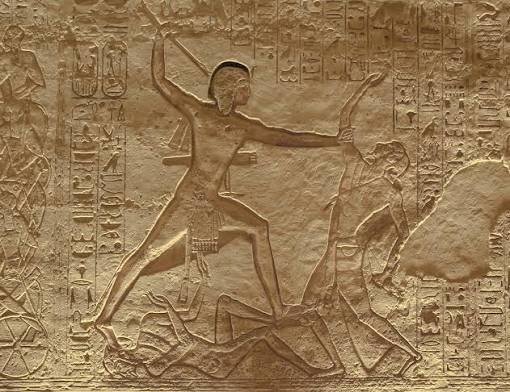
Few ancient battles are as vividly described as the Battle of Kadesh, yet few are so difficult to judge. Ramesses II had the encounter carved across the walls of major Egyptian temples, where a colossal pharaoh charges through terrified enemies while the god Amun restores his courage. Scribal copies preserved a long literary account of the same ordeal. The result looks like an eyewitness archive—but it was also a royal publicity campaign.
Around 1274 BCE, in the fifth year of Ramesses II’s reign, an Egyptian army met the forces of the Hittite king Muwatalli II near Kadesh in western Syria. The pharaoh survived an ambush and prevented disaster, but he did not take the city. Hittite power in the region endured. More than a decade later, Ramesses and a different Hittite king concluded the celebrated Egyptian–Hittite peace treaty.
That sequence has often been compressed into a neat story: Ramesses won history’s greatest chariot battle and immediately signed the world’s first peace treaty. Almost every part of that sentence needs qualification. Kadesh matters not because it offers a simple victory, but because its competing evidence reveals how Bronze Age rulers fought, remembered, and eventually negotiated.
Egypt and Hatti Compete for Syria
Kadesh was one episode in a long contest for influence across Syria and the Levant. During Egypt’s New Kingdom, pharaohs projected power northward through Canaan and into Syria. The Hittite kingdom, centered in Anatolia, expanded south into the same politically fragmented region. Local rulers navigated between the great powers, changing allegiance when circumstances made it advantageous or unavoidable.
This was not merely a feud over prestige. Northern Syria linked inland routes, Mediterranean ports, timber, metals, horses, and wealthy cities. Control depended less on drawing a permanent border than on securing loyal vassals, collecting tribute, and moving armies through a landscape of fortified settlements. The diplomatic world behind that struggle appears in the Amarna Letters, an earlier archive in which kings exchanged gifts, complaints, marriage proposals, and demands for loyalty.
Ramesses inherited the rivalry from his father, Seti I, whose campaigns temporarily restored Egyptian influence in parts of Syria. Kadesh and the neighboring kingdom of Amurru remained especially contentious. By Ramesses’ reign they stood within the Hittite sphere, and recovering them promised to demonstrate that the young pharaoh could match or surpass his predecessors.
Why Kadesh Mattered
The city occupied a strategic position near the Orontes River, close to routes connecting inland Syria with the Mediterranean coast. Its defenses and location made it both a military strongpoint and a symbol of regional allegiance. An Egyptian occupation could have weakened the Hittite network in southern Syria; a failed attempt would show the limits of Egyptian reach.
Kadesh is sometimes advertised as the largest chariot battle in history. It was certainly a major chariot engagement, and ancient accounts imply forces drawn from a wide coalition. Exact totals, however, are not census returns. Figures such as 2,500 Hittite chariots are reconstructions or claims transmitted through partisan material. “One of the ancient world’s largest chariot battles” is defensible; a precise record ranking is not.
Two Armies Built Around Different Strengths
Ramesses advanced with four divisions named for the gods Amun, Re, Ptah, and Set. Each combined infantry and chariotry, while additional troops and allies operated alongside the main formation. The divisions marched separately along the approach to Kadesh. That arrangement eased movement and supply on narrow roads, but it also created dangerous gaps that Muwatalli could exploit.
Egyptian chariots were generally light, fast platforms carrying a driver and an archer. Their value lay in mobility, missile fire, reconnaissance, and pursuit rather than in crashing through dense infantry like much later heavy cavalry. Hittite chariots are conventionally described as heavier vehicles, often with three men, though scholars caution against treating every vehicle on either side as identical.
False Intelligence Draws Ramesses Forward
According to the Egyptian narrative, two Shasu men approached the advancing army and claimed that Muwatalli was far away, near Aleppo. They were presented as deserters offering useful intelligence. Ramesses accepted their report and moved ahead with the Amun division, establishing camp northwest of Kadesh before the rest of his army had closed up.
Egyptian scouts then captured two Hittite agents and beat information from them. These prisoners revealed that Muwatalli was not distant at all. He had concealed a large force behind Kadesh, on the opposite side of the river. The pharaoh had been deceived, and his divisions were badly dispersed.
The episode may preserve the essentials of a successful Hittite deception plan, but its literary function is also clear. It transfers blame away from the king. Ramesses is misled by enemy trickery and failed by his own intelligence system; he is not portrayed as a commander who advanced recklessly. Even apparently candid admissions in royal inscriptions can serve propaganda.
The Hittite Ambush Shatters the Re Division
Muwatalli acted before the Egyptians could concentrate. Hittite chariots crossed the Orontes and struck the Re division while it was still marching toward the royal camp. Surprised and unprepared, the column broke. Fugitives rushed north into the Amun camp, spreading confusion among men who had only just learned that the enemy was nearby.
The attack was a serious operational success. It separated the Egyptian army and threatened its command center. Temple reliefs show Hittite chariots surging into the camp among tents, baggage, animals, and overturned equipment. Although the scenes were designed for drama, their broad outline fits the prose account: Ramesses’ forward force faced the possibility of destruction before Ptah and Set could arrive.
The Egyptian texts say that Hittite troops began plundering the camp and lost cohesion. That is plausible, but it is also convenient. Looting explains how an apparently overwhelming attack stalled and provides a moral contrast between enemies chasing spoils and a king fighting for honor. No independent Hittite battle narrative survives to confirm the detail.
Ramesses Turns a Crisis into a Heroic Story
At the center of the official account stands a nearly abandoned pharaoh. Ramesses calls to Amun, asking why the god has deserted a faithful son. Amun answers by strengthening his hand. The king then charges into the Hittite host, claiming that he fought alone while his soldiers and officers failed him.
This was not neutral reporting. Egyptian royal art regularly enlarged the king, compressed events, and represented victory as the restoration of divine order. At Kadesh, those conventions were applied to a genuine emergency. Ramesses may have led or participated in a determined counterattack, but the image of one man defeating thousands belongs to royal ideology, not literal battlefield mechanics.
The narrative is revealing precisely because it blends experience and convention. It admits that Egyptian formations collapsed, that the enemy reached the camp, and that senior troops were absent. A completely invented triumph would not need those humiliating circumstances. Propaganda works best when it reorganizes real danger into a persuasive story of rescue.
The Ne’arin and the Egyptian Recovery
The arrival of troops called the Ne’arin helped reverse the situation. Their exact identity remains debated. They may have been an Egyptian-associated force approaching from the coast, soldiers recruited in Amurru, or a specially organized auxiliary contingent. The texts make their timing decisive but do not resolve the question for modern readers.
With reinforcements entering the struggle and the Ptah division approaching from the south, the Hittite chariot force faced a less favorable fight. Egyptian counterattacks drove enemy vehicles toward the river. Reliefs show men and horses tumbling into the water, including a half-drowned Hittite prince being hauled out by companions. Such details create visual spectacle; they should not be read as a frame-by-frame record.
Ramesses had escaped encirclement and restored enough order to prevent annihilation. That was a real achievement after a catastrophic intelligence failure. Survival, however, is not the same as accomplishing the campaign’s original objective.
Why Muwatalli’s Infantry Stayed in Reserve
The Egyptian record says Muwatalli watched from the far side of the Orontes with a large infantry reserve. If so, one of the battle’s central puzzles is why those troops were not committed to finish the attack.
Claims that one obvious decision would have guaranteed victory impose modern hindsight on an uncertain battlefield. Commanders worked with dust, noise, delayed messages, river obstacles, and incomplete knowledge. Muwatalli’s restraint may have been a missed opportunity, a rational precaution, or both.
Who Won the Battle of Kadesh?
Egyptian monuments answer without hesitation: Ramesses won. The pharaoh scattered the Hittites, rescued his army through personal courage, and received an appeal for peace. If “victory” means avoiding defeat after an ambush, he had reason to celebrate. His army remained intact enough to withdraw, and his kingship emerged stronger rather than discredited.
By strategic measures, the claim is far weaker. Ramesses did not capture Kadesh, and Hittite influence in Syria survived. Amurru returned to Hittite control. The Egyptian army went home without the durable territorial transformation that the campaign had sought. The Hittites therefore had the better strategic outcome, even if they failed to destroy the Egyptian force.
Most cautious modern descriptions call the battle indecisive, a stalemate, or an Egyptian tactical recovery followed by strategic failure. Those labels emphasize different levels of war. There was no simple scoreboard. Muwatalli held the contested system; Ramesses converted a near-disaster into political capital.
A Battle Repeated Across Egyptian Temples
Ramesses’ greatest victory may have been representational. Accounts and reliefs of Kadesh appeared at Abydos, Karnak, Luxor, the Ramesseum, and Abu Simbel. Their repetition gave the campaign an exceptional public life. Visitors saw the king towering above enemies, drawing his bow from a speeding chariot, and receiving divine favor.
The surviving material is not one text. Scholars distinguish a relatively concise narrative often called the Bulletin, a longer literary composition known as the Poem or Poem of Pentaur, captions attached to reliefs, and pictorial programs. Papyrus copies show that the story circulated beyond monumental walls. Differences among versions help historians study how the episode was composed and transmitted.
Temple placement gave the story a religious meaning. The king defended Egypt and cosmic order against foreign chaos with the support of Amun. The reliefs were not newspaper illustrations intended to let citizens evaluate policy. They affirmed the reciprocal bond between god and ruler.
How Historians Read Royal Propaganda
Calling the Kadesh record propaganda does not mean discarding it. The inscriptions preserve names of divisions, movements, places, dialogue, and moments of crisis that can be compared across copies and with the wider political record. Their bias is not a contaminant that can simply be removed; it is part of the evidence.
Historians ask what the story needed to explain. Why mention the army’s panic? Because the king’s recovery becomes more miraculous. Why emphasize false deserters? Because deception excuses the initial surprise. Why condemn officers? Because their failure isolates Ramesses as the indispensable hero. Why show Muwatalli distant from the action? Because the Egyptian king appears courageous while his rival appears passive.
Material omissions matter too. The monuments do not celebrate the occupation of Kadesh, because no such occupation followed. Later political geography does not match the imagery of total Egyptian domination. Reading the sources against their silences produces a more convincing reconstruction than accepting or rejecting them wholesale.
The Battle Did Not Immediately Produce Peace
A common summary jumps directly from the battlefield to a treaty, sometimes suggesting that exhausted opponents signed peace at Kadesh. They did not. Fighting and competition continued after the battle. Ramesses campaigned again in the Levant, while Hittite authority in Syria remained substantial.
The eventual agreement belonged to a different moment. Muwatalli II had died, and his brother Hattusili III had taken the Hittite throne after deposing Muwatalli’s son Urhi-Teshub. Hattusili needed international recognition. Both powers also faced a changing strategic environment, including the growth of Assyria. Peace answered later diplomatic needs rather than merely stopping combat from one famous day.
The treaty was concluded around 1259 or 1258 BCE, in Ramesses’ twenty-first regnal year—roughly fifteen years after the battle, depending on the chronology used. It does not narrate Kadesh. Calling it the “Treaty of Kadesh” is convenient, especially in popular culture, but can falsely imply an immediate battlefield settlement.
What the Egyptian–Hittite Treaty Said
The agreement was made between Ramesses II and Hattusili III. It established peace and “brotherhood,” renounced aggression, and promised mutual assistance against external enemies and internal rebellion. It included provisions for returning fugitives and assurances that returnees would not be harshly punished. It also supported the legitimacy and succession interests of the Hittite king.
The wording belongs to a diplomatic tradition in which great kings addressed one another as brothers. Peace was not presented as one side’s surrender. Each ruler could frame the relationship in a way useful at home. Egyptian inscriptions prefaced the treaty with their own account of Hittite initiative; the substantive clauses created reciprocal obligations.
The original documents were reportedly written on silver tablets, which have not survived. Versions are known from Akkadian cuneiform tablets excavated at Hattusa and from Egyptian hieroglyphic inscriptions at Karnak and the Ramesseum. Because the agreement survives through both diplomatic traditions, scholars can compare how it was rendered for different courts.
Was It Really the World’s First Peace Treaty?
The treaty is routinely called the world’s first peace treaty, including in institutional displays. A copper replica is exhibited at United Nations headquarters as an emblem of ancient diplomacy. The phrase is memorable, but “first” depends on definition and survival.
Earlier agreements between ancient states are known, including treaties from third-millennium BCE Mesopotamia and Syria. Some survive only fragmentarily or from one side. The Egyptian–Hittite agreement is better described as one of the earliest surviving international peace treaties and the earliest famous example preserved in versions from both parties. That formulation recognizes its exceptional documentation without erasing older diplomacy.
Nor was the treaty a modern charter of universal peace. It was a bilateral pact between monarchs, combining non-aggression, alliance, extradition, and dynastic interest. Its value lies in showing sophisticated interstate practice long before modern international law, not in pretending that Bronze Age kings shared twenty-first-century institutions.
Peace Became a Dynastic Relationship
The agreement endured and was reinforced by correspondence, gifts, and marriage. Ramesses later married a Hittite princess, whom the Egyptians called Maathorneferure. Royal marriage did not create peace by itself; it publicized and strengthened an already established relationship between courts.
This outcome is easily made sentimental. In reality, the peace worked because political incentives aligned. Hattusili gained recognition and security, Ramesses stabilized Egypt’s northern relations, and both courts could direct attention elsewhere. Durable diplomacy often rests less on friendship than on a shared assessment of risk.
What Kadesh Reveals About Bronze Age Warfare
The battle demonstrates both the reach and fragility of late Bronze Age states. Kings could assemble coalitions, move thousands of people and animals across great distances, and coordinate chariot units. Yet one piece of false intelligence and the spacing of marching divisions nearly destroyed an imperial army.
It also warns against technological determinism. Chariots mattered, but the outcome depended on reconnaissance, timing, terrain, reserves, discipline, and reinforcement. Neither a lighter Egyptian design nor a heavier Hittite design automatically decided the day. The machines worked within human organizations.
Finally, Kadesh exposes the relationship between war and information. Intelligence shaped the ambush; messages shaped the response; monuments shaped the memory. Ramesses could not secure Kadesh, but he controlled the most extensive surviving account of the battle. That asymmetry has influenced the story for more than three thousand years.
Conclusion: A Victory in Memory, Not Conquest
The Battle of Kadesh was not the uncomplicated triumph carved on Ramesses II’s temples. The Egyptian army was surprised, the Re division broke, and the royal camp came under attack. Ramesses and his forces recovered impressively, aided by reinforcements, but they failed to take Kadesh. The Hittites retained the stronger strategic position in Syria.
Nor did the battle immediately create peace. The famous treaty came about fifteen years later under Hattusili III, in response to a transformed political landscape. It was a remarkable, well-preserved pact, but describing it as the first treaty in human history oversimplifies a much older tradition of interstate agreements.
Kadesh remains compelling because the evidence does not yield a single heroic answer. It offers a battlefield crisis, a masterclass in royal propaganda, and a later diplomatic settlement that both sides could accept. Ramesses did not conquer the city, yet he conquered the memory of the campaign. Modern history begins by separating those two achievements.