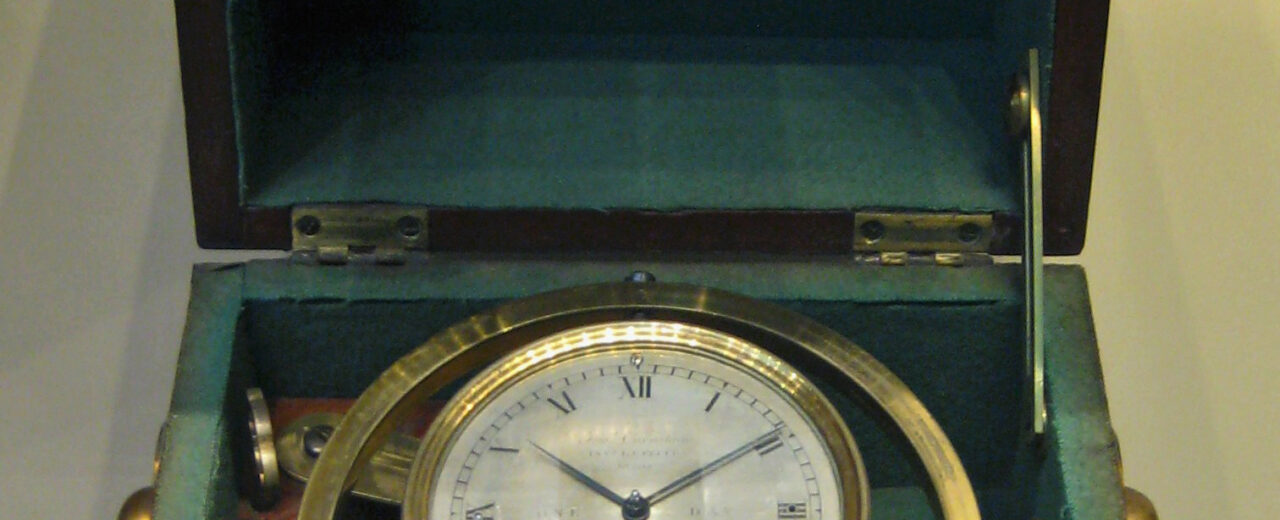
marine chronometer is a revealing historical subject because it opens a clear path into the people, events, and wider changes that shaped its era.
For centuries, the sea was both a highway and a trap. Sailors could read winds, currents, stars, and shorelines with impressive skill, yet one question remained stubbornly dangerous: where, exactly, were they east or west of where they thought they were? The answer depended on longitude, and longitude remained infamously difficult to measure at sea. That uncertainty wrecked ships, delayed trade, threatened lives, and made empires far more fragile than they liked to admit.
The documented story of how that problem was solved is also a story about invention, persistence, and unlikely genius. At its center stood John Harrison, a self-taught carpenter and clockmaker from rural England who had no university training, no powerful patron at the start, and no reason to expect that the world would listen to him. Yet by building increasingly precise timekeepers that could survive the violent motion of a ship, he helped change navigation forever. His work did not merely improve seamanship; it transformed global travel, military power, commerce, and the pace at which information and goods could move across the oceans.
The Longitude Problem That Haunted the Age of Sail
Latitude was relatively manageable. Sailors could estimate it by the height of the sun, the North Star, and other familiar celestial cues. Longitude was another matter entirely. To know east-west position, navigators needed a way to compare local time at sea with the time at a fixed reference point, usually home port or a known meridian. The catch was obvious and devastating: there was no easy way to keep accurate time on a rolling, damp, storm-battered ship for weeks or months at a stretch.
This was not a merely technical inconvenience. A ship that misjudged longitude by even a modest amount could run aground, miss a harbor, or collide with reefs and shoals hidden in unfamiliar waters. In an era when maritime trade linked continents and navies projected power across oceans, the stakes were enormous. The problem became a national obsession in Britain, where Parliament offered a prize in the early eighteenth century to anyone who could solve the practical challenge of determining longitude at sea. The famous longitude prize was not just a reward; it was a declaration that navigation had become a matter of state importance.
Many solutions were proposed. Some relied on lunar distances, using the moon’s motion against background stars as a kind of celestial clock. Others imagined astronomical tables precise enough to guide mariners across the globe. These methods were ingenious, but they were also demanding and vulnerable to weather, skill level, and the realities of life aboard ship. What the world needed was not simply a theory. It needed a reliable instrument that an ordinary navigator could trust on a rough voyage.
That is where John Harrison enters the story. In a period that prized learned authority, he was an outsider: a village craftsman who learned by making. His background as a carpenter mattered more than it might first appear. A carpenter understands movement, grain, stress, friction, and the behavior of materials under changing conditions. Harrison brought that practical intelligence to horology. He saw the sea not as an abstract problem in astronomy, but as a violent physical environment that could defeat conventional timekeeping. That insight would prove decisive.
John Harrison’s Unlikely Path from Carpenter to Horologist
Harrison was born in 1693 and grew up in modest circumstances, far from the centers of elite scientific culture. He did not attend university or train in the formal mathematical traditions that dominated many learned debates about longitude. Instead, he taught himself by observing, building, and improving mechanical devices. As a carpenter and clockmaker, he developed a deep familiarity with wood, metal, and movement. He had the patient eye of a craft worker and the imagination of an inventor.
His early clocks were impressive in their own right, but what made them revolutionary was the way he rethought the entire problem of timekeeping. Ordinary clocks and watches of the period depended on mechanisms that were sensitive to temperature changes, wear, and vibration. On land, a skilled maker could sometimes compensate for these weaknesses. At sea, the pounding motion of a ship, the salt-laden air, and the shifting temperatures turned small flaws into catastrophic errors. Harrison understood that if time itself was to be carried across the ocean, the clock had to be built almost like a machine designed to survive a siege.
His earliest successful marine designs were the H1 and H2, enormous and ingenious clocks filled with unusual mechanisms intended to reduce the impact of motion and friction. These were not elegant pocket watches scaled up for the sea. They were experimental devices, each one a lesson in physical engineering. Harrison kept refining the idea, eventually producing H3, another ambitious prototype that absorbed years of labor. Yet the most celebrated of his creations was H4, completed in the 1750s. It looked more like a large watch than a ship’s clock, and that was part of its brilliance. Smaller movements could be more stable, and H4 demonstrated a level of precision previously thought impossible in a portable instrument.
What makes Harrison’s career so compelling is that he solved a problem many assumed required academic brilliance alone. He did it through apprenticeship, observation, and stubborn craftsmanship. His work reminds us that the history of science and technology is not only written by professors and theorists. It is also shaped by makers who understand materials at the bench, the worktable, and the shipyard. In that sense, Harrison belongs in the company of other practical innovators who changed the world by making things work better, whether in medicine as in the John Snow Broad Street pump story or in the quieter revolution of mechanical systems that later inspired modern computing, as seen in The Jacquard Loom.
Why Ordinary Clocks Failed at Sea
The central difficulty Harrison tackled was not merely accuracy, but durability under hostile conditions. A timekeeper that works in a calm workshop may fail badly on a pitching vessel. Gravity changes as the ship rolls and pitches. Temperature varies from sunlit deck to cold night air and from one climate to another. Moisture corrodes metal. Shocks and vibration disturb delicate escapements. Even the lubricants used in clock mechanisms can behave differently depending on heat and cold. A clock that loses or gains only a few seconds each day may be acceptable on shore; at sea, that tiny drift compounds into a disastrous navigational error.
This is why Harrison’s invention mattered so much. Longitude by time required a clock that could preserve a known reference time over long voyages. If a ship’s local noon could be compared with noon at a home meridian, the difference could be translated into degrees of longitude. Since the Earth rotates 360 degrees in 24 hours, every hour of time difference represented 15 degrees of longitude. That elegant relation only worked if the clock was trustworthy. A few minutes of error could mean being dozens of miles off course.
In the eighteenth century, many respected thinkers believed that a clock-based solution would be nearly impossible. Some favored astronomy instead, arguing that celestial observations were more natural and universal. But lunar-distance methods required clear skies, advanced calculation, and considerable expertise. Harrison’s approach had a different logic: simplify the task for the navigator by embedding precision into the instrument itself. If the clock could do the hard work, the sailor could use it more readily.
The importance of this breakthrough extended well beyond navigation manuals. Merchants could plan safer routes. Naval commanders could maneuver more confidently. Cartographers could improve maps. Ports could receive ships with fewer delays and fewer losses. The sea became more legible. In that sense, Harrison’s work belongs to the long history of technologies that made the world measurable, comparable, and therefore governable. It helped turn oceans from mysteries of chance into spaces that could be organized by data, observation, and timing.
The Prize, the Politics, and the Struggle for Recognition
Although Harrison’s prototypes were extraordinary, his path to recognition was anything but smooth. The longitude prize was administered in a world where authority mattered, and where many judges and advisers were more comfortable with astronomical theory than with the claims of a provincial mechanic. Harrison found himself in a difficult position: he was asked to prove that his timekeepers could work under real conditions, and then to prove it again, and again. Trust in an invention of this magnitude did not come quickly.
Part of the tension came from the fact that the problem of longitude was national and commercial, not merely technical. A successful solution would shape trade routes, naval power, and imperial reach. Britain, like other seafaring powers, understood that safer navigation meant stronger control over distant territories and shipping lanes. Precision timekeeping was not an abstract triumph of horology alone. It was a tool of empire, enabling ships to cross oceans with greater confidence and fewer losses.
Harrison’s H4 eventually performed impressively on voyage tests, demonstrating that a portable timekeeper could indeed preserve the time needed for longitude calculations. Yet even success did not end the controversy. The slow pace of official recognition, the demands for further proof, and the reluctance to hand over the full prize all revealed how disruptive the invention was to established assumptions. Harrison’s struggle became a reminder that technical breakthroughs often face resistance not because they are weak, but because they overturn entrenched expectations.
It is tempting to tell this story as a simple triumph of genius over ignorance, but the reality was more layered. Harrison benefited from the broader culture of improvement in eighteenth-century Britain, where experimentation, instrument-making, and practical science were increasingly valued. At the same time, he had to fight for the legitimacy of craft knowledge. His career shows how innovation can be delayed by institutions that are unsure how to evaluate work that does not fit neatly into their categories. The eventual success of the marine chronometer was therefore not only a scientific victory, but also a social one: a partial reordering of who got to be seen as a trustworthy maker of knowledge.
How Accurate Time Redrew the Map of the World
Once precise marine timekeepers became practical, navigation changed dramatically. Ships could determine longitude with far greater confidence, making ocean travel safer, faster, and more efficient. This improvement affected nearly every aspect of maritime life. Routes could be chosen with better information. Hazards could be avoided more reliably. Travel times became more predictable, which mattered enormously for trade, naval operations, and long-distance communication.
The marine chronometer did not instantly eliminate all navigational risk. Sailors still needed skill, charts, and judgment. Weather still mattered. Currents still deceived. But the chronometer gave navigators a stable reference point in a world that had long been ruled by uncertainty. It transformed time into a navigational instrument, and in doing so it changed the relationship between humans and the ocean.
The broader consequences were immense. As timekeeping improved on land and at sea, standards began to matter more. Port schedules, mapping practices, rail travel, and eventually global time coordination all built on the idea that accurate time could organize space. The same impulse to standardize and measure can be seen in many other historical developments, from disease mapping to industrial automation to the careful reconstruction of the past, such as the discoveries surrounding Sutton Hoo. Different fields, same underlying revolution: once information becomes precise, systems become more powerful.
Harrison’s achievement also reminds us that technological revolutions often begin with one stubborn question: how can we make an unreliable world more exact? In his case, the answer involved gears, springs, escapements, and decades of patient refinement. But the result reached far beyond the workshop. It helped tie together distant coasts, sustain empires, protect lives, and shrink the practical size of the globe. The sea remained vast, beautiful, and dangerous, but it no longer held quite the same absolute power over human movement.
In the end, the story of the longitude problem is not just about a clock. It is about the moment when human ingenuity found a way to master time well enough to cross the world. John Harrison, the self-taught carpenter who refused to accept that the sea must always defeat the watch, gave navigation a new foundation. His legacy lives wherever precise time quietly guides a journey, and wherever craftsmanship proves that transformative science can begin in the hands of someone willing to build, test, and build again.
Research and further reading
For readers who want to verify details or continue researching this subject, these external reference collections provide useful starting points: