Tunguska event is a revealing historical subject because it opens a clear path into the people, events, and wider changes that shaped its era.
On the morning of June 30, 1908, a brilliant explosion tore across the sky above remote Siberia and changed the landscape below in an instant. Trees were flattened across an immense stretch of forest near the Podkamennaya Tunguska River, windows rattled hundreds of miles away, and witnesses later described a fireball so intense it seemed to split the heavens. Yet when scientists finally reached the region, they found something almost more unsettling than the blast itself: no crater. No obvious impact site. No simple answer.
The Tunguska Event has endured for more than a century because it sits at the intersection of science and mystery. It was real, violent, and measurable, but it also arrived in a place so remote and so poorly documented that the first accounts were fragmentary, delayed, and colored by rumor. Over time, researchers pieced together the story from eyewitness reports, the direction trees had fallen, traces of atmospheric disturbance, and later computer models. What emerged was not a supernatural puzzle but a remarkable case study in how the Earth responds when a cosmic object arrives from space.
Even now, the Tunguska Event remains one of history’s most compelling unexplained events—not because we know nothing, but because every answer opens the door to larger questions about Earth’s vulnerability, scientific investigation, and the thin line between legend and evidence.
A blast over Siberia that history nearly missed
The Tunguska Event occurred over central Siberia on June 30, 1908, in a sparsely populated region where roads were few, communications were limited, and the nearest settlements were isolated by vast distances. That remoteness is one reason the event became a mystery in the first place. There were no cameras, no satellites, and no immediate scientific response. Instead, the first records came from local eyewitnesses who had seen an enormous flash and heard explosive sounds that rolled across the taiga like thunder with unnatural force.
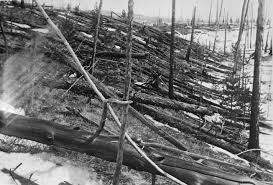
People living many miles away reported a bright object crossing the sky, followed by a shock wave that knocked individuals off their feet and broke windows in distant towns. The explosion was so powerful that it is now estimated to have released energy equivalent to a large modern nuclear weapon, though it happened high in the atmosphere rather than at the ground. The forest directly below the event was devastated. Trees were blasted outward from the center in a radial pattern, with many standing trunks stripped bare or snapped and laid down like matchsticks.
For decades, the Tunguska Event remained a local story, barely known outside the region. This delay matters because historical mysteries often begin with gaps in the record, not with the event itself. In that sense, Tunguska shares something with other famous historical enigmas such as the Roanoke Colony disappearance: the facts were there, but the evidence arrived incomplete, and uncertainty filled the space where certainty should have been.
When researchers later reconstructed the event, they concluded that a massive aerial explosion had occurred above the Siberian forest. The exact nature of the object that triggered it, however, would become the core of the Tunguska mystery and the subject of debate for generations.
The destruction on the ground and the strange shape of the damage
What makes Tunguska so extraordinary is not simply that something exploded, but the scale and pattern of the destruction it caused. Roughly two thousand square kilometers of forest were affected, with the most severe damage concentrated near the center of the blast. Trees were not merely toppled in random directions; they were knocked down in a pattern that suggested a tremendous shock wave descending from above. Near the epicenter, many trees were left standing but stripped of branches, giving the landscape a scorched, skeletal appearance. Farther out, the forest lay in concentric zones of destruction, as if a giant invisible hammer had struck the air and sent force radiating outward.
Eyewitnesses described the sky splitting open, a blazing body moving across the horizon, and a noise like artillery or a prolonged thunderclap. Some later accounts may have been exaggerated by memory, but the consistency of the reports from different locations is striking. The blast was felt in multiple settlements, and seismic instruments far away recorded disturbances. Those independent traces helped historians and scientists realize that this was not a local accident, a lightning strike, or a conventional forest fire.
Modern reconstructions suggest the object likely exploded several miles above the ground, which explains the enormous airburst effect. A body entering Earth’s atmosphere at great speed would have compressed and heated the air ahead of it, building immense pressure until the object fractured and detonated in the sky. That kind of explosion can flatten forests without creating the classic crater associated with a ground impact.
The physical evidence also became crucial for separating myth from reality. Tree-fall patterns, blast radius, and later atmospheric models all pointed to a cosmic event rather than a terrestrial one. In historical mysteries, the landscape itself can serve as a witness, and at Tunguska the forest recorded the violence in a way no camera could.
Why no crater was found, and why that mattered so much
The absence of a crater is the feature that has kept Tunguska alive in the public imagination. For years, people expected that any event of such force must have left a hole in the ground. When expeditions found none, speculation flourished. Some proposed a comet made mostly of ice that exploded before impact. Others imagined exotic matter, antimatter, or even speculative technologies. The truth, as scientific evidence increasingly showed, was less theatrical but far more instructive: the object likely disintegrated in the atmosphere before reaching the surface.
This matters because not all cosmic impacts behave the same way. A dense asteroid can survive deeper into the atmosphere, but a smaller or more fragile object may break apart under the intense stresses of entry. If enough energy is released while the object is still airborne, the result is an airburst rather than a crater-forming strike. Tunguska became the classic example of this phenomenon. The ground was not punched by a single mass; it was overwhelmed by a shock wave descending from above.
The missing crater also delayed serious investigation. In the absence of an obvious impact site, some early observers treated the story as exaggerated rumor, while others searched for signs of a strange meteorite field or hidden explosion. It was not until scientific expeditions reached the region years later that the evidence began to align with an atmospheric detonation. The famous Russian scientist Leonid Kulik played a major role in this effort, leading searches and documenting the flattened forest in painstaking detail.
Even today, the lack of a crater remains one of the most important lessons from Tunguska. It showed that a dangerous space object does not need to strike the Earth’s surface to produce catastrophic effects. That realization has made the event central to modern planetary defense discussions. Scientists now study potential asteroid airbursts precisely because Tunguska proved how much damage a relatively modest object can do before it ever touches the ground.
How scientists reconstructed a mystery from fragments
One of the most remarkable things about the Tunguska Event is the way researchers reconstructed it from scattered, imperfect evidence. The initial clues were eyewitness accounts, many of them collected long after the event itself. These testimonies were valuable, but they were also vulnerable to memory distortion and local folklore. Historians had to compare multiple reports, identify recurring details, and separate core observations from embellishment. That work is often slow, but it is also how historical mysteries become understandable.
Another major source of evidence came from the pattern of the fallen trees. The direction in which trunks had been laid down suggested a blast wave from above rather than from a surface-level explosion. The center of the damaged zone contained standing, damaged trees and relatively little debris, which is exactly the kind of pattern scientists expect from an airburst. Later analyses of atmospheric conditions and energy estimates helped refine the likely altitude and force of the explosion.
As the twentieth century progressed, scientific tools improved. Researchers could model how asteroids or comets behave when entering the atmosphere, and they could compare those models with the Tunguska evidence. These studies supported the idea that a stony asteroid or similar body exploded in the sky, releasing energy over a broad area. The answer was not a hidden crater waiting to be found; it was a broken object that never survived its descent intact.
The evolution of the Tunguska mystery is part of what makes it historically fascinating. It moved from rumor to investigation, from local memory to global scientific case study. In that way, it resembles other events that began in confusion and only gradually became legible to historians and researchers. The Dancing Plague of 1518, for example, also shows how human testimony, fear, and incomplete records can create a mystery that later generations must decipher with caution and care.
What Tunguska means today: from legend to planetary defense
The legacy of the Tunguska Event extends far beyond Siberia. For a long time, it lived at the edge of history and folklore, a dramatic episode known mostly to specialists and local communities. But as science advanced, Tunguska became a warning. It demonstrated that Earth is not isolated from space hazards and that even a relatively small object can devastate a huge area if it enters the atmosphere under the right conditions. In modern terms, it is a planetary defense case study written in fire, shock waves, and fallen timber.
NASA and other scientific organizations have repeatedly returned to Tunguska when discussing asteroid risk. The event helps researchers think about size thresholds, airburst effects, warning systems, and the kinds of damage that can occur without a crater. It also reminds us that the planet has been struck before and will likely be struck again. The challenge is not simply to predict direct impacts, but to understand the broader spectrum of cosmic threats, including objects that explode overhead and still manage to cause serious destruction.
At the same time, Tunguska remains a subject of study because it still feels slightly unreal. A sky fire over remote Siberia, a forest knocked flat, a century of debate, and no crater to mark the scene: it has all the ingredients of a legend. Yet unlike pure myth, Tunguska can be traced through evidence, and that is what gives it enduring power. It is a mystery solved in broad outline but never fully drained of wonder.
In the end, the Tunguska Event stands as a reminder that history is not only shaped by kings, wars, and revolutions. It is also shaped by sudden natural catastrophes that arrive without warning and leave human beings trying to understand what happened after the sky itself seemed to break open. For that reason, Tunguska remains one of the most compelling episodes in the category of Historical Mysteries & Unexplained Events: an event once shrouded in uncertainty, now better understood, yet still hauntingly memorable.
Research and further reading
For readers who want to verify details or continue researching this subject, these external reference collections provide useful starting points: