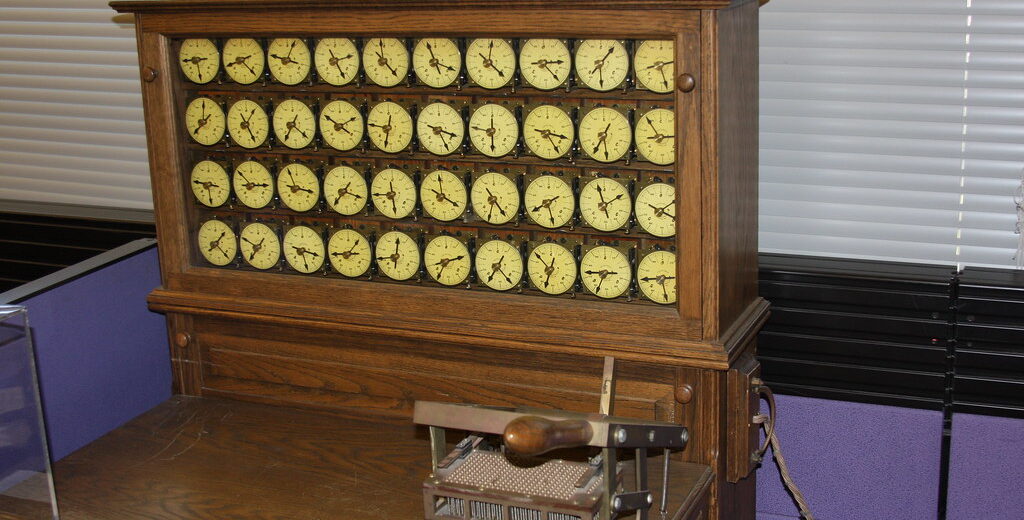
In the late nineteenth century, the United States was growing faster than its government could count. Railroads stitched the continent together, cities swelled, immigration surged, and the Constitution required a fresh census every decade. By 1880, the machinery of enumeration had become a national problem in itself. The 1890 U.S. census would be the first to confront a modern-scale flood of information, and the solution came from an unlikely place: a young engineer named Herman Hollerith, whose punch-card system turned census-taking into an early triumph of data processing. His invention did more than speed up a bureaucratic task. It helped define how machines could read, sort, and summarize information at industrial scale, laying foundations that eventually led to the company that became IBM.
Hollerith’s story belongs squarely in the history of science and technology because it captures a turning point when information itself became a technical challenge. In earlier eras, governments had relied on clerks, ledgers, and patience. By 1890, that method was buckling under the weight of a nation in motion. Hollerith responded with a strikingly modern idea: encode facts on punched cards, then let electromechanical devices count and sort them. The result was not only a faster census, but a new way of thinking about data as something machines could process. That shift still shapes the digital world today.
The census crisis that demanded a machine
The U.S. census was never a simple headcount. By the nineteenth century, it had become a sprawling statistical project meant to measure the country’s population, occupations, families, birthplaces, health, and more. Each decade brought more Americans and more questions. The 1880 census, completed with the best methods then available, took so long to tabulate that officials feared the next count would be obsolete before the results were fully assembled. Congress and the Census Bureau faced an escalating bottleneck: the nation was producing more information than human clerks could efficiently classify and total.
This was not merely an administrative inconvenience. Census data affected representation, taxation, public planning, and the government’s understanding of a rapidly changing society. The challenge resembled earlier moments when communication and measurement had outgrown older systems, whether in long-distance signaling or precise navigation. Just as the transatlantic telegraph cable compressed the time it took to move information across oceans, the census demanded a way to compress the time needed to interpret information at home. The problem was scale, and scale was becoming the defining feature of modern governance.
Officials experimented with clerical reforms, but the pace of manual tabulation remained painfully slow. Every person counted generated a paper record, and every record had to be sorted repeatedly by age, sex, race, occupation, birthplace, and other categories. Human beings can sort with judgment, but they are not fast calculators when millions of records are involved. The census required a technology that could count without fatigue and classify without confusion. That need created the opening for Herman Hollerith, whose background in engineering and statistics gave him a fresh perspective on a very old governmental task.
Hollerith understood that the problem was not just writing down facts; it was making those facts machine-readable. That insight seems obvious now, but in the 1880s it was revolutionary. He recognized that if a census could be translated into a physical code, then the counting itself could be automated. Instead of clerks repeatedly copying and tallying information, a machine could register a person’s attributes through a standard physical pattern. This was the moment when the census stopped being only a statistical exercise and became an engineering challenge.
Herman Hollerith and the idea of punched information
Herman Hollerith was born in 1860 and trained as an engineer, later working in statistical and engineering contexts that exposed him to the weaknesses of manual tabulation. He is often remembered for a single invention, but his breakthrough came from combining several ideas already familiar in different fields: standardized records, electrical contact, and mechanical sorting. He created a system in which each census questionnaire could be encoded onto a stiff card by means of punched holes. The card did not “store” information in a modern electronic sense, yet it represented data in a physical format that a machine could interpret.
The punch-card concept had a logic that was both simple and elegant. A hole in a particular position could stand for a specific characteristic, such as male or female, native-born or foreign-born, a certain age range, or a marital status. When the card was placed into a tabulating machine, spring-loaded pins passed through the holes and completed electrical circuits. The machine then registered counts on dials or counters. In this way, the physical absence of paper became a symbol, and the symbol became a number. Hollerith had transformed demographic facts into a language of machine-readable patterns.
What made the system so powerful was not just the card itself, but the broader workflow. Cards could be sorted by category and re-sorted again, allowing officials to examine the population from multiple angles without re-copying the underlying information every time. In that sense, Hollerith anticipated a basic principle of modern computing: once data are encoded in a standardized form, they can be processed repeatedly for different purposes. His machine was electromechanical, not electronic, but the conceptual leap was enormous.
Hollerith’s background also reflected a larger technological culture of the era, one in which precise measurement and mechanical reliability were prized. The nineteenth century had already seen important advances in tools for timing, navigation, and long-distance communication, including the marine chronometer, which made global navigation more exact, and the telegraph, which made information more immediate. Hollerith applied that same spirit of precision to population statistics. He did for census data what instruments had done for sailors and telegraphers: he made information manageable by building a device that could standardize it.
The 1890 census and the triumph of tabulation
When the 1890 census arrived, Hollerith’s system was ready for a national test. The Census Bureau adopted his punched-card method to process the flood of returns from across the country. The scale was enormous, but the results were dramatic. Tabulation proceeded far more quickly than it had in the past, proving that the machine could tame a data problem that had threatened to overwhelm the government. In a matter of months, rather than years, officials could begin to see the shape of the nation they had counted.
The success mattered because it demonstrated that mechanical tabulation was not a clever novelty but a practical administrative tool. The census could now be analyzed more efficiently across multiple categories, and the government could publish results with greater speed and confidence. That achievement changed expectations. Once people saw that a machine could sort and count millions of records, manual tabulation looked increasingly antiquated. The 1890 census became a landmark not simply because it was completed, but because it revealed a new standard for information processing.
There is a strong historical contrast here with earlier forms of statistical labor. In previous centuries, governments relied on human clerks to do what a machine could now accomplish at scale, much as early modern scholars and navigators depended on physical tools to preserve accuracy. The advantage of Hollerith’s system was not just speed, but consistency. Machines do not tire, hesitate, or lose concentration in the same way people do. That reliability made them ideal for repetitive tabulation. For a census, where the meaning of the data depended on exact counts, this was a profound improvement.
Still, the machine did not eliminate human work; it reorganized it. Workers had to punch the cards, feed them through sorters, and manage the flow of records. Yet the strategic burden shifted from interpreting every line by hand to designing a process that could be automated. That is one of the defining features of modern science and technology: the best inventions often do not remove labor entirely, but move labor into higher-value tasks. Hollerith’s invention encouraged officials to think of data processing as a system rather than a stack of papers. That system thinking became central to twentieth-century administration, business, and eventually computing.
From census machine to business empire
Hollerith did not stop with one census. The real commercial significance of his invention emerged when he adapted and marketed tabulating equipment beyond the 1890 count. The census had proven that the idea worked; now there was a market for organizations that needed to process large volumes of data. Railroads, insurance firms, and other enterprises were facing the same problem the government had faced: too much information for manual methods to handle efficiently. Hollerith’s machines offered a solution, and that solution became increasingly valuable as institutions grew more complex.
To meet demand, Hollerith built a business around his tabulating technology. Over time, that enterprise evolved through mergers and corporate changes until it became part of the company known as IBM. Britannica notes IBM’s roots in the punch-card and tabulating business that emerged from Hollerith’s work, making his invention one of the deepest ancestors of modern information technology. The point is not that Hollerith “invented IBM” in a direct one-step sense, but that he helped create the commercial model for selling machine-based data processing as a service and product.
This was a crucial transition in the history of technology. The census had been a public challenge, but the solution proved profitable in private hands. Once businesses understood that data could be encoded, sorted, and counted mechanically, they began to imagine entirely new administrative workflows. Accounting, inventory, payroll, and records management all became candidates for mechanization. Hollerith’s system therefore bridged government statistics and corporate information systems, helping usher in a world where machines were not just tools for manufacturing, but tools for managing information itself.
The lasting significance of this shift cannot be overstated. Punch-card technology became a major medium of data handling for decades, and the logic behind it persisted long after the cards themselves disappeared. The idea that information should be standardized for machine processing is a direct ancestor of digital databases, spreadsheets, and computer code. What Hollerith achieved in the 1890 census was therefore not an isolated success, but the opening chapter in a much larger story about the mechanization of knowledge.
Why Hollerith still matters in the age of data
Looking back, Herman Hollerith’s achievement can seem almost quaint: paper cards, metal pins, and counters. But the deeper significance lies in the way he reframed a problem. He recognized that raw information becomes useful only when it can be organized, compared, and counted efficiently. That principle now underlies everything from census databases to search engines. In that sense, Hollerith was not merely a nineteenth-century inventor; he was a pioneer of information architecture.
His work also reminds us that technological revolutions often begin in bureaucratic places. We tend to associate invention with laboratories, workshops, or grand industrial projects, but a census office can be just as important. When government faces a scale problem, it can push innovation forward. The 1890 census was one such pressure point. The need to count an expanding nation forced a breakthrough that altered the future of data processing. Hollerith’s machine succeeded because it answered a specific administrative crisis, yet the implications spread far beyond the census.
There is also a broader historical lesson in the story. The modern world depends on the ability to convert messy reality into standardized information. That is how states measure populations, how companies track customers, and how researchers analyze trends. The punch-card machine was an early and highly visible expression of that impulse. It was a bridge between handwritten records and computational systems. Even though the cards themselves are obsolete, the idea behind them remains central to the digital age.
Herman Hollerith tamed the 1890 U.S. census not by making people count better, but by teaching machines how to count at all. That achievement transformed a national bottleneck into a demonstration of technological possibility. It also launched a business lineage that would help define the twentieth century. If the census is one of the clearest ways a nation sees itself, Hollerith gave that vision a machine. And once the machine could read the record, the modern information age had already begun.
Research and further reading
For readers who want to verify details or continue researching this subject, these external reference collections provide useful starting points: