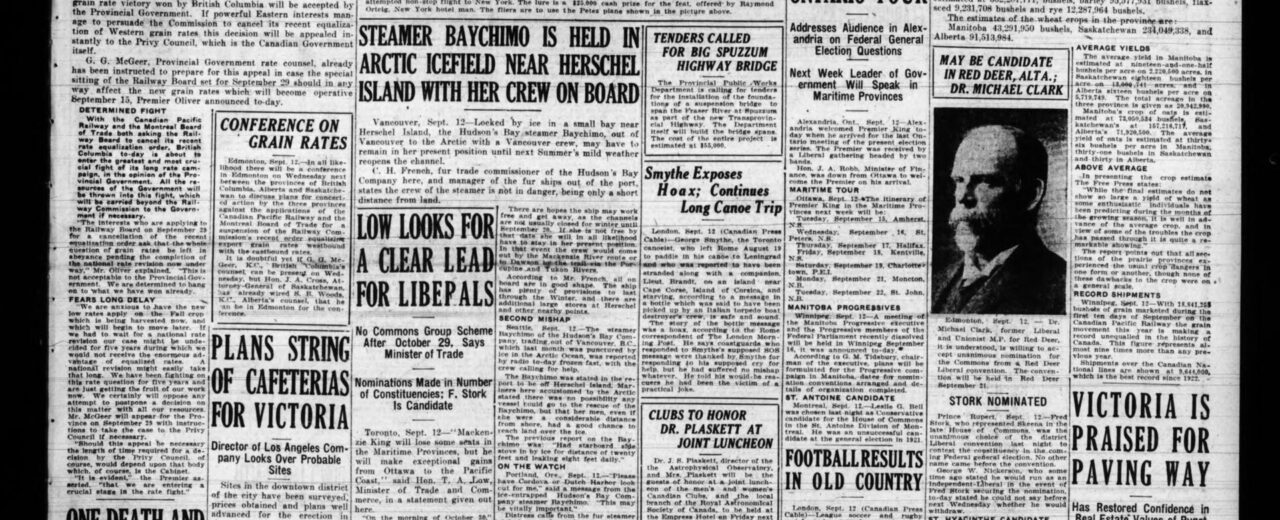
Few historical mysteries feel as quietly haunting as the story of the SS Baychimo. Unlike legends built from rumor alone, this was a real cargo steamer, a real Arctic vessel, and a real disappearance that unfolded in one of the harshest environments on earth. The Baychimo did not vanish in a single dramatic explosion or sink in a storm witnessed by a crowd. Instead, she slipped away into the ice, was abandoned, and then—according to scattered sightings over the following decades—kept turning up like a stubborn memory the world could not quite bury.
That is what makes the case so compelling for readers interested in Historical Mysteries & Unexplained Events. The Baychimo story sits in a strange space between maritime history and folklore. There is enough documentation to satisfy historians, enough uncertainty to frustrate them, and enough repeated reports to keep the legend alive. The ship became a ghost in the most literal and practical sense: a vessel left behind in pack ice, drifting through the Arctic long after her crew had walked away.
To understand why the Baychimo still fascinates people today, it helps to look beyond the romance of a “ghost ship” and into the world that produced her. The Hudson’s Bay Company’s Arctic network depended on ships like Baychimo to carry trade goods, collect furs, and maintain links between remote settlements and larger supply lines. The Arctic was not a backdrop in this story; it was the central force. Ice could trap a ship, crush a hull, or make rescue impossible. In that setting, the line between survival, abandonment, and disappearance was often razor thin.
The Baychimo’s place in the Hudson’s Bay Company’s Arctic world
The SS Baychimo was built for trade, not legend. Launched in Germany in the early twentieth century, she eventually entered the service of the Hudson’s Bay Company, which had long operated a commercial and logistical network across the Arctic. The company’s ships were part of a larger system that linked coastal posts, Indigenous communities, and trading settlements across an enormous and difficult region. These vessels brought supplies, collected furs, and helped sustain a colonial-era economic network that depended on seasonal access to sea routes that were never truly predictable.
The Arctic trade route was a practical necessity, but it was also a gamble every time a ship entered ice-choked waters. Navigation in those regions relied on experience, weather judgment, and a great deal of luck. Ice floes shifted constantly, winds could close open water in hours, and fog or early freeze-up could strand a ship far from help. Unlike a modern maritime accident with immediate response options, a ship trapped in the Arctic might be isolated for days or weeks. The crew had to think not only about the ship’s safety, but also about food, fuel, cold exposure, and whether there would be any chance of escape.
That is why the Baychimo’s fate is so revealing as a historical event. She was not some isolated oddity wandering empty seas for no reason. She was part of a working system that attempted to impose order on a vast and unforgiving frontier. The Hudson’s Bay Company’s Arctic network depended on timing and discipline, yet the environment repeatedly reminded everyone that the sea still set the terms. Ships like Baychimo were expected to be tough, but even a sturdy cargo vessel could become helpless when pack ice closed around it.
This context matters because it shifts the story away from fantasy and toward the realities of Arctic commerce. The “ghost ship” image only became possible because there was first a world of hard labor, risky navigation, and seasonal trade. Baychimo was born out of that world, and the mystery of her survival after abandonment reflects its instability.
The 1931 abandonment in pack ice
The central event in the Baychimo mystery occurred in 1931, when the ship became trapped in pack ice off the coast of Alaska. At the time, she was carrying cargo for the Hudson’s Bay Company, operating along the northern trading routes that were essential to Arctic commerce. The ice tightened around the vessel and made movement nearly impossible. Crew members worked to free her, but the situation kept worsening. The Baychimo was not simply delayed; she was immobilized by a force that could not be negotiated with or outpaced.
As temperatures fell and conditions remained dangerous, the crew eventually abandoned the ship. Some were evacuated by aircraft, and others took refuge on shore while waiting for a better chance to recover the vessel. A ship left behind in the Arctic was not necessarily lost forever, but it was always at the mercy of the weather. The Baychimo was expected to sink, break apart, or be crushed by the ice. Instead, the sea made a different decision. She remained afloat.
That detail is one of the reasons the Baychimo story has endured for so long. The most extraordinary part was not that the crew left her behind; it was that the ship apparently survived after being deserted. In a place where ice can split timber, wreck propellers, and crush steel, the Baychimo stayed intact enough to keep drifting. The ship was seen again after the abandonment, which confirmed that she had not vanished immediately. From there, the mystery deepened. If she was still out there, where would she end up? Would she eventually sink, or continue moving under the influence of currents and floes?
The abandonment itself was a practical decision, not a theatrical one. The crew acted out of necessity, not superstition. But later retellings often flatten that moment into a ghost story. The truth is more interesting. The Baychimo became a mystery because experienced mariners were forced to leave her in conditions where recovery was uncertain, and then the ship behaved in a way that defied expectation. This was not myth layered onto a routine event; it was a routine event that turned uncanny because the vessel refused to disappear on schedule.
Documented sightings and the long drift through Arctic memory
What transformed Baychimo from abandoned ship to enduring enigma was the series of reported sightings that followed. In the months and years after 1931, people in the Arctic claimed to have seen her drifting, stranded, or moving with the ice. Some reports came from ship crews; others came from local observers familiar with the coast. These sightings were not all identical, and that is part of what keeps historians cautious. A drifting vessel in the Arctic can be hard to identify from a distance, especially in poor light, harsh weather, or sea ice that distorts perspective.
Still, the repetition of reports matters. The Baychimo was not remembered because of a single ambiguous glimpse. She became famous because different people, at different times, continued to describe a vessel that seemed to fit her profile. In some accounts, the ship was found stuck in ice and unable to be reached. In others, she appeared to have broken free and drifted farther than anyone expected. The pattern suggested not a neat ending, but a prolonged unresolved afterlife at sea.
These sightings are the heart of the historical puzzle. A ship that is officially abandoned should eventually be accounted for in some way, even if only through wreckage or definitive loss. Yet the Baychimo story resists closure. Her fate became a matter of oral report, vessel logs, local memory, and later reconstructions from museum collections and historical archives. The pattern of evidence is substantial enough to show that the ship’s disappearance was not a simple one-time incident, but it is also fragmented enough to prevent a final conclusion. That tension is exactly why the story remains alive.
For many historians, the Baychimo is a reminder that the Arctic was a place where certainty was often impossible. For enthusiasts of mysteries, she occupies a space alongside other unresolved historical episodes such as the Dyatlov Pass incident or the Tunguska event: not identical in cause or scale, but similarly powerful because they leave us with evidence, interpretation, and no final answer. The ship’s sightings are not proof of the supernatural. They are proof that history can survive as a chain of partial observations, each one extending the story without closing it.
Why the Baychimo became an Arctic ghost ship
The phrase “ghost ship” often brings to mind a vessel crewless and drifting under some mysterious curse, but the Baychimo’s reputation emerged from a far more grounded process. After her abandonment, people continued to see a ship where no ship should have been. That alone was enough to capture the public imagination. Over time, the Baychimo became less a working steamer and more a symbol of Arctic indifference, a vessel that seemed to refuse disappearance in the way ships are expected to disappear when lost at sea.
Part of the fascination comes from the contrast between human purpose and natural force. The Baychimo was built for commerce, and commerce assumes routes, schedules, and destinations. Yet in the Arctic, those assumptions are fragile. Pack ice can trap a ship for a season or longer, and once a vessel is abandoned, its future becomes a matter of currents, pressure, and chance. If it is later seen again, it acquires a strange second life in the public mind. What was once an economic tool becomes an object of speculation.
There is also the role of memory. Maritime mysteries last because they can be retold across generations without losing their emotional power. The Baychimo has been preserved not only in news reports and historical summaries but also in museum collections, archival references, and the stories people tell when discussing unexplained survivals. The University of Alaska Fairbanks museum materials, for example, help anchor the story in documented history, while later news coverage has kept it in wider circulation. These sources do not solve the mystery, but they ensure it remains tied to evidence rather than drifting entirely into folklore.
This is why the Baychimo occupies such a distinctive place in Arctic history. She is not just a “spooky ship.” She is a case study in how extreme environments produce stories that resist neat closure. The ship’s persistence in memory reflects the persistence of uncertainty in the far north. A vessel abandoned in pack ice can become legendary precisely because the sea does not always finish the job in the way people expect.
What we know, what we don’t, and why the mystery still matters
Even now, the Baychimo remains unresolved. Historians can reconstruct the broad outline with confidence: the ship served in the Arctic trade, became trapped in ice in 1931, was abandoned by her crew, and was reportedly seen again afterward. What cannot be pinned down with certainty is the ship’s ultimate end. Did she sink silently beneath the ice? Was she crushed and scattered by pressure ridges? Did she drift until she finally vanished beyond observation? The available evidence does not give a definitive answer.
That absence of closure is precisely what gives the story its lasting power. In many historical mysteries, the best evidence points in several directions at once. Logs confirm part of the chain of events, oral reports preserve other parts, and museum collections keep the artifacts and records connected to the case. Together, they create a credible narrative without producing a final resolution. The Baychimo survives in that in-between space, where history ends and mystery begins.
It is worth resisting the temptation to turn her into a supernatural tale. The real significance of the Baychimo is not that she was haunted in any literal sense, but that she became a ghost ship through the ordinary pressures of geography, weather, and human limitation. The Arctic did what it has always done: it tested ships to the breaking point. The Baychimo’s story reminds us that some mysteries are not solved because the evidence is insufficient, but because nature itself leaves too few traces behind.
For that reason, the Baychimo remains one of the most evocative unresolved episodes in maritime history. She stands beside other enduring enigmas such as the Green Children of Woolpit or the Mad Gasser of Mattoon in the way she invites questions that can never be fully settled. But unlike a purely folkloric mystery, the Baychimo is anchored in the hard reality of Arctic trade and the consequences of ice. That is what makes her so compelling. She is not just a story about a lost ship. She is a story about the limits of control, the endurance of evidence, and the way history can leave behind a silence that still feels alive.
More than ninety years later, the Baychimo continues to drift through the imagination because she never quite reached the end of her story. Whether resting on the seafloor or broken apart long ago, she remains a reminder that the Arctic can preserve uncertainty as effectively as it preserves ice. In that sense, the “ghost ship” label is less a superstition than a verdict on how little we can know once a vessel disappears into the northern cold.
Research and further reading
For readers who want to verify details or continue researching this subject, these external reference collections provide useful starting points: