galvanism is a revealing historical subject because it opens a clear path into the people, events, and wider changes that shaped its era.
Few ideas in the history of science have arrived with such drama as the notion that a jolt of electricity might bring the dead-looking back to life. In the late eighteenth century, a strange chain of events linked a dissecting room, a thunderstorm, a theater stage, and a set of twitching frog legs into one of the most memorable episodes in medical history. What began as an accident of metal hooks and damp nerves became a debate about the nature of life itself. It also helped launch a fad that promised relief, stimulation, and even cure through controlled shocks, a movement that would eventually be known as electrotherapy.
The story is larger than the famous image of a frog’s leg kicking in response to a spark. It belongs to a moment when natural philosophers were trying to understand whether electricity was merely a force to be generated and stored, or something already woven into living bodies. It also belongs to a culture fascinated by spectacle. Public demonstrations, salon debates, and sensational medical claims all helped push electrical experiment from the laboratory into the marketplace of ideas. In that collision of science and showmanship, a new therapeutic dream was born.
Frog Legs, Metal Hooks, and the Question of Life
Luigi Galvani, an Italian physician and anatomist, is the central figure in this strange origin story. Working in Bologna in the late 1700s, he was studying animal anatomy and the effects of electrical stimulation on nerves and muscles. One of the most famous accounts of his work involves prepared frog legs that twitched when touched by metal instruments during a storm. The spectacle was unforgettable. To Galvani, it suggested that living tissue contained its own form of electricity, a vital force that could be awakened under the right conditions.
This idea resonated with a period already alive with electrical curiosity. Static electricity machines, Leyden jars, and public demonstrations had made electricity a fashionable wonder. But Galvani’s experiments seemed to raise the stakes. If muscles responded to electrical triggers even after removal from the body, did that mean electricity was part of life itself? Was it a hidden mechanism of motion, or merely a spark that could disturb the system? These questions became a major scientific controversy.
Modern histories of bioelectricity still treat Galvani as foundational because his work helped show that electrical activity and living tissue were deeply connected. Today, the nervous system is understood in electrical terms, but in Galvani’s time that was a radical thought. His experiments turned humble frog limbs into philosophical evidence. They also made the laboratory feel like a place where the boundaries between life and mechanism could be crossed, or at least tested. That borderland between animal physiology and physics is what made the episode so unforgettable.
There was also something theatrical about the whole affair. The best experiments of the era were often performed, not simply observed. They were meant to astonish. A twitching frog leg had the force of a stage effect, and it helped carry electrical science from elite inquiry into public fascination. The image was so vivid that it outlived the original context, becoming a kind of shorthand for the moment when life seemed to reveal its electrical secrets.
From Lightning in the Sky to Electricity in the Body
Part of what gave Galvani’s work such power was the broader eighteenth-century fascination with lightning. Benjamin Franklin and others had already made the storm cloud a subject of scientific inquiry, helping people imagine that the same force responsible for thunderbolts might also be harnessed in the laboratory. Once electricity was understood as something that could be drawn from machines and captured in jars, it seemed less like a novelty and more like a universal principle waiting to be applied.
That larger imagination mattered. When people saw lightning as a natural electrical event, it became easier to believe that bodies, too, might operate through electrical processes. The human organism no longer seemed wholly separate from the forces of the atmosphere. Instead, it appeared to belong to a continuum of physical phenomena. Galvani’s frog experiments took advantage of this intellectual atmosphere. If a storm could move the world, maybe a spark could move muscle.
In practical terms, the period was crowded with experiments meant to test how electricity affected sensation, muscle contraction, and the pulse. Some of these efforts were serious scientific attempts to understand physiology. Others were more like wonders-on-display, inviting the public to marvel at the invisible force that could leap across gaps, make metal shine, and bring limp limbs to motion. The same force that once seemed terrifying in the heavens was becoming intimate, even medical, in the clinic.
This shift from sky to body is one reason the history of electrotherapy is so important in the history of science and technology. It shows how a natural phenomenon can be reinterpreted through new instruments, new theories, and new expectations. Electrical science was not developed in isolation; it moved through popular culture, theater, salons, and hospitals. The idea that electricity could be healing was not a clean product of laboratory evidence alone. It grew out of wonder, persuasion, and a willingness to see life itself in electrical terms.
In that sense, the path from lightning to therapy was not a straight line. It was a cultural translation. Lightning became a model for electricity, electricity became a model for life, and life became a possible patient of electricity. That sequence changed medicine’s imagination, and it did so long before modern neuroscience gave the idea a firmer scientific basis.
Volta, the Debate Over Animal Electricity, and the Birth of the Battery
Galvani’s interpretation did not go uncontested. Alessandro Volta, an Italian physicist, challenged the notion that animal tissues themselves generated the effect Galvani observed. Volta argued that the twitching frog legs were not proof of a special life force, but evidence of a difference created by dissimilar metals. In his view, the metals were the key actors, and the tissue served mainly as a conductor. This disagreement was not a minor scientific squabble. It went to the heart of how electricity itself should be understood.
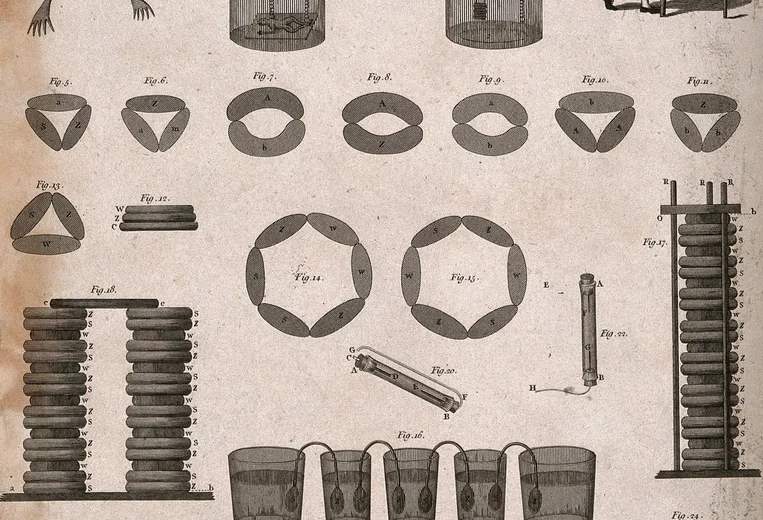
The controversy proved immensely productive. Volta’s experiments helped lead to the invention of the voltaic pile, an early battery and one of the most important devices in the history of electricity. Even when the theory was disputed, the practical result was undeniable: electricity could now be generated more reliably and in greater quantities. This was a breakthrough that changed experimental science. It also made electrical medicine more plausible, because practitioners now had a steadier source of power to work with.
In retrospect, the Galvani-Volta debate looks like a classic example of scientific disagreement generating technological advance. Galvani had asked whether life itself possessed electrical properties. Volta, in challenging that idea, helped create a machine that made electricity controllable. Both men mattered. One pointed toward bioelectricity, the other toward usable electrical technology. The dialogue between them shaped the future of both physiology and engineering.
This is one reason the story still feels modern. Scientific controversies often begin with competing explanations for the same phenomenon, and the resolution often arrives not only through theory but through devices. The battery mattered because it transformed electricity from a fleeting curiosity into a stable tool. That stability was essential for everything that came later, from laboratory research to therapeutic applications. Without it, the promise of treating the body with electrical force would have remained a spectacle of sparks and storms rather than a repeatable procedure.
In a broader history of technology, this moment sits alongside other systems that made communication and control more reliable, from the Transatlantic telegraph cable to the later networks that carried information and power across distance. The battery did for electricity what those systems would later do for messages: it made the invisible manageable.
From Scientific Curiosity to Public Medical Fad
Once electricity could be generated more consistently, the leap into medicine came quickly. Physicians, entrepreneurs, and self-styled healers began to explore how electrical shocks or currents might relieve pain, restore movement, or revive depleted energy. Some of these claims were grounded in sincere experimentation. Others were plainly promotional. But the public was ready for them. Electricity had already acquired a reputation as a force that could awaken the inert, and that made it easy to imagine it awakening the sick as well.
Electrotherapy spread in a climate where people were willing to try new cures, especially for chronic conditions that conventional medicine struggled to treat. Electrical treatments were advertised for a wide range of ailments, from paralysis and nervous disorders to melancholy and fatigue. The language surrounding them often mixed scientific authority with almost miraculous promise. This was not unlike other period innovations that moved quickly from technical novelty to public enthusiasm, as with communication systems such as pneumatic mail tubes, which also inspired both practical hope and sensational imagination. See the story of Pneumatic mail tubes: the forgotten pneumatic mail tube network for another example of a technology that captured the public mind.
The rise of electrotherapy was also shaped by theatrical culture. Electrical demonstrations were inherently dramatic: lights flashed, bodies jerked, and invisible forces were made visible through motion. Showmen understood this instinctively. So did some medical promoters. When a treatment produces a visible reaction, it gains an aura of efficacy, even when its real benefits are uncertain. That made electrotherapy ripe for both legitimate clinical inquiry and quackery.
Still, it would be a mistake to dismiss the movement entirely. The experimentation around electrical treatment helped physicians think more seriously about nerves, sensation, and muscular response. It also encouraged the view that the body could be influenced by measurable physical forces rather than only by humors or vague constitutional balances. In that respect, electrotherapy belonged to a wider transformation in medicine: a move toward systems, mechanisms, and interventions that could be tested, repeated, and refined.
The fad may have overstated what electricity could do, but it helped normalize the idea that medicine could be technological. That legacy would matter long after the most extravagant claims faded.
Theater, Spectacle, and the Long Afterlife of Electrical Healing
The image of frog legs twitching under the influence of electricity persists because it sits at the intersection of laboratory science and public performance. Eighteenth-century audiences were already accustomed to marvels on stage, in lecture halls, and in salons. Electrical demonstrations fit perfectly into that world. They were visual, immediate, and uncanny. If a body could move at the touch of an invisible force, then the boundary between mechanism and life seemed wonderfully unstable.
That theatrical quality helped electrotherapy survive its early uncertainties. Patients were often drawn not just by medical claims but by the experience of encountering modern science firsthand. The clinic could feel like a performance space where a new kind of power was being applied to the body. This was not unique to electricity, of course. Later technologies that organized information, labor, and communication also depended on public trust and wonder. The punch-card age, for instance, transformed administration by making data visibly mechanical; the story of Herman Hollerith and the punch-card machine shows another case where a technical device altered the scale of human systems.
But electrotherapy has a special place in history because it emerged at a moment when the language of vitality and the language of machinery were becoming intertwined. The controversy between Galvani and Volta did more than settle a scientific question. It opened a path toward a medicine that imagined the body as electrically responsive, and therefore potentially adjustable, repairable, and measurable. That idea survives today in much more sophisticated forms, from nerve stimulation therapies to cardiac devices and brain research into electrical activity. The old frog-leg image, once a philosophical curiosity, now reads almost like a preface to modern bioelectric medicine.
In the end, the age of electrotherapy began not with a single invention, but with a convergence: frog legs, lightning, and theater all meeting at the edge of scientific uncertainty. Galvani’s experiments gave electricity a biological face. Volta’s challenge gave it a machine. Public fascination gave it momentum. Together they helped create a world in which electric currents were not only tools of physics, but possible agents of healing. That transformation marks one of the most vivid passages in the history of science and technology, when a twitch in a dissecting room helped teach Europe to imagine the body itself as electrically alive.
Research and further reading
For readers who want to verify details or continue researching this subject, these external reference collections provide useful starting points: