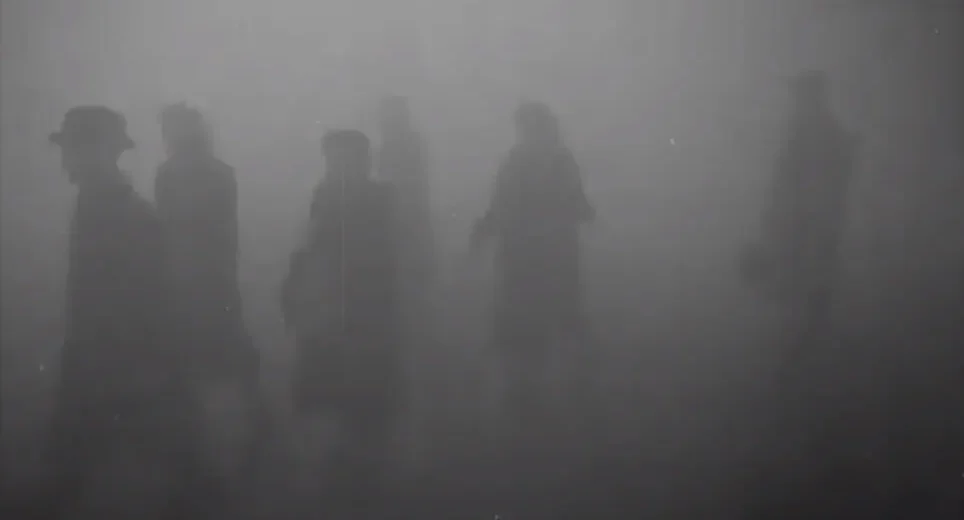
On Friday, December 5, 1952, Londoners woke to cold, still air and a fog that seemed familiar. The city had lived with coal smoke and “pea-soupers” for generations. By evening, however, the air had become something more dangerous: a yellow-black mixture so dense that people could lose sight of their own feet, vehicles stopped in the streets, and smoke entered homes, hospitals, and theaters. For five days, London’s ordinary fuel became an invisible mass-casualty event.
The Great Smog of London did not arrive without warning. Industrial smoke, domestic coal fires, weak regulation, postwar fuel policy, and recurring winter fogs had already made dirty air a chronic feature of urban life. What changed in December 1952 was the weather’s ability to trap a vast concentration of pollutants close to the ground. The disaster killed thousands immediately and, according to later research, many thousands more in the following weeks and months. It also forced Britain to confront a fact long obscured by habit: familiar pollution could be lethal on a historic scale.
Why London had lived with smoke for centuries
London’s smoke problem long predated the twentieth century. Coal use increased as the city grew and wood became expensive. By the industrial era, factories, power stations, railways, commercial boilers, and millions of household fireplaces added smoke to an atmosphere already prone to natural fog. The word “smog,” formed from smoke and fog, was coined in the early twentieth century, but the phenomenon was much older.
Coal was embedded in everyday life. It heated rooms, boiled water, cooked food, and powered industry. A smoky chimney was not automatically interpreted as evidence of public danger; it could symbolize warmth, production, and employment. Laws against smoke tended to distinguish industrial emissions from domestic fires, which were politically and practically harder to regulate.
London’s geography and weather amplified the problem. Moist air in the Thames basin could produce fog, while calm winter conditions allowed pollutants to accumulate. Smoke particles helped water droplets form and darkened the fog. Residents learned to navigate reduced visibility, dirty curtains, blackened buildings, coughing, and soot settling on household surfaces.
This normalization is essential to understanding 1952. The Great Smog was not shocking because London had never seen polluted fog. It was shocking because a hazard considered unpleasant and inevitable suddenly produced an unmistakable surge in illness and death. The disaster’s roots lay in decades of accepted exposure rather than one unexpected industrial accident.
The weather trap of December 1952
In early December, cold weather increased demand for domestic heating. Londoners burned more coal in household grates, while power stations, industry, and transport continued operating. At the same time, a high-pressure system settled over the region. Winds weakened, and a temperature inversion formed: colder air remained close to the ground beneath a layer of warmer air.
Normally, warmer air rising from the surface helps disperse smoke upward. During an inversion, the stable warm layer acts like a lid. Pollutants accumulate in the shallow layer where people breathe. Moisture condensed into fog, and coal smoke supplied soot particles and gases that became part of the mixture. Each day of continued burning added emissions that the atmosphere could not remove.
Contemporary discussions often spoke generally of smoke and sulphur dioxide. Later atmospheric research has examined chemical reactions within fog droplets, including the formation of sulphuric acid. The precise chemistry is complex, and the smog should not be reduced to a single compound. Its danger came from an intense mixture of soot, acidic particles, sulphur compounds, and other combustion products concentrated under exceptional meteorological conditions.
The episode began on December 5 and persisted until December 9, when the weather changed and winds dispersed the polluted air. The sudden clearing did not end the health crisis. Respiratory damage, infection, and stress on vulnerable hearts and lungs continued to produce deaths after visibility returned.
What it was like inside the smog
Visibility fell to a few yards in many places and at times to less than a meter. Buses crawled behind conductors walking with lamps, then many services stopped. Cars were abandoned. Ambulances struggled to reach patients, and pedestrians followed walls or railings to avoid becoming lost in familiar streets. River traffic and flights were disrupted.
The smog did not remain outdoors. It entered poorly sealed homes and public buildings. Cinemas and theaters could not keep the air clear enough for audiences to see screens or stages. A performance at Sadler’s Wells was famously abandoned when the auditorium filled with smog. Hospitals faced rising numbers of people with breathing difficulties while transport obstacles complicated admissions and staffing.
Londoners described soot coating faces and clothing. People who coughed produced darkened phlegm. Those with asthma, chronic bronchitis, heart disease, or damaged lungs were at particular risk, but severe exposure affected otherwise healthy people as well. Infants and older adults were especially vulnerable.
Animals suffered too. Reports from the Smithfield livestock show described cattle experiencing respiratory distress, and some were slaughtered or died. These incidents made the pollution’s physical effects difficult to dismiss, but the full human death toll was not apparent while the fog remained. London had no real-time environmental health surveillance capable of announcing that thousands were dying from polluted air.
Counting the dead
The first widely reported official estimate identified roughly 4,000 excess deaths during and immediately after the episode. Death registrations rose sharply, as did hospital admissions for respiratory illness. The pattern was strongest among older people and those with existing heart or lung conditions. Contemporary medical analysis established that the event was far more than a visibility problem.
Later studies extended the period examined and estimated a much larger toll, commonly cited at around 10,000 to 12,000 deaths. These figures include excess mortality that continued after the fog lifted. They are estimates, not a list of individually proven victims. Researchers compare observed deaths with the number expected under normal conditions while considering seasonal disease and other possible explanations.
Debate has included the role of influenza. Could an epidemic rather than pollution explain some of the elevated mortality? Retrospective research has generally found that influenza does not account for the full pattern. The timing, respiratory effects, pollution measurements, and concentration of deaths strongly support the smog as the principal cause of the extraordinary increase.
The distinction between 4,000 and 12,000 is therefore not a choice between a “true” and “false” number. The lower figure reflected early counting over a shorter interval; the higher estimate emerged from broader retrospective analysis. A responsible account explains the method and uncertainty rather than presenting 12,000 as if every death certificate used the words “Great Smog.”
Coal, class, and postwar Britain
The Great Smog was also a social and economic disaster. Britain was still recovering from the Second World War. Coal remained central to national energy, employment, exports, and household survival. Many homes relied on open fires, and cleaner fuels or modern heating systems were not equally affordable.
Postwar fuel policy contributed to the quality of coal burned at home. Higher-grade coal could be prioritized for export, while consumers used smoky lower-grade varieties. This did not mean officials intentionally created the disaster; it shows how trade, austerity, housing, and energy policy converged in the air Londoners breathed.
Exposure was unequal. Poorer residents were more likely to live in cold, inadequately heated, densely populated housing and to depend on inexpensive coal. People with physically demanding jobs or existing illness had fewer ways to avoid outdoor air. Wealth did not create a sealed bubble—the smog entered affluent districts and public institutions—but resources affected heating choices, housing conditions, and access to care.
Environmental reform consequently raised a difficult question: who would pay for clean air? Banning smoky domestic fuel without grants, alternative supplies, or new appliances could leave families unable to heat their homes. Effective policy had to regulate emissions while helping households convert. The eventual legislation reflected this reality through financial assistance and gradual implementation.
Why the government did not act immediately
It is tempting to tell the story as a simple sequence: the smog killed thousands, public outrage erupted, and Parliament passed a clean-air law. In reality, policy moved more slowly. Fog and smoke were familiar, the deaths were dispersed among hospitals and homes, and government departments initially hesitated to attribute every excess death to pollution.
Britain also faced competing priorities: housing shortages, industrial production, energy supply, and postwar financial constraints. Smoke control threatened costs for local authorities, businesses, fuel producers, and households. Ministers could agree that cleaner air was desirable while resisting an expensive national commitment.
Scientific and political work nonetheless advanced. The government appointed a committee chaired by Sir Hugh Beaver to investigate air pollution. Its reports recommended cleaner fuels, smoke-control areas, changes to industrial combustion, and coordinated action. Medical evidence, local campaigns, parliamentary pressure, and further pollution episodes sustained attention.
The delay does not mean the Great Smog had little influence. It transformed the political weight of evidence. Previous reformers had described smoke as wasteful, unhealthy, and ugly; after 1952, opponents of regulation had to confront a documented mortality crisis. The disaster made inaction harder to defend, even though legislation still required negotiation.
The Clean Air Act of 1956
Parliament enacted the Clean Air Act in 1956, nearly four years after the Great Smog. The law enabled local authorities to establish smoke-control areas in which specified smoky fuels could not be burned unless approved appliances were used. It also addressed industrial emissions, chimney requirements, and methods intended to reduce dark smoke.
Domestic conversion was central. Households in designated areas might need smokeless fuel, gas, electricity, or altered fireplaces. Grants helped cover part of the expense. This financial mechanism was not a minor detail: it recognized that public health regulation would fail if compliance depended entirely on families who could not afford new equipment.
The act did not instantly remove pollution from London. Smoke-control zones expanded over time, fuel supplies had to change, and enforcement varied. A further Clean Air Act followed in 1968, and later environmental legislation developed broader systems of air-quality control. Britain’s urban atmosphere improved through cumulative changes in fuel, technology, industry, housing, and regulation.
Even so, the 1956 act was a decisive landmark. It treated clean air as a legitimate field of government intervention and connected household combustion to public harm. The law’s significance lies not in a magical overnight cure, but in converting the lessons of a disaster into an enforceable transition.
What the Great Smog changed in public health
The episode strengthened the case for studying environmental exposure at the population level. A patient could die of bronchitis, pneumonia, heart failure, or another immediate condition while pollution acted as the trigger that made the death occur when it did. Recognizing that relationship required statistics, air measurements, hospital data, and epidemiological reasoning.
This approach had precedents. A century earlier, John Snow’s investigation of the Broad Street cholera outbreak had shown how mapping deaths and examining patterns could reveal an environmental source of disease. The Great Smog presented a different problem—airborne exposure across an entire metropolis—but again demonstrated that urban health could be understood through carefully connected evidence.
The disaster also changed the meaning of mortality data. Immediate deaths captured only part of the burden. Pollution could worsen chronic disease, increase infections, and produce delayed effects. Later reassessments of the 1952 toll anticipated modern efforts to estimate deaths attributable to particulate pollution even when individual certificates name heart or lung disease.
Public health agencies around the world studied London’s experience. The event became a warning for industrial cities dependent on coal and vulnerable to temperature inversions. It helped establish severe air pollution as a preventable environmental hazard rather than an unavoidable price of urban modernity.
Myths and oversimplifications
One myth is that the smog appeared without precedent. London had endured polluted fog for generations, including serious episodes before 1952. The Great Smog was exceptional in concentration and mortality, but it grew from a normalized problem. Treating it as a freak accident hides the policy failures that allowed risk to accumulate.
Another oversimplification blames only factories. Industrial sources and power stations contributed, but domestic coal fires were enormously important. Cold weather caused millions of households to burn more fuel at the exact moment the atmosphere stopped dispersing emissions. Transport and other combustion sources added to the mixture.
It is also misleading to say that everyone knew 12,000 people had died as soon as the fog cleared. The contemporary estimate was far lower, and the larger figure resulted from retrospective study. Likewise, the Clean Air Act was not passed in the immediate aftermath, nor did it end British air pollution by itself.
Finally, the Great Smog was not simply “natural fog made dirty.” Weather created the trap, but human activity supplied the lethal pollution. Neither factor alone explains the event. The tragedy resulted from the interaction between meteorology, energy systems, housing, regulation, and social inequality.
London before and after the Great Smog
London’s environmental history contains more than one moment when a familiar nuisance became an intolerable political crisis. The Great Stink of 1858 forced Parliament to experience the polluted Thames directly and accelerated support for modern sewer infrastructure. In 1952, dirty air rather than sewage revealed another hidden cost of metropolitan growth.
The comparison has limits. The Great Stink was notorious for odor and disease fears, while the Great Smog produced a measurable wave of respiratory and cardiovascular deaths. Sewer construction and smoke control also required different technologies and institutions. Yet both events show how sensory experience, scientific evidence, and political proximity can turn long-known problems into legislative priorities.
Modern London no longer experiences coal smogs on the 1952 scale, but air pollution has not disappeared. Traffic emissions, nitrogen dioxide, and fine particles present different regulatory challenges. The history of the Great Smog is therefore not a completed victory story. It demonstrates that pollution changes with technology and that yesterday’s successful policy does not eliminate the need for new ones.
Its clearest lesson is institutional. Dangerous exposure can become ordinary when it is distributed across a city and tied to essential activities. Recognizing harm requires measurement; reducing it requires rules, infrastructure, affordable alternatives, and political willingness to challenge what society has learned to accept.
Conclusion: the fog that made pollution visible
The Great Smog of London lasted only from December 5 to 9, 1952, but its causes had accumulated for generations and its deaths continued after the air cleared. Cold weather increased coal burning, a temperature inversion trapped emissions, and dense fog carried an acidic mixture of soot and gases into every part of urban life.
Confirmed evidence supports an immediate excess death toll of roughly 4,000 and a broader modern estimate near 12,000. The exact number remains an epidemiological reconstruction, not a perfectly enumerated list. What is not seriously in doubt is that pollution caused a major mortality crisis, striking hardest at people already made vulnerable by age, illness, housing, and poverty.
The disaster’s political legacy was equally substantial but gradual. Investigation, campaigning, and negotiation culminated in the Clean Air Act of 1956, followed by later legislation and long-term changes in heating and industry. Reform worked because it combined restrictions with a practical transition away from smoky fuels.
The Great Smog matters because it turned an accepted feature of modern city life into evidence of preventable death. Londoners had seen smoke before. In 1952, they were forced to see what smoke had been doing all along.