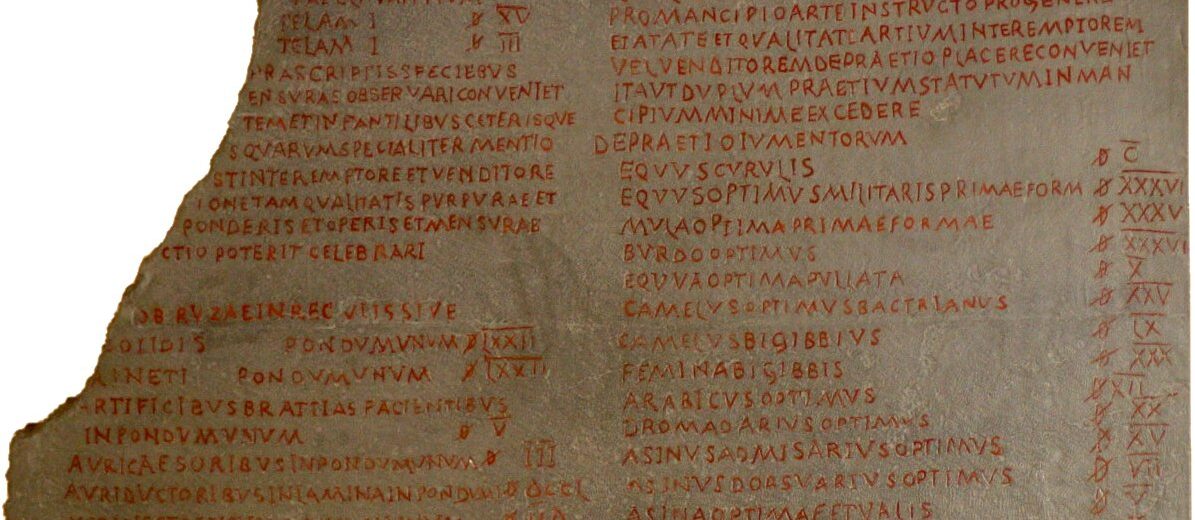
In 301 CE, the Roman government ordered traders across a vast empire not to charge more than the prices carved into public stone. The list covered grain and wine, meat and clothing, transport, skilled labor, teachers, lawyers, lions, and purple silk. Violators could face death. It was one of antiquity’s most ambitious attempts to make an economy obey an official schedule.
The Edict on Maximum Prices is often presented as a simple lesson: Emperor Diocletian imposed price controls, markets disappeared, and the policy failed. That summary rests partly on a hostile ancient author and partly on modern economic assumptions. The edict probably was difficult to enforce and did not solve Roman monetary instability. Yet its surviving fragments reveal something larger—a government trying to protect armies and civilians while rebuilding the empire after decades of war, inflation, and political collapse.
Rome after the crisis of the third century
Diocletian became emperor in 284 after a period in which emperors rose and fell rapidly, frontiers were attacked, provinces broke away, and civil wars repeatedly disrupted taxation and trade. The empire survived, but survival required larger military commitments and a government able to collect resources more reliably.
Currency had also deteriorated. Earlier Roman silver coins had contained substantial precious metal, but repeated debasements reduced their silver content. Rulers could mint more coins to meet urgent expenses, yet the numbers stamped on money became increasingly disconnected from metal value. Prices recorded in accounting units rose dramatically, while people preferred dependable gold, silver, goods, or payments in kind.
It is misleading to describe the entire Roman economy as uniformly ruined. Conditions differed between cities, regions, and social groups. Local exchange continued, long-distance trade survived, and taxes still moved enormous quantities of produce. The problem confronting Diocletian was instability: the government needed predictable revenue and supplies across markets operating with different goods, currencies, and risks.
Diocletian’s wider program of reconstruction
The price edict was not an isolated outburst. Diocletian reorganized provinces, enlarged the bureaucracy, strengthened frontier defense, and shared imperial rule through the Tetrarchy. Two senior emperors and two junior colleagues governed different regions while presenting themselves as one ruling college. The arrangement was intended to improve military response and prevent succession crises.
Reform was expensive. More soldiers, administrators, courts, capitals, fortifications, and imperial ceremonies required resources. Diocletian’s government improved assessment of land and population so taxes could be demanded more systematically. Important obligations were calculated in produce and services because coin alone could not reliably purchase what the state required.
The emperor also reformed coinage. New gold, silver, and base-metal issues attempted to restore useful denominations, while a currency edict in 301 revalued coins and debts. The Edict on Maximum Prices followed within the same troubled monetary environment. It was therefore part of an attempt to coordinate taxation, currency, military supply, and exchange—not merely a ruler’s spontaneous anger at expensive bread.
What the Edict on Maximum Prices actually did
The Latin title is conventionally rendered Edictum de Pretiis Rerum Venalium, the edict concerning the prices of things for sale. Its long preamble blamed uncontrolled greed for harming society, especially soldiers whose cash payments supposedly lost value when merchants raised prices. The emperors portrayed intervention as protection of the public from profiteering.
The law did not command that every item be sold at one compulsory price. It set ceilings: sellers could charge less but not more. That distinction matters. A maximum intended to prevent exploitation is not the same as a fixed imperial retail price, even though a ceiling set below local costs could function as one.
The schedule contained more than a thousand entries arranged in sections. It listed foods, textiles, hides, footwear, timber, metals, animals, slaves, freight rates, and wages for many occupations. The extraordinary range suggests that officials collected information from existing administrative price schedules, military procurement, market observation, or regional submissions, although the compilation process is not documented.
Stone fragments from a lost imperial law
No complete official copy survives. The text has been reconstructed from many fragments discovered mainly in the eastern Mediterranean, including pieces from Aphrodisias, Aezani, Stratonicea, and other sites in modern Turkey, Greece, and Egypt. Versions were inscribed in Latin and translated into Greek so local populations could read them.
The concentration of finds in the East has produced debate. It may reflect where the edict was displayed most intensively, where Diocletian personally ruled, or simply where durable inscriptions survived and attracted archaeological attention. Absence of western fragments does not prove the law never applied in the West, but enforcement may have varied between the territories of the tetrarchs.
Inscribing rules in public space turned regulation into political theater. Like the publicly displayed Code of Hammurabi many centuries earlier, the text presented the ruler as the source of justice and order. The comparison has limits: Diocletian’s edict was a targeted economic measure, not a broad legal collection. Both monuments, however, made authority visible through written law.
Reading the prices without mistaking them for a market survey
The edict priced wheat, barley, wine, oil, pork, beef, fish, vegetables, clothing, and numerous other goods. It also distinguished quality. Wines from famous regions could have different ceilings, while textiles varied by material, workmanship, and color. Purple-dyed silk occupied the extreme luxury end of the schedule.
These numbers are valuable but dangerous. They record legal maxima, not necessarily the prices buyers usually paid. A ceiling might stand above the normal market price in one province and below the cost of supply in another. Historians cannot simply treat every entry as a receipt from a Roman shop.
The unit is commonly called the denarius, but it was largely an accounting denomination rather than the high-silver denarius familiar from earlier imperial centuries. Comparing it directly with modern dollars is impossible. Purchasing-power comparisons can still be attempted by relating wages to staple goods, but only if differences in region, season, quality, and legal status are acknowledged.
What wages reveal about Roman society
The schedule sets maximum payments for farm laborers, builders, carpenters, stonecutters, painters, barbers, teachers, advocates, and other workers. Some rates include food, while others do not, making direct comparisons difficult. The list nevertheless shows how the state classified labor and valued specialized skills.
A day laborer’s ceiling measured against grain suggests that basic food could absorb a significant share of earnings, especially for a household rather than one person. Skilled craftsmen received more, but their tools, training, uncertain employment, and travel costs also mattered. Roman living standards cannot be reduced to one wage divided by one bread price.
Teachers were priced according to subject and per pupil, while advocates received fees for legal work. These entries reveal an economy extending far beyond farms and armies. Education, litigation, medicine, transport, and entertainment all appeared within the government’s regulatory imagination. The edict is therefore a catalogue of occupations as much as a monetary document.
Transport costs and the geography of empire
Freight entries demonstrate why one empire could not possess one effortless market. Moving heavy goods overland was expensive because animals required food, carts wore out, and roads did not eliminate labor. Sea and river transport could be cheaper, but storms, seasons, piracy, port charges, and transshipment introduced other risks.
A price ceiling that looked generous near a grain-producing region might become impossible in a distant city after transport. The edict attempted to account for some freight services, yet no central list could capture every mountain route, drought, local tax, ship shortage, or military requisition affecting cost.
This geographical problem is central to judging the law. Modern summaries often imagine “the Roman market” as one national economy receiving one regulation. In practice, hundreds of local markets were connected unevenly. An empire-wide maximum could restrain genuine exploitation in one place while making legal sale unattractive in another.
Why the emperors blamed greed
The preamble uses fierce moral language. Traders are accused of limitless avarice, and the rulers insist that scarcity alone cannot explain rising prices. Soldiers receive special attention because merchants allegedly charged more whenever military buyers arrived. The government cast itself as defender of disciplined service against private appetite.
This rhetoric should not be read as neutral economic analysis. Roman laws often described offenders in exaggerated moral terms. By blaming greed, the tetrarchs defended their own currency and fiscal policies. If prices rose because sellers were wicked, imperial coinage and requisitions did not need to bear primary responsibility.
Yet profiteering was not imaginary. Armies created concentrated demand, officials possessed coercive power, and shortages allowed well-positioned traders to extract high prices. The false choice is between “greedy merchants” and “bad money.” Both opportunism and structural instability could operate at once, while the edict simplified a complex crisis into behavior punishable by law.
The death penalty and the problem of enforcement
The edict threatened death not only for charging above the maximum but also for forms of evasion. Buyers who collaborated and people who withheld goods could be punished. The language projected uncompromising authority, although Roman legal threats did not always correspond to consistent practice.
Enforcement required local governors, city councils, market officials, soldiers, informers, and courts. These agents had different capacities and interests. Officials might make examples of a few sellers, accept informal payments, tolerate shortages, or interpret quality categories creatively. The imperial center could publish a rule more easily than it could observe every transaction.
No empire-wide record shows how many people were prosecuted or executed. Claims that countless Romans died because of the edict rely heavily on Lactantius, a Christian author intensely hostile to Diocletian. The penalty was real and serious; the scale of its application remains unknown. It is wrong either to dismiss the threat or to convert hostile rhetoric into statistics.
Lactantius and the famous story of failure
Lactantius wrote that Diocletian’s policies produced extreme high prices, that the edict caused bloodshed over small goods, and that merchandise disappeared from sale. According to his account, the law eventually faded away after proving destructive. This passage supplies much of the familiar black-market narrative.
He is indispensable but not impartial. Diocletian later launched the Great Persecution of Christians, and Lactantius composed a work celebrating the terrible deaths of persecuting emperors. His purpose was moral and religious demonstration, not balanced administrative history. He emphasized tyranny, incompetence, and divine punishment.
Economic logic makes withdrawal of goods plausible when legal maxima fell below costs, and the edict’s survival mostly as stone fragments suggests no long administrative life. Still, there is no evidence for one dramatic empire-wide collapse on a known date. Enforcement may have been uneven, brief, locally negotiated, or gradually abandoned.
Was the edict a response to inflation?
Calling the policy an anti-inflation measure is broadly reasonable, but “inflation” can hide several processes. Coin denominations had been altered, precious-metal content changed, state spending was high, and confidence varied. Taxes and requisitions affected supplies. War and transport problems could raise particular prices without creating the same rate everywhere.
The government seems to have wanted to stabilize the purchasing power of payments, especially those connected to the army. The price edict worked alongside monetary revaluation, but it did not repair trust in coin or eliminate the state’s resource demands. A ceiling addressed the visible symptom—the number demanded by a seller—more directly than the fiscal and monetary causes.
Some popular accounts say Rome had destroyed its currency and then foolishly outlawed inflation. That contains part of the truth but compresses decades of crisis into one mistake. Diocletian inherited monetary disorder, tried substantial reforms, and governed an economy where taxes in kind already reduced dependence on cash. The edict was an ambitious component of that reconstruction, not the whole policy.
Did it create a black market?
If a legal ceiling prevented sellers from covering replacement and transport costs, they had reasons to hide stock, reduce quality, favor powerful customers, demand side payments, or trade outside official channels. These are predictable responses and fit Lactantius’s allegation that goods vanished. They probably occurred in at least some places.
But “a black market” should not be imagined as one separate underground economy appearing overnight. Roman exchange was already filled with bargaining, credit, household production, patronage, barter, requisition, and unofficial fees. Avoiding a price rule could blend easily into practices the state struggled to see.
Nor does the existence of evasion prove the edict had no effect. Even partially enforced ceilings might influence negotiations, military purchasing, court disputes, or the language people used to denounce excessive prices. Failure to create lasting uniform compliance is clear; complete irrelevance is harder to demonstrate.
Why the law disappeared
The edict is not prominent in later Roman legal collections, and no evidence shows that its immense schedule remained a functioning empire-wide system for long. Diocletian abdicated in 305, the Tetrarchy fractured, and civil wars returned. Later emperors continued to regulate particular wages, supplies, and occupations, but they did not preserve this universal catalogue in its original form.
Its disappearance probably reflected administrative impracticality and changing monetary conditions rather than a single formal repeal. Thousands of ceilings required constant information and revision. A static inscription could not adjust efficiently to harvest failure, changing coin values, military movement, or regional supply.
The Roman state did not respond by embracing an abstract free market. It continued requisitioning goods, fixing official payments, controlling strategic supplies, and binding obligations to communities and professions. The lesson officials drew was not necessarily that all regulation failed; it was that a universal retail schedule was a blunt instrument for an empire sustained by taxation in money and kind.
What historians can responsibly conclude
Several facts are secure. Diocletian and his imperial colleagues issued the edict in 301. It established maximum prices and wages for more than a thousand goods and services, carried severe penalties, and was publicly inscribed. Surviving fragments make it one of the richest documents for the material economy of the later Roman Empire.
Other claims require caution. We do not know uniform enforcement rates, prosecution totals, or ordinary prices in every province. The law likely encouraged concealment where ceilings were unrealistic, but Lactantius’s description cannot quantify the effect. Its limited duration does not tell us exactly when each locality stopped applying it.
The edict was neither proof that Romans understood modern macroeconomics nor proof that ancient government was uniquely irrational. It was an authoritarian response to real instability, built from administrative knowledge but constrained by geography, information, coercion, and the state’s unwillingness to acknowledge its own contribution to the crisis.
What survives beyond the popular version
The Edict on Maximum Prices tried to place a legal roof over the economic life of an empire. Its list turns abstractions into things people needed: grain for families, cloth for clothing, fodder for animals, transport for goods, and wages for work. That detail is why the broken inscriptions remain so valuable.
The policy almost certainly failed to achieve durable, uniform price stability. Regional costs varied too widely, enforcement was too difficult, and monetary and fiscal problems could not be solved by punishing sellers. Severe penalties exposed the coercive confidence of Diocletian’s reconstructed state.
Yet the edict should not be flattened into a slogan about price controls. It reveals rulers confronting the consequences of military survival, currency reform, taxation, and unequal markets. It also reveals their political choice to describe a structural crisis as private greed.
Its deepest lesson is about information and power. A government capable of carving more than a thousand maxima across the empire possessed remarkable administrative ambition. It still could not make one schedule fit every harvest, road, port, workshop, and household. Roman power could publish a universal price. It could not create universal economic conditions.
Research and further reading
For readers who want to verify details or continue researching this subject, these external reference collections provide useful starting points: