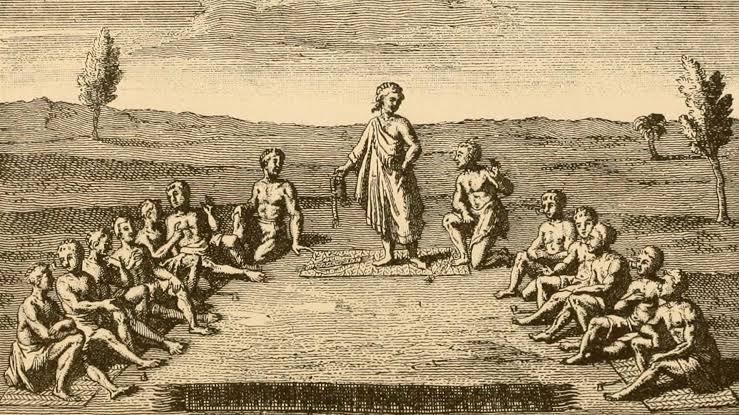
Long before the United States or Canada existed, five Indigenous nations in northeastern North America created a political union designed to replace cycles of retaliation with deliberation. They imagined their alliance as a single longhouse: the Mohawk guarded its eastern door, the Seneca its western door, and the Onondaga kept the central council fire. The Oneida and Cayuga occupied their own places within the same extended house.
This was the Haudenosaunee Confederacy, governed through the Great Law of Peace. European colonists later called it the Iroquois Confederacy or League of Five Nations. The Tuscarora joined in the early eighteenth century, producing the familiar name Six Nations, but the political tradition began with the original five.
The Confederacy is often praised as one of the world’s oldest continuing representative governments. It is also frequently forced into simplistic stories: assigned a precise founding year that the evidence cannot prove, described as a copy of a modern federal state, or credited as the direct blueprint for the United States Constitution. Its real achievement is more interesting. The Haudenosaunee built a durable system in which peace, kinship, women’s authority, local autonomy, ritual, and consensus formed one constitutional order.
Haudenosaunee, Iroquois, and the People of the Longhouse
Haudenosaunee is commonly translated as “People of the Longhouse” or “People Building a Longhouse.” It is the preferred collective name used by the nations themselves. “Iroquois,” the term best known from older English and French sources, is an external name with a disputed linguistic history.
Using Haudenosaunee does more than update vocabulary. It directs attention toward the Confederacy’s own political metaphor. A longhouse could contain related families under one roof while preserving separate hearths. In the same way, the member nations joined for common purposes without surrendering their distinct identities or internal councils.
The original nations were the Kanien’kehá:ka, or Mohawk; Onyota’a:ka, or Oneida; Onondaga; Gayogo̱hó:nǫ’, or Cayuga; and Onöndowa’ga:’, or Seneca. English spellings vary because the languages, colonial transcriptions, and modern orthographies differ. Respectful history acknowledges those variations rather than treating one English form as timeless.
The Peacemaker’s Journey and the Founding Tradition
Haudenosaunee oral tradition places the Great Peacemaker at the center of the Confederacy’s creation. He carried a message intended to end feuding and mourning wars among the nations. Ayonwatha, widely known in English as Hiawatha, became his essential spokesman and collaborator.
Jikonsaseh, often called the Mother of Nations, also holds a foundational role. Some older accounts recorded primarily through male informants minimized her importance, an omission later scholars and Haudenosaunee knowledge keepers have challenged. Her presence reflects the constitutional authority of women and clan mothers within the new peace.
The Onondaga leader Tadodaho appears in the founding narrative as a terrifying opponent whose body and mind were twisted by conflict. Through condolence and persuasion, he was transformed and brought into the peace. His title became associated with the keeper of the central council fire, turning a figure of division into a guardian of unity.
These accounts should not be dismissed as decorative legend or read as if they were modern courtroom transcripts. Oral constitutional history carries law, ethics, political memory, and identity together. Historians can distinguish what outside evidence verifies while still recognizing that the narrative itself is part of how the Confederacy understands and renews its government.
When Was the Confederacy Founded?
No universally accepted year exists. The Confederacy was established before sustained European colonization, but written colonial documentation begins too late to date its formation precisely. Archaeology, linguistics, oral history, and astronomical interpretation offer different clues.
One influential argument links a darkened sky in the Peacemaker tradition to a solar eclipse visible in 1142. Supporters see that event as a strong fit and therefore date the union to the twelfth century. Other researchers favor a later eclipse, especially one in 1451, or a broader fifteenth-century context more consistent with their reading of archaeological settlement patterns.
Each method has limits. Oral descriptions need not encode a single observable event in the way a modern astronomical report would. Archaeological changes do not automatically reveal the date of a political agreement, and absence of material proof is not proof that an institution did not yet exist.
The responsible conclusion is a range, not false precision. The Confederacy arose in the precolonial era, perhaps centuries before Europeans documented it. Both 1142 and 1451 appear frequently in public accounts, but neither should be presented as an uncontested founding date.
The Great Law of Peace as a Living Constitution
The Great Law of Peace—known in different Haudenosaunee languages by names including Kayanla Kówa or Kaianere’kó:wa—is often called an oral constitution. The comparison is useful if it does not imply a single ancient parchment divided from the beginning into numbered clauses.
The law combines the founding narrative with rules for leadership, council procedure, condolence, succession, diplomacy, public conduct, and the duties connecting clans and nations. It is recited and interpreted through people trained in its traditions. Ceremony is not separate from constitutional practice; it helps authorize and renew it.
Published English versions appeared much later. Arthur C. Parker’s 1916 compilation, often arranged into 117 sections, was an important record but not the one definitive original. Different recitations and translations preserve variations. Turning those versions into a single fixed text can hide the law’s oral and performative character.
The Great Law rests on principles often rendered in English as peace, power or strength, righteousness, and a good mind. Its constitutional purpose was not merely to stop fighting. It sought to create disciplined leaders and communities capable of resolving conflict without reopening cycles of vengeance.
The Tree of Peace and the Longhouse of Nations
The eastern white pine symbolizes the Great Peace. In the founding tradition, weapons were buried beneath the Tree of Peace, whose white roots extended outward as an invitation to those willing to follow the law. An eagle above the tree watched for danger.
The Hiawatha Belt expresses the union in wampum. Four white squares represent the Mohawk, Oneida, Cayuga, and Seneca, while a central white tree or heart represents the Onondaga and the council fire. A line joins them without erasing their separate forms.
The longhouse metaphor explains why “confederacy” is more accurate than “centralized state.” Each nation retained its own council, communities, and power over internal affairs. The Grand Council addressed matters affecting the union. Unity was built through relationship, not absorption.
How the Grand Council Reached Consensus
The Grand Council brought together chiefs holding named hereditary titles. The original structure is traditionally described through fifty chiefly offices distributed among the Five Nations. Modern arrangements and descriptions can differ, particularly when discussing Tuscarora participation.
Chiefs did not act as legislators elected for fixed terms by individual ballot. They were expected to voice the considered position of their clans and nations. Deliberation moved through established groupings sometimes described as Elder and Younger Brothers, with the Onondaga fire keepers confirming whether agreement had been reached.
Consensus did not mean that everyone instantly shared one opinion. Proposals could move back and forth, requiring speakers to listen, restate objections, and continue until no member nation was forced into a decision it rejected. A failed consensus meant the Confederacy did not act collectively.
Clan Mothers and Women’s Constitutional Authority
Haudenosaunee clans are matrilineal: clan identity and related social belonging pass through the mother. This kinship structure shaped political authority. Clan mothers selected and advised the male chiefs who represented the clan in council.
A chief was expected to possess patience, honesty, and concern for future generations. If he neglected his duties or violated the Great Law, the responsible clan mother could initiate his removal—often symbolized as taking away the antlers of office. Leadership was therefore hereditary in title but conditional in the individual.
Women also held influence over land, agriculture, community welfare, and decisions touching war and peace. Their authority should not be translated too casually into modern electoral categories. Women did not simply occupy identical positions to men, and Haudenosaunee gender roles had their own spiritual and social logic.
Wampum Was More Than Money
Popular histories often describe wampum as “Indian money.” Shell beads did acquire exchange value in colonial commerce, but their political and cultural functions were much broader. Belts could record agreements, offices, condolence, and diplomatic relationships through recognized patterns and the words attached to them.
Wampum was not alphabetic writing that allowed any stranger to decode a belt independently. It served as a mnemonic and authoritative object within a community of trained speakers. The belt and the recitation worked together.
In diplomacy, presenting and accepting a belt could make words solemn, visible, and renewable. Agreements were not imagined as documents signed once and forgotten. Relationships required repeated councils, remembrance, and what diplomats sometimes called polishing or brightening the chain.
Local Autonomy, Collective Peace, and the Limits of Council Power
The Grand Council’s importance has led some outsiders to imagine it as a federal parliament commanding every Haudenosaunee community. That overstates central authority. Nations and towns retained considerable freedom, and local councils remained central to political life.
The Confederacy could make peace, receive diplomats, and address common threats, but it did not eliminate all disagreement or independent action. War parties did not always represent a unanimous league decision. European officials sometimes exploited that complexity by treating one leader’s words as binding on everyone.
Nor did the Great Law abolish conflict across the region. It established peace among member nations and offered procedures for extending relationships, but Haudenosaunee communities fought other Indigenous peoples and later European powers. During the seventeenth-century wars often called the Beaver Wars, trade, firearms, mourning practices, territorial strategy, disease, and colonial rivalry became entangled.
Diplomacy with Dutch, French, and British Colonies
As European settlements expanded, Haudenosaunee diplomats used the Confederacy’s experience to negotiate with competing powers. Relationships with the Dutch and later the British developed through the Covenant Chain, a series of agreements expressed as kinship and mutual obligation.
Haudenosaunee leaders understood that treaties required maintenance. Councils renewed terms, exchanged belts, corrected misunderstandings, and adapted the language of kinship. Europeans often preferred written land deeds and claims of permanent surrender, creating dangerous differences in interpretation.
The Confederacy’s position between French and British spheres created leverage. Diplomats could balance rivals, protect trade, and limit intrusion. That policy was neither perfect neutrality nor permanent alliance; different nations and communities made choices according to changing conditions.
Colonial powers admired Haudenosaunee political skill while seeking their land and allegiance. Epidemics, warfare, missionaries, commerce, and settlement altered the balance. The Confederacy endured not because contact left it untouched, but because its institutions helped communities negotiate relentless pressure.
The Tuscarora and the League of Six Nations
The Tuscarora were an Iroquoian-speaking people from the Carolinas. After colonial encroachment, enslavement, and war in the early eighteenth century, many migrated north. They were accepted into the Haudenosaunee Confederacy, commonly dated to around 1722.
Their arrival created the Six Nations, but it did not simply add a sixth equal block to every older constitutional procedure. The original chiefly titles and council structure had been established for the Five Nations, and descriptions of Tuscarora representation vary by time and source.
The adoption nevertheless showed that the longhouse could expand. The Great Law was not only a memory of one founding moment; it contained a principle by which people seeking peace could come beneath the tree’s roots.
The American Revolution Fractures the Longhouse
The American Revolution placed the Confederacy under extraordinary strain. Member nations had longstanding relationships with the British, colonial settlers, and one another. There was no single safe choice when war reached Haudenosaunee homelands.
Many Mohawk, Seneca, Cayuga, and Onondaga communities supported the British, while Oneida and Tuscarora communities more often aided the Americans. Allegiances were not perfectly uniform, but the division led warriors from nations bound by the Great Peace to fight on opposing sides.
At the Battle of Oriskany in 1777, Haudenosaunee people confronted one another in a conflict remembered as a profound rupture. In 1779, the Sullivan-Clinton campaign burned towns and food stores across Haudenosaunee territory, causing displacement and hunger whether particular communities had fought or not.
The war damaged the Confederacy but did not erase it. Some families moved to lands along the Grand River in what became Canada; others remained in New York. Like the communities that later coordinated the Pueblo Revolt, Haudenosaunee nations faced the challenge of defending sovereignty without becoming one undifferentiated people.
Did the Great Law Shape the United States Constitution?
Benjamin Franklin and other colonial leaders knew Haudenosaunee diplomats and observed a durable union of separate nations. At the 1754 Albany Congress, Haudenosaunee representatives urged the colonies toward greater unity, and Franklin promoted a plan of colonial union.
In 1988, the United States Congress formally acknowledged a Haudenosaunee contribution to the development of American constitutional ideas. Supporters of a strong influence thesis point to federal union, councils, checks on leaders, and symbols such as bundled arrows.
Other historians argue that direct borrowing is difficult to prove from Constitutional Convention records and that European political traditions supply closer textual precedents. The structural differences are substantial: the Great Law emphasized consensus, matrilineal clan authority, titled chiefs, and sovereign nations, while the U.S. Constitution created majority-based institutions and originally protected slavery while excluding most women from formal power.
The strongest conclusion lies between denial and overstatement. Colonial leaders encountered and sometimes admired Haudenosaunee federal practice. That contact formed part of their political world. Calling the Great Law the single blueprint for the U.S. Constitution, however, claims more precision than surviving evidence supports.
Misconceptions About “Democracy” and Equality
Describing the Confederacy as the world’s oldest democracy communicates its representative and consensual character, but the label can also impose a modern category. The Great Law did not organize universal elections, political parties, or a legislature based on population.
Chiefly titles belonged to clans, and clan mothers selected qualified men to hold them. Ordinary people influenced decisions through councils and kinship networks rather than casting an identical secret ballot. Authority was distributed, accountable, and constrained, but through Haudenosaunee institutions.
The society was not free of hierarchy, warfare, captivity, or historical change. Some people were adopted into clans after conflict; others occupied marginal positions. “Egalitarian” is useful only when it does not erase these complexities.
Comparisons with European governments can illuminate differences, especially women’s political authority and the protection of national autonomy. They become misleading when Haudenosaunee society is praised only for resembling later Western ideals.
A Living Confederacy, Not a Vanished Experiment
The Haudenosaunee Confederacy continues as a political and cultural reality. Traditional councils still meet, clan mothers and chiefs retain responsibilities, and the Great Law guides positions on sovereignty, land, treaties, and relations with settler governments.
Haudenosaunee citizens also live under different elected or federally recognized governing structures in the United States and Canada. Those systems can coexist, compete, or represent different constituencies. Outsiders should not assume that one council speaks automatically for every Haudenosaunee person.
Treaties such as the 1794 Treaty of Canandaigua remain part of contemporary nation-to-nation claims. Land rights, border crossing, environmental protection, language, and ceremonial life are not merely historical subjects; they are ongoing dimensions of sovereignty.
The survival of the Confederacy refutes the habit of ending Indigenous history with conquest. Institutions have adapted through forced removal, divided borders, boarding schools, land loss, and legal pressure while maintaining a constitutional tradition older than the states surrounding it.
What the historical record leaves us with
The Haudenosaunee Confederacy did not create unity by eliminating difference. It joined five nations beneath one law while preserving their own councils, territories, languages, and responsibilities. The Tuscarora later found a place within that political longhouse.
Its durability came from more than a clever council design. Clan systems connected communities; clan mothers made leadership accountable; wampum joined memory to diplomacy; condolence restored minds damaged by grief; and consensus prevented collective action from resting on simple coercion.
Some questions remain open. The founding year cannot be fixed with certainty, oral versions should not be collapsed into one supposedly original document, and the degree of direct influence on the United States Constitution remains debated. A careful history makes those uncertainties visible without treating the Confederacy itself as uncertain.
The Great Law’s central achievement is confirmed by continuity. An agreement formed before European domination survived colonial war, revolution, removal, and divided borders. It turned peace from a temporary truce into a structure that had to be spoken, remembered, and renewed. That remains the deepest lesson of the People of the Longhouse.
Research and further reading
For readers who want to verify details or continue researching this subject, these external reference collections provide useful starting points: