In the summer of 1982, sponge diver Mehmed Çakır surfaced near Turkey’s southern coast with news of strange objects on the seabed. He drew what he had seen: flat metal shapes with four projecting corners, which he described as “metal biscuits with ears.” Archaeologists recognized them as copper oxhide ingots. Two years later, excavation began on a ship that had gone down more than three thousand years earlier carrying enough metal to equip a small kingdom.
The Uluburun shipwreck is often called a snapshot of Late Bronze Age globalization. The phrase is tempting. Its cargo brought together Cypriot copper, tin of disputed origin, Levantine jars, African ebony and ivory, Baltic amber, Egyptian objects, Aegean pottery, glass ingots, jewelry, food, tools, and weapons. Yet “globalization” can conceal as much as it reveals. The eastern Mediterranean around 1320 BCE was not a borderless market. It was a world of palace administrations, diplomatic gifts, specialist merchants, coastal intermediaries, and dangerous voyages.
Uluburun matters because it replaced broad claims about Bronze Age trade with a single, tightly associated cargo. The wreck proves that enormous quantities of strategic raw material moved together by sea. It also preserves personal objects that hint at life aboard. What it does not preserve is a shipping manifest. The vessel’s home port, precise route, owner, destination, and commercial status remain arguments built from material clues rather than facts written down by the crew.
A wreck found by knowledge carried between divers
The discovery was not a lucky accident in an archaeological vacuum. Turkish sponge divers knew the seabed intimately, and the Institute of Nautical Archaeology had encouraged them to report objects that might indicate ancient wrecks. Çakır’s sketch allowed specialists to identify a cargo type before they fully inspected the site. The wreck lay off the rocky cape of Uluburun, near Kaş, on a steep slope at depths exceeding 44 meters. Working there required far more than ordinary excavation technique.
A survey confirmed that the “biscuits” were Bronze Age copper ingots. Excavation followed for eleven campaigns between 1984 and 1994 under the auspices of the Institute of Nautical Archaeology and the Bodrum Museum of Underwater Archaeology. George Bass directed the first campaigns; Cemal Pulak subsequently led the work. Divers logged more than 22,000 descents. At that depth, bottom time was short, decompression obligations were serious, and every artifact had to be mapped, stabilized, raised, desalinated, studied, and conserved.
The site did not resemble an intact wooden ship resting upright. The vessel had struck or approached a steep shore and spilled material downslope. Most organic hull fabric had disappeared, and heavy ingots settled among rocks while smaller objects became mixed with sediment. Archaeologists established a grid underwater and recorded finds through repeated seasons. The published cargo is therefore the result of sustained recovery and reconstruction, not a treasure haul lifted in one dramatic operation.
Dating a disaster without a written year
The ship sank in the later fourteenth century BCE, conventionally expressed as about 1320 ± 15 BCE. That range does not come from a coin or dated inscription. Researchers combined ceramic chronology, radiocarbon measurements, tree-ring evidence, and historically datable objects. Each form of evidence has limitations, so the date is a reasoned convergence rather than a timestamp.
A small gold scarab bearing the name of Queen Nefertiti is the cargo’s most famous chronological clue. Because Nefertiti belonged to the reign of Akhenaten in fourteenth-century BCE Egypt, the wreck cannot plausibly predate the production of the scarab. But it does not prove that Nefertiti was alive when the ship sailed. Small valuable objects could circulate for years, and a royal-name scarab might be kept as jewelry, bullion, a token, or an heirloom.
The late-fourteenth-century date places Uluburun within the international system documented by the Amarna letters, diplomatic correspondence between the Egyptian court and rulers across western Asia. Those tablets describe exchanges of gold, copper, luxury goods, royal gifts, envoys, and marriage negotiations. The ship’s cargo resembles that world, but no surviving letter identifies this voyage. Archaeological compatibility is not documentary proof.
The metal cargo was the economic heart of the voyage
Most of the ship’s commercial weight consisted of raw metal. Excavators recovered approximately ten tons of copper, much of it in about 350 large oxhide ingots, together with smaller bun-shaped forms. The projecting corners of an oxhide ingot made the heavy slab easier to lift or lash, although the shape only loosely resembles an animal hide. Isotopic and archaeological evidence strongly connects most of this copper with Cyprus, the eastern Mediterranean’s major source.
About one ton of tin accompanied the copper. The approximate ten-to-one ratio attracts attention because mixing copper with a much smaller amount of tin produces useful bronze. The cargo therefore contained the ingredients for around eleven tons of alloy—enough for a vast number of tools, weapons, fittings, vessels, and prestige objects. It is direct evidence that Bronze Age metal industries depended on bulk maritime transport rather than only on tiny exchanges of luxury goods.
The copper source is clearer than the tin source. Tin deposits are rarer, and corrosion, recycling, mixing, and analytical uncertainty complicate provenance. Scholars have proposed sources in Anatolia, Central Asia, and farther west. Recent isotopic studies have produced competing conclusions, including arguments involving Central Asian material and counterarguments rejecting the Mušiston mines as a source for Uluburun. Claims that one test has finally solved the “tin problem” should therefore be treated cautiously.
Nor does the metal tell us the transaction under which it traveled. It could have belonged to a merchant serving palatial clients, formed part of institutional exchange, included gifts alongside commercial freight, or combined several consignments. The scale and high-status objects suit elite demand, but a valuable cargo is not automatically a royal diplomatic shipment. Bronze Age exchange did not necessarily divide neatly into modern categories of state gift and private trade.
Jars, resin, glass, and the less glamorous economy
Metal dominates discussion, but the ceramic containers reveal a broader commercial world. At least 149 Canaanite jars were recovered. Many contained terebinth resin, a fragrant substance obtained from Pistacia trees and used in incense, perfumery, medicine, or the treatment of wine. Other containers held foods or smaller objects. Their standardized forms made them practical packages in a maritime system connecting Levantine producers with distant consumers.
The ship also carried nearly two hundred glass ingots, many colored cobalt blue or turquoise, as well as purple and other hues. In the Late Bronze Age, glass was a controlled high-value material rather than an ordinary household commodity. Workshops could remelt imported ingots to manufacture vessels, inlays, beads, and decorative elements. Analyses link different colors and compositions to specialist production traditions, demonstrating that raw glass itself traveled as an international commodity.
Logs of ebony from Africa, unworked elephant and hippopotamus ivory, ostrich eggshells, shells, and pieces of amber expanded the geographic reach of the assemblage. Baltic amber did not need to travel directly from northern Europe to the Levant in one journey; it could pass through many hands and regions. The wreck records convergence at one moment, not necessarily direct bilateral trade between every source area and the ship’s home port.
Food remains—including almonds, figs, olives, grapes, pomegranates, spices, cereals, and other plant material—blur the line between cargo and provisions. Some were commodities, some shipboard supplies, and some may have served both purposes. This is a useful warning against reading every object as an item on a sales list. Ships were workplaces and temporary homes as well as transport platforms.
Luxury objects connected courts without identifying the customer
Gold and silver jewelry, carved ivory containers, faience beads, seals, ceremonial objects, and precious stones gave the shipment an elite character. A gold chalice and a bronze female figurine with gold-covered extremities belong to the most visually striking finds. The tiny Nefertiti scarab links the cargo to Egyptian royal symbolism, while a Kassite cylinder seal points toward Mesopotamian cultural connections.
Such objects resemble the valuable goods exchanged among rulers in the Amarna correspondence. Kings addressed one another as “brothers,” requested gold, sent gifts, arranged marriages, and complained about inadequate returns. It is reasonable to interpret at least part of Uluburun against this diplomatic economy. It is less secure to label every prestigious object a royal gift destined for a named palace.
Balance weights are especially revealing. The ship carried a substantial and varied collection, including geometric and animal-shaped examples. Weights allowed people using different regional systems to measure metal and other goods. Their presence supports active valuation and exchange aboard or at ports. They suggest economic specialists capable of translating between standards, not merely couriers ordered to deliver an untouched diplomatic package.
The strongest interpretation is mixed rather than absolute. Uluburun carried bulk raw materials, workshop supplies, luxury objects, tools, provisions, and personal possessions. That combination could serve merchants, palaces, or both. The Late Bronze Age economy allowed political and commercial relationships to overlap.
A small fragment of hull changed the history of shipbuilding
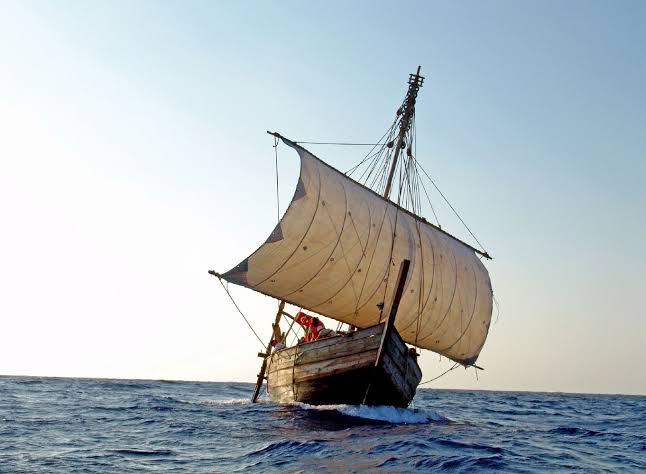
Only a limited portion of the vessel survived, but it was enough to reveal a sophisticated hull. Planks were joined edge to edge with pegged mortise-and-tenon joints: tongues fitted into slots and were locked with wooden pegs. This shell-first technique created strength before the internal framing systems familiar from later ship construction. Similar principles are known from other ancient Mediterranean wrecks, but Uluburun pushed firm evidence deep into the Bronze Age.
The hull is commonly described as built from Lebanese cedar, a valued and durable timber. A proto-keel ran along the bottom, though it was not a deep keel in the later sense. Stone anchors, shipboard tools, galley ware, fishing equipment, and rigging-related finds help reconstruct operation even where the vessel itself vanished.
The ship was not a primitive raft overloaded by people who barely understood the sea. Its builders employed specialized joinery; its operators managed anchors, rigging, provisions, weights, and a complex cargo. Coastal navigation still carried lethal risks. A sudden wind shift, navigational error, equipment failure, or collision near the cape could destroy years of accumulated value. No surviving evidence identifies the immediate cause of the wreck.
Who sailed the ship remains a careful inference
The cargo contains objects associated with many regions, so assigning the ship a modern nationality is misleading. Excavators have argued that personal effects, ceramics, balance weights, weapons, and the ship’s construction point toward a Syro-Canaanite crew. This is a plausible synthesis, not an inscription naming captain and home port.
Some objects are Mycenaean, including pottery and weapon types, and a pair of swords has contributed to suggestions that people from the Aegean traveled aboard. They may have been passengers, envoys, guards, traders, or simply absent owners of cargo. Material culture can indicate habits and affiliations, but a pot or sword is not a passport. Individuals in port societies could use foreign objects, and traded goods can travel without their makers.
The ship may have sailed from the Levant or Cyprus and headed west toward the Aegean, perhaps through Cyprus and along the Anatolian coast. Rhodes or a Mycenaean palatial center has been proposed as a destination. The wreck’s location suits a westward route, but its final port is not recoverable from direction alone. Ancient ships could call at several ports, take on new cargo, and discharge only part of a load.
Responsible history keeps these levels separate: a Levantine or Cypriot sphere of operation is probable; a Syro-Canaanite crew is well argued; Aegean individuals aboard are possible; an exact itinerary and destination remain unknown.
What one ship reveals about the Late Bronze Age system
Around the eastern Mediterranean, large states and palace societies depended on resources they did not possess locally. Cyprus exported copper. Egypt supplied gold and grain and drew goods from Africa and Asia. Levantine ports acted as manufacturing and redistribution centers. Mycenaean palaces consumed metals, glass, ivory, aromatics, and prestige objects. Inland routes connected coasts to Mesopotamia, Anatolia, and regions much farther away.
Uluburun does not prove that every place participated equally or directly. It shows that layered networks could assemble products from remarkable distances into one shipment. A piece of amber might move through several exchange zones before reaching a Levantine port. Tin could be traded, remelted, and aggregated. Political envoys, seafaring merchants, craftspeople, and local carriers all participated in chains that no single ruler necessarily controlled.
Other discoveries illuminate different parts of the same era. The Nebra Sky Disc, for example, raises questions about knowledge, materials, and long-distance contacts in Bronze Age Europe. Uluburun provides much more direct evidence for maritime freight, yet neither object should be made to represent an entire continent. Exceptional finds reveal possibilities and connections; ordinary settlements are still needed to show how widely those connections shaped daily life.
The tin debate shows how archaeological conclusions change
Few questions have produced more confident headlines than the origin of Uluburun’s tin. Because bronze requires tin and major sources are scarce in the eastern Mediterranean, tracing the metal could reconstruct routes stretching thousands of kilometers. Chemical composition and isotopic signatures offer powerful tools, but archaeological tin is notoriously difficult to match to ore deposits.
Corrosion changes surfaces. Ancient smiths could combine metal from several sources, and ingots might incorporate recycled material. Modern ore databases are incomplete, while mines exploited in antiquity may be exhausted or unidentified. Similar signatures can occur in different geological settings. A provenance proposal must therefore integrate chemistry, isotopes, artifact context, chronology, and plausible transport routes.
Recent teams have disagreed over connections to Central Asian mines, Anatolian sources, and western European tin. A 2023 study specifically argued that Mušiston in present-day Tajikistan was not the source of the Uluburun ingots, challenging an earlier interpretation. Research on Bronze Age tin from other Mediterranean contexts has also revived debate about material from Cornwall and Devon. These developments do not justify replacing one certainty with another.
This is a case where the honest sentence is “the origin remains disputed.” That is not a failure of archaeology. It identifies exactly where evidence is strong—the presence and quantity of tin—and where interpretation remains open.
Claims the wreck cannot support
Its cargo did not come directly from every region represented. African ivory, Baltic amber, Cypriot copper, and Mesopotamian seals could converge through exchange chains. Geographic variety does not map the vessel’s itinerary.
Mycenaean objects do not prove a Mycenaean ship. They may indicate passengers, consumers, earlier port calls, or traded cargo. The crew’s likely eastern Mediterranean background rests on a wider pattern of evidence.
Uluburun did not sink in the Late Bronze Age collapse. Its accepted date is around 1320 BCE, substantially earlier than the widespread disruptions around 1200 BCE. It reveals the mature network whose later transformation historians seek to explain.
Removing these exaggerations leaves a more remarkable reality. A relatively small wooden vessel carried industrial quantities of metal and culturally diverse goods within a highly connected political economy centuries before classical Greece.
Why the Uluburun shipwreck still matters
Textual archives favor rulers, officials, and exceptional transactions. Shipwrecks preserve a different record: the material consequences of decisions made by miners, smelters, potters, resin collectors, ivory workers, glassmakers, packers, merchants, sailors, and clients. Uluburun brings those activities into one archaeological context even when the workers’ names are lost.
Most of all, Uluburun gives scale to Bronze Age interdependence. Ten tons of copper and roughly one ton of tin were not curiosities. They were strategic materials in transit to furnaces and workshops. The luxury pieces mattered because palaces consumed status; the jars mattered because everyday substances also moved; the personal objects mattered because a ship was crewed by people rather than by arrows on a trade map.
The vessel failed to complete its voyage, but that failure preserved the clearest cargo ever recovered from the Late Bronze Age Mediterranean. It shows an ancient world capable of coordinating resources over immense distances—and reminds us that the exact people, contracts, and destinations behind that coordination can remain beyond recovery.
Sources and further reading
- Institute of Nautical Archaeology, “Uluburun Late Bronze Age Shipwreck Excavation” — excavation history, cargo overview, hull evidence, dating, and bibliography.
- Cemal Pulak, “Uluburun Shipwreck,” The Oxford Handbook of the Bronze Age Aegean — a scholarly synthesis by the excavation director.
- Penn Museum, “Archaeometry and Shipwrecks” — discussion of the metal cargo and the debates surrounding provenance analysis.
- Republic of Türkiye Ministry of Culture and Tourism, Bodrum Underwater Archaeology Museum — official museum context for the Uluburun finds and underwater archaeology.
- Sturt Manning et al., “Absolute Age of the Uluburun Shipwreck” — academic publication record for the wreck’s radiocarbon and tree-ring chronology.