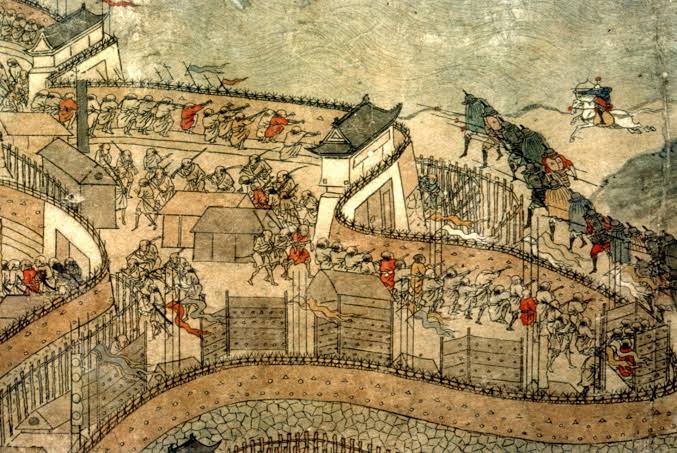
In the spring of 1592, battle-hardened armies crossed the Korea Strait from a newly unified Japan. They took Busan, drove north, occupied the Joseon capital, and reached Pyongyang with a speed that stunned the Korean court. Toyotomi Hideyoshi’s invasion appeared to have broken a kingdom in weeks. It had not.
The Imjin War became a six-year struggle involving Japan, Joseon Korea, and Ming China. Naval warfare severed supply routes; Korean local armies rose behind the invaders; Chinese troops changed the balance on land; and diplomacy consumed years without resolving the conflict. A second Japanese invasion followed in 1597 before Hideyoshi’s death led to withdrawal in 1598. Korea survived, but villages, farms, archives, temples, and human lives were devastated on a scale that shaped East Asian memory for centuries.
What Was the Imjin War?
“Imjin War” derives from the Korean cyclical name for 1592, the year of the first invasion. Korean sources also distinguish the second phase, beginning in 1597, as the Jeongyu War. In Japanese history the campaigns may be called the Bunroku and Keichō invasions, after Japanese era names. Scholars increasingly use “the East Asian War of 1592–1598” to emphasize that this was not merely a bilateral conflict.
The war involved two major invasion waves. The first Japanese armies landed in 1592 and initially conquered much of the peninsula. A Ming-Joseon counteroffensive and Korean control at sea pushed Japanese forces into southern coastal positions by 1593. Negotiations continued for several years. When they failed, Japan launched a second, more limited invasion in 1597. Fighting ended only after Hideyoshi died and Japanese leaders ordered a withdrawal in 1598.
Numbers demand care. Contemporary records and modern studies offer different totals because armies arrived in phases, garrisons changed, and noncombatants supported each force. It is safe to say that hundreds of thousands of soldiers participated over the course of the war. A recent study in Medical History describes more than half a million combatants mobilized across the three states. Precise casualty totals, especially for civilians, remain uncertain.
The familiar phrase “Japan invaded Korea to conquer China” captures Hideyoshi’s declared ambition but not every motive. His plans combined personal glory, continental expansion, diplomacy, trade, and the management of warriors after Japanese unification. Historians debate how realistic he believed the conquest of Ming China to be. The invasion itself, however, was no bluff.
Hideyoshi’s Ambition After Unifying Japan
Japan’s sixteenth-century civil wars created powerful regional lords and armies experienced in mass warfare. Oda Nobunaga began a program of political unification, and Toyotomi Hideyoshi extended it. By 1590, Hideyoshi had defeated or subordinated most remaining rivals. He lacked an inherited shogunal title, but he exercised national authority through court rank, land surveys, disarmament policies, and personal alliances.
Hideyoshi demanded that Joseon Korea facilitate his passage toward Ming China. The Korean court refused. Joseon maintained a tributary and diplomatic relationship with the Ming, while its contacts with Japan were managed partly through Tsushima. Korean envoys who visited Japan before the invasion returned with divided assessments of the danger, a disagreement later remembered as a catastrophic intelligence failure.
It is tempting to explain the invasion as a way to send restless samurai abroad. Redirecting military energies probably mattered, but it does not fully account for Hideyoshi’s repeated diplomatic demands or the enormous logistical preparations at Hizen Nagoya Castle in Kyushu. The castle served as headquarters, assembly point, and supply base for forces crossing to Korea.
Why Joseon Was Overrun So Quickly
Joseon Korea was not wholly unaware of Japanese military change, but its defenses were unprepared for the scale and speed of the attack. Japanese forces landed near Busan in spring 1592, overwhelmed coastal defenses, and advanced along several routes. Matchlock firearms, disciplined formations, and extensive experience from Japan’s domestic wars gave the invaders an early tactical advantage.
Korean command suffered from weak mobilization, divided authority, and inaccurate reporting. Fortifications that might resist raiders were not always prepared for large armies with firearms. As Japanese columns moved north, many local forces dissolved or were defeated separately. The capital, Hanseong—modern Seoul—fell within weeks, and King Seonjo’s court fled toward the northern frontier.
The speed of collapse should not be confused with complete conquest. Japanese armies controlled roads, towns, and strongpoints more easily than the countryside between them. Their farther advance lengthened supply lines back to ports in the south. Occupation also produced resistance among officials, soldiers, monks, farmers, and local elites.
Claims that Korea “had no guns” are false. Joseon used gunpowder weapons, cannon, rockets, and firearms, though organization and deployment differed from Japanese practice. The imbalance in 1592 came from preparation, leadership, operational surprise, and the concentrated experience of the invading armies—not from a simple contrast between modern Japan and technologically backward Korea.
Admiral Yi Sun-sin and the War at Sea
Yi Sun-sin, naval commander in southwestern Korea, responded without waiting for the enemy to reach his bases. His fleets attacked Japanese vessels along the southern coast, winning at Okpo and in subsequent engagements. At Hansan Island in 1592, Korean forces inflicted a major defeat that restricted Japanese naval movement and protected the sea routes around the peninsula’s west.
These victories did not annihilate every Japanese supply line. Cargo still moved through southern ports and along coastal routes. Yet Korean control of important waters prevented Japan from freely using the sea to reinforce an advance deep into northern Korea. The invasion armies could not rely on maritime mobility in the way Hideyoshi’s planners had intended.
Yi’s surviving Nanjung Ilgi, or War Diary, is one of the conflict’s strongest primary sources. UNESCO describes seven handwritten volumes containing near-daily notes from 1592 to 1598. The entries record weather, discipline, sickness, family grief, logistics, and combat preparations. They reveal a commander under persistent strain rather than the flawless statue of later legend.
Yi employed panokseon warships, cannon, trained crews, and local geographic knowledge. Turtle ships, enclosed vessels associated with his fleet, were real but relatively few. Popular images often add iron plating as an established fact; the surviving evidence does not prove that their entire roofs were armored in the modern sense. Korean naval success rested on a system, not a single wonder weapon.
Righteous Armies and Resistance on Land
As royal forces faltered, local volunteer formations known as uibyeong, often translated as “righteous armies,” organized resistance. Former officials, Confucian scholars, farmers, hunters, and Buddhist monks took part. They attacked detachments, defended strategic places, gathered intelligence, and disrupted the occupation’s access to food and communication.
These groups were not one national army under a unified command. Their size, equipment, motives, and effectiveness varied. Some arose from loyalty to the king and Confucian ideals; others defended families and local communities. Buddhist monks fought despite the Joseon state’s long political restriction of Buddhism, complicating any simple picture of society united under established institutions.
Resistance denied Japanese armies secure control behind their front lines. It also preserved parts of Jeolla province, an important agricultural and naval base. The combination of local land resistance and Korean naval pressure made the first invasion increasingly difficult to sustain.
Ming China Enters the Conflict
Joseon appealed to the Ming dynasty for assistance. Ming leaders initially doubted reports of the invasion’s scale and worried that Korean collapse might conceal another political crisis. A small early force was defeated. Larger Chinese armies then crossed into Korea, turning the invasion into a regional war.
Under Li Rusong, Ming forces helped recapture Pyongyang in early 1593. The allies pushed south but suffered a setback near Byeokjegwan, north of Seoul. Japanese forces withdrew from the capital and concentrated in the south, while disease, hunger, transport problems, and disagreement complicated allied operations.
Ming intervention was not simply an act of charity. Korea occupied a crucial place in the Ming diplomatic order, and a Japanese presence on the peninsula threatened China’s northeastern security. Defending Joseon also defended Ming prestige and the regional system through which the dynasty understood legitimate international relations.
Chinese forces were indispensable, but older accounts sometimes make Joseon a passive battlefield between China and Japan. That view neglects Korean naval power, local armies, state diplomacy, and the population that supported all military operations. Yale historian Nam-lin Hur has argued that Joseon’s diplomatic agency during the negotiations deserves far more attention than it traditionally receives.
The Negotiations That Solved Almost Nothing
From 1593 to 1596, major fighting decreased while Ming and Japanese representatives negotiated. The process was undermined by incompatible objectives and by intermediaries who softened or altered demands. Ming officials attempted to fit Hideyoshi into an investiture framework by recognizing him as “king of Japan.” Hideyoshi expected acceptance of far broader terms and reacted angrily when the settlement failed to match them.
Joseon opposed agreements that might legitimize Japanese occupation or sacrifice Korean interests. Yet negotiations were frequently conducted between Ming and Japanese actors, encouraging the later impression that Korea lacked a voice. Research on wartime diplomacy shows the court pressing its position through appeals, envoys, intelligence, and management of its alliance with Ming China.
The long truce was not peace. Japanese forces retained coastal fortresses, known as wajō, in the south. Populations lived with requisition, disease, displacement, and uncertainty. Both sides rebuilt forces while envoys exchanged proposals based partly on deliberate ambiguity.
Calling the negotiations a comic misunderstanding minimizes their stakes. Interpreters and commanders manipulated messages because an honest statement of demands could end talks immediately. Diplomatic distortion bought time, protected careers, and postponed renewed war, but it could not reconcile Hideyoshi’s ambitions with Joseon sovereignty and Ming security.
The Second Invasion of 1597
After diplomacy collapsed, Hideyoshi ordered a second invasion in 1597. This campaign was smaller and more geographically constrained than the first. Japanese commanders aimed to strengthen their hold in southern Korea and punish resistance, while Ming and Joseon forces were better prepared than in 1592.
Joseon nevertheless suffered a naval catastrophe before the renewed land campaign fully unfolded. Court intrigue and questionable intelligence contributed to Yi Sun-sin’s removal from command. Under Won Gyun, most of the Korean fleet was destroyed at Chilcheollyang. Yi was reinstated with only a remnant available.
At Myeongnyang, Yi used a narrow strait and powerful currents to defeat a much larger Japanese force. Tradition famously credits him with thirteen ships. The victory restored a measure of naval control and became central to Korean memory. Exact enemy numbers vary dramatically in later accounts, so the battle’s strategic importance should not depend on the largest claimed ratio.
On land, Japanese armies advanced but could not reproduce the sweeping success of 1592. Ming-Joseon forces contested fortresses and routes. Sieges such as Ulsan showed the war’s brutality and logistical strain: defenders starved, attackers suffered from weather and poor coordination, and relief forces could reverse apparent victory.
Civilians, Atrocities, and Captivity
The Imjin War was catastrophic for civilians. Armies requisitioned grain, destroyed settlements, spread disease, and disrupted planting and harvest. People fled repeatedly or starved in places stripped of supplies. Government registers, land records, and cultural institutions were damaged, making precise demographic reconstruction difficult.
Japanese troops killed civilians and took noses or ears as proof of enemy deaths, trophies later associated with the Mimizuka mound in Kyoto. These practices cannot be dismissed as ordinary battlefield counting. Modern scholarship treats massacres, mutilation, and enslavement as central to the invasion’s violence.
Large numbers of Koreans were carried to Japan. Estimates vary, and round figures should be presented cautiously; academic studies often discuss tens of thousands and sometimes figures approaching 100,000. Captives included farmers, scholars, physicians, artisans, and potters. Some were ransomed or returned, while many remained and formed new lives under coercive circumstances.
Korean ceramics influenced Japanese production before the war, but the forced movement of potters accelerated transfers of skill into domains such as Satsuma and Hagi. Describing this only as “cultural exchange” conceals abduction. Artistic change in Japan was one consequence of human captivity.
Hideyoshi’s Death and the Final Withdrawal
Toyotomi Hideyoshi died in September 1598, leaving a young heir and a council concerned with preserving political order in Japan. His death was initially concealed from troops, but Japanese leaders soon arranged withdrawal from Korea. The decision reflected both succession politics and the exhausted logic of a campaign whose promised conquests had not materialized.
The last months remained violent. Allied forces attempted to block or destroy retreating garrisons. At the Battle of Noryang in December 1598, Korean and Ming fleets attacked Japanese ships evacuating the south. Yi Sun-sin was struck by a bullet and died during the battle, as Japanese forces continued their departure.
Legend says Yi ordered that his death be concealed so the fighting would continue. Versions of the words attributed to him differ, and no invented quotation is needed to establish his conduct. His diary ends shortly before the final battle, limiting direct evidence for his last moments.
The withdrawal ended the invasion without a negotiated peace treaty that resolved every issue. Diplomatic relations between Joseon and Tokugawa Japan were rebuilt gradually through Tsushima in the seventeenth century. Japan’s political center shifted after Hideyoshi’s death, eventually producing the Tokugawa order whose urban world later faced disasters such as the Great Fire of Meireki.
What the War Changed in Korea, China, and Japan
Joseon survived but faced immense reconstruction. Agricultural land had been abandoned or ruined, tax registers were unreliable, military institutions required reform, and cultural property had been lost. The court strengthened garrison and firearms systems, while memories of royal flight and official failure remained politically sensitive.
The Ming dynasty spent troops, silver, grain, and administrative attention on Korea while also confronting rebellions and threats elsewhere. The war weakened Ming resources, but the claim that it single-handedly caused the dynasty’s fall in 1644 is an oversimplification. Fiscal problems, climate, internal revolt, and the rise of the Jurchen-led Later Jin—later Qing—followed their own connected histories.
In Japan, the campaign failed to create an Asian empire. Hideyoshi’s death reopened struggles among leading lords, and Tokugawa Ieyasu emerged victorious at Sekigahara in 1600. Some commanders returned with prestige, captives, and material knowledge; others carried losses. The war’s failure did not erase the military networks created by unification.
Popular Myths and What the Evidence Supports
The first myth is that Admiral Yi won every encounter single-handedly with iron turtle ships. Yi’s record was extraordinary, but he depended on officers, sailors, shipbuilders, local officials, intelligence networks, and ordinary suppliers. Turtle ships contributed to some actions; they did not form the majority of his fleet, and complete iron armor remains unproven.
The second myth is that Ming troops simply rescued a defeated Korea. Ming intervention was essential, especially on land, but Korean naval victories and local resistance had already prevented Japan from converting rapid occupation into secure conquest. The alliance worked through cooperation, rivalry, and conflicting priorities.
The third is that all wartime numbers are equally reliable. Chroniclers counted units differently, commanders inflated enemy losses, and later national narratives preferred dramatic ratios. Figures for troops, ships, deaths, and captives should be given as ranges or attributed estimates when the sources disagree.
Finally, describing the war as Hideyoshi’s irrational fantasy explains too little. His ambitions were extreme and ultimately disastrous, but the invasion drew on real state capacity, military organization, logistics, and the politics of Japanese unification. Understanding those structures makes the failure more historically significant, not less.
Conclusion: A Regional War Remembered Nationally
The Imjin War began as Hideyoshi’s attempt to force a path through Korea toward a continental empire. Japan’s early victories exposed serious Joseon weaknesses, but speed could not solve supply, occupation, and resistance. Yi Sun-sin’s navy, local armies, state recovery, and Ming intervention transformed the campaign into a prolonged war Japan could not win.
Its military drama should not eclipse its human cost. Civilians endured killing, hunger, enslavement, mutilation, and displacement. Captive artisans changed Japanese industries, but their skill moved through coercion. Ming soldiers and Japanese conscripts also died far from home in a campaign driven by rulers’ ambitions.
The war is remembered differently in Korea, Japan, and China because it occupies different places in national history. Yet the evidence points beyond national isolation. The conflict joined three states, maritime supply systems, local communities, and regional diplomacy in one of the largest wars of the sixteenth century. Its lasting lesson is that conquest can begin with spectacular speed and still fail when territory, food, sea power, and political legitimacy refuse to follow.
Sources and Further Reading
- UNESCO: Nanjung Ilgi, War Diary of Admiral Yi Sun-sin
- Academy of Korean Studies: Imjin War
- Cambridge University Press: Ming Grand Strategy during the Great East Asian War
- Cambridge University Press: Climate, Disease, and Soldiers’ Welfare
- Metropolitan Museum of Art: Joseon Buncheong Ware and the Invasions