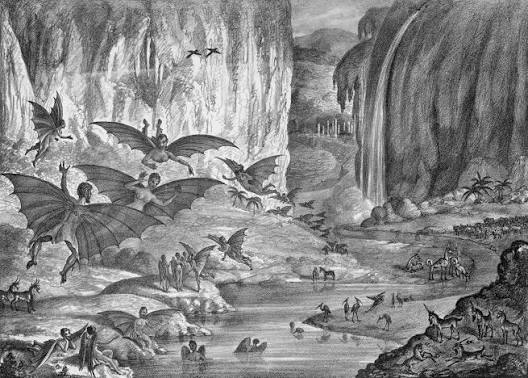
On 25 August 1835, readers of New York’s penny newspaper The Sun encountered news that seemed to redraw the boundaries of creation. A new telescope, the paper reported, had allowed the celebrated astronomer Sir John Herschel to see forests, beaches, bison-like animals, horned goats, upright beavers, and winged humanoids on the Moon. The language was technical, the attribution prestigious, and the details arrived in installments calculated to make readers buy the next issue.
None of it was true. The six-part series now known as the Great Moon Hoax was written by journalist Richard Adams Locke and falsely presented as a report derived from Herschel’s work in southern Africa. Yet calling the episode merely a prank misses why it mattered. It succeeded at the meeting point of new mass journalism, genuine astronomical excitement, speculative theology, and a public learning to navigate unfamiliar forms of scientific authority.
The hoax also attracts myths of its own. It is often said that every reader believed it, that leading scientists rushed to verify it, or that the story single-handedly created modern fake news. The evidence is more complicated. Some readers believed, some doubted, some enjoyed the spectacle without caring whether it was factual, and rival editors rapidly attacked the story. Its real importance lies not in proving that nineteenth-century people were uniquely gullible, but in showing how credibility can be manufactured from a mixture of truth, prestige, novelty, and commercial pressure.
New York’s Penny Press Before the Hoax
The Sun was founded by Benjamin Day in 1833 and sold for one cent, far less than the six-cent papers aimed primarily at merchants, politicians, and established elites. Its price opened newspaper reading to clerks, artisans, laborers, and other urban customers. The new business model depended on large circulation and advertising rather than chiefly on subscriptions or party patronage.
That model changed what counted as news. Crime, accidents, court cases, city curiosities, and human-interest stories could draw buyers from the street. The paper did not invent sensational reporting, but it demonstrated how quickly an inexpensive daily could turn attention into revenue. Competition among penny papers rewarded stories that were immediate, vivid, and easy to discuss.
The Great Moon Hoax fit this environment perfectly. It combined respectable science with serialized suspense and fantastic imagery. Each installment made the next one more valuable. The story was therefore both a literary performance and a commercial newspaper event, created for a medium in which wonder could be sold one copy at a time.
Why Sir John Herschel Was the Perfect Authority
John Herschel was not a fictional scientist. He was one of the most respected astronomers of his age, the son of William Herschel, discoverer of Uranus. In the 1830s John Herschel was conducting a major survey of the southern sky from the Cape of Good Hope. His real location, distant from New York and difficult to contact quickly, gave the invented reports plausibility and delayed authoritative contradiction.
The articles claimed to transmit discoveries made through an enormous “hydro-oxygen” telescope. Technical descriptions of lenses, illumination, magnification, and projected images sounded impressive to general readers. They also mixed real scientific vocabulary with impossible engineering. The apparatus allegedly produced detailed lunar views far beyond the capabilities of any telescope then existing.
The choice of Herschel supplied borrowed credibility without his knowledge or consent. The reports did not simply say that anonymous observers had seen life. They attached the claim to a living authority already associated with ambitious observational work. This strategy remains familiar: a false assertion becomes more persuasive when placed beside genuine expertise.
The Fictional Chain of Sources
The hoax concealed responsibility behind multiple layers. The Sun suggested that it was reproducing material connected to an Edinburgh scientific publication. The supposed narrator was “Dr. Andrew Grant,” described as Herschel’s companion or amanuensis. Grant did not exist, and the Edinburgh Journal of Science invoked by the series had ceased publication.
These layers made the account resemble imported scientific news rather than an original New York fabrication. A local newspaper appeared to be passing along a report from a learned British source, written by a man close to the observations. Readers would have needed both specialist knowledge and access to distant publications to check the chain promptly.
The technique also gave Locke literary freedom. He could praise Herschel, explain the instrument, and describe observations through a fictional intermediary rather than impersonating the astronomer directly. The result was a document that looked like reportage while operating like a fantastic travel narrative.
What the Six Articles Claimed
The series built its lunar world gradually. Early installments described geological formations, oceans, beaches, vegetation, and animals. The imagined creatures included bison-like quadrupeds, goats, small zebras, unicorns, and tailless beavers that walked upright and appeared to use fire. Familiar earthly forms made the strange landscape easier to visualize.
The most famous inhabitants were winged humanoids named Vespertilio-homo, literally “bat-man.” They supposedly conversed, gestured, flew, and displayed social behavior. Later descriptions introduced larger and more refined varieties and elaborate structures, including a temple built from blue stone or sapphire-like material.
Locke used accumulation rather than one abrupt miracle. A barren surface became a living ecosystem, then a civilized world. Every new observation seemed to follow from the telescope’s extraordinary power. The mounting extravagance could signal satire, yet serialization encouraged readers to suspend judgment until the full report appeared.
The Telescope That Could Not Have Worked
The imaginary telescope was essential because ordinary astronomy could not support the story’s level of detail. The articles described an immense lens and a system that supposedly projected a brightly enlarged lunar image onto a screen. Contemporary readers familiar with popular accounts of optical innovation might accept that a breakthrough had overcome previous limits.
In reality, the design ignored fundamental constraints. Magnification cannot create detail that an instrument’s aperture and the atmosphere fail to resolve. Projecting and enlarging a blurred image only produces a larger blur. The claimed view of small animals and architecture on the Moon was far beyond nineteenth-century optics.
That does not mean only the uneducated could be fooled. Most readers could not personally test advanced optical claims, and rapid technological change made once-impossible achievements seem plausible. Steam power, railways, industrial machinery, and improved instruments had already transformed daily expectations. The fictional telescope succeeded because it exaggerated a real culture of invention.
Life on the Moon Was Not an Absurd Question
Modern retellings sometimes mock readers for believing that the Moon might be inhabited. In 1835, however, extraterrestrial life was a respectable subject of philosophical and theological speculation. Astronomers knew the lunar surface contained mountains and craters, but the Moon’s atmosphere and physical conditions were not yet established with modern certainty.
Popular writers went much further than cautious observers. The Scottish minister and science author Thomas Dick argued that other worlds were populated and even estimated enormous numbers of inhabitants across the solar system. Earlier observers, including William Herschel, had speculated about lunar life. Claims about vegetation, buildings, or intelligent beings circulated alongside legitimate astronomy.
Locke later said his story was intended partly to satirize such confident speculation. That explanation is credible, but it does not exclude commercial motives. A satire designed for a penny paper could ridicule extravagant theories while also increasing sales. Historical intentions are often mixed rather than singular.
Who Was Richard Adams Locke?
Richard Adams Locke was an English-born journalist who worked for The Sun in New York. He possessed enough knowledge of scientific writing to imitate its tone and exploit its vulnerabilities. His authorship was not announced at the beginning, and rumors attached other names to the affair, but the evidence strongly identifies him as the writer.
Locke acknowledged authorship publicly in 1840. Later editions and recollections further connected him with the series. Claims that a French astronomer, Joseph-Nicolas Nicollet, secretly devised the hoax have circulated, but documentary support is weak. Responsible histories distinguish these rumors from the well-supported attribution to Locke.
His exact purpose remains debated. Satire of speculative astronomy, criticism of religious cosmology, literary amusement, professional ambition, and a desire to benefit the paper can all be present at once. Locke’s later claim of satirical intent should be considered evidence, not accepted as the only possible interpretation of a work that deliberately masqueraded as news.
Did Everyone Really Believe It?
No reliable evidence shows that the entire reading public accepted the reports literally. Contemporary responses ranged from enthusiasm to skepticism. Rival newspapers questioned the source, mocked the claims, and investigated the supposed reprint. Some readers may have recognized comic exaggeration while still enjoying the series.
Belief is also difficult to measure from newspaper commentary. Editors quoted one another, performed outrage, extended jokes, and used the controversy to sell their own papers. A person who purchased the next installment was not necessarily convinced that bat-people lived on the Moon. Curiosity and entertainment could produce the same behavior as belief.
Stories about learned delegations arriving to inspect the original scientific source are often repeated in popular accounts, but details vary and documentation is uncertain. The safest conclusion is that the hoax persuaded many readers, intrigued many more, and generated a public debate in which belief, doubt, and playful participation overlapped.
Circulation Claims and Commercial Success
The series unquestionably brought The Sun extraordinary attention. Copies were reprinted, discussed, and circulated beyond New York. Pamphlet versions and illustrations extended the story’s life. The newspaper strengthened its position within the rapidly expanding penny-press market.
Exact circulation figures require caution. Later accounts often state that sales reached roughly 19,000 copies a day or made The Sun the world’s most widely circulated newspaper. Such figures are plausible in outline but come from interested newspapers and retrospective histories rather than modern audited data. They should not be treated as perfectly precise measurements.
What can be confirmed is the commercial logic. Spectacle created attention; attention sold papers; circulation attracted advertisers. The hoax demonstrated that fabricated scientific wonder could function as a commodity even after doubts emerged. Readers were buying an event as much as a factual report.
Rival Newspapers, Exposure, and the Lack of a Clean Retraction
New York’s newspaper competition ensured that the story would not go unchallenged. James Gordon Bennett’s New York Herald attacked the claims and identified weaknesses in the source trail. Other editors repeated extracts, expressed doubt, or joined the spectacle. The argument itself became fresh content.
There was no single dramatic moment when every reader learned the truth. The fabrication became increasingly apparent through criticism, failed verification, and public discussion. The Sun did not immediately publish the kind of explicit correction expected from a modern news organization. Its response mixed defense, humor, and continued exploitation of the publicity.
This messy ending explains why later summaries disagree about when the hoax was “revealed.” Deception can collapse socially before its creator offers a formal confession. By the time Locke acknowledged authorship years later, the episode was already widely remembered as the Moon Hoax.
Edgar Allan Poe and the Question of Influence
Edgar Allan Poe had published “The Unparalleled Adventure of One Hans Pfaall” shortly before the Moon series. His tale described a fictional voyage to the Moon and used elaborate technical detail. Poe initially argued that Locke’s hoax resembled or borrowed from his work, though the two narratives also drew on a larger tradition of imaginary lunar voyages.
The dispute reveals how uncertain genre boundaries had become. Newspapers printed fiction, satire, reports, advertisements, and anonymous material side by side. A technically styled story might be read as imaginative literature in one setting and factual news in another.
The Moon Hoax belongs to the prehistory of modern science fiction, but it was not simply a science-fiction story mislabeled by accident. Its newspaper presentation and false attribution were integral to its effect. The reader’s uncertainty was part of the design.
Satire, Deception, and “Fake News”
Calling the series an early example of “fake news” is understandable but incomplete. It was fabricated content presented in a newspaper under false scientific authority. At the same time, Locke’s satire targeted claims that already blurred theology, speculation, and science. The work mocked misinformation by producing more misinformation.
Modern labels can conceal nineteenth-century media conditions. There were fewer professional reporting standards, corrections were inconsistent, and partisan newspapers routinely mixed advocacy with information. Yet readers were not without critical habits. They compared papers, recognized political motives, and learned to distrust sensational claims.
The most useful comparison with the present concerns mechanisms rather than moral equivalence. Prestigious names, technical language, inaccessible sources, repeated sharing, commercial incentives, and emotional novelty can still make weak claims persuasive. The platforms have changed; the architecture of credibility remains recognizable.
A Hoax Within a Culture of Speculation
The articles appeared during intense popular interest in astronomy. Halley’s Comet returned in 1835, observatories were expanding, and public lectures made science part of urban entertainment. The boundaries between expert research and popular wonder were especially porous.
The imagined lunar world also reflected earthly hierarchies. Locke described species in ascending ranks of refinement and intelligence, using assumptions about civilization familiar to nineteenth-century readers. Scholars have therefore read the series not only as astronomical satire but also as a text shaped by contemporary ideas about race, order, religion, and empire.
Those interpretations are valuable when presented as interpretations rather than settled authorial instructions. Locke did not leave a complete guide explaining every symbol. The articles can expose the cultural categories of their time without every detail having one provable allegorical meaning.
What the Great Moon Hoax Changed
The hoax did not create sensational journalism from nothing, nor did it immediately produce a modern press code. Its influence was cumulative. It showed publishers how serialized scientific spectacle could enlarge an audience and demonstrated how a mass newspaper could become the center of a shared cultural event.
It also generated copies, illustrations, pamphlets, plays, and later historical retellings. The creatures outlived the correction because they were memorable. Falsehood proved culturally durable even when literal belief faded—a pattern familiar from other spectacular deceptions, including the site’s account of the Poyais affair, where persuasive publicity transformed an invented country into a deadly investment scheme.
The deeper legacy is the problem of verification at speed. The claim moved faster than authoritative correction could travel from South Africa. In that delay, newspapers, readers, and competitors created meanings of their own. Communication technology has accelerated dramatically since 1835, but faster correction has not eliminated the advantage enjoyed by an astonishing first claim.
Common Myths About the Great Moon Hoax
Myth: all New Yorkers believed the articles. Many were persuaded or fascinated, but skepticism appeared quickly and purchasing a paper does not prove literal belief.
Myth: Herschel participated in the deception. He was an involuntary source of authority. His real expedition provided the setting, not the fictional discoveries.
Myth: Locke’s only aim was satire. He later emphasized satire, but commercial and professional incentives were inseparable from publication in a competitive penny paper.
Myth: the hoax was exposed in one decisive confession. Doubt accumulated through rival reporting and failed verification. Locke’s public acknowledgment came later.
Myth: it was the first fake newspaper story. Fabrications and hoaxes long predated 1835. The episode is distinctive for its scale, serialization, scientific performance, and place in the rise of mass-market journalism.
Conclusion: Why the Moon Story Still Matters
The Great Moon Hoax worked because it was built from real parts. Herschel was real, his southern expedition was real, telescopes were improving, lunar life was seriously discussed, and penny newspapers were creating new audiences. Locke inserted impossible creatures into a framework of recognizable facts and let authority carry imagination across the line into news.
Its history becomes less useful when reduced to a morality tale about foolish readers. The public response included belief, doubt, amusement, and opportunism. Rival editors could condemn the deception while profiting from the controversy. Locke could claim satire while helping his employer sell papers. These contradictions are the story.
The episode endures because it exposes a permanent weakness in information systems: people must often judge unfamiliar claims before direct verification is possible. They rely on names, institutions, style, repetition, and the reactions of others. In August 1835, those signals pointed toward bat-people on the Moon. The creatures were imaginary, but the machinery that made them credible was entirely real.
Research and Further Reading
- Library of Congress: “Peoples and Creatures of the Moon”
- Smithsonian Libraries: digitized edition of The Moon Hoax
- Library of Congress: primary-source teaching collection
- Hungarian Journal of English and American Studies: “The Great Moon Hoax of 1835”
- University of Michigan Clements Library: “Life on the Moon in Two Acts”