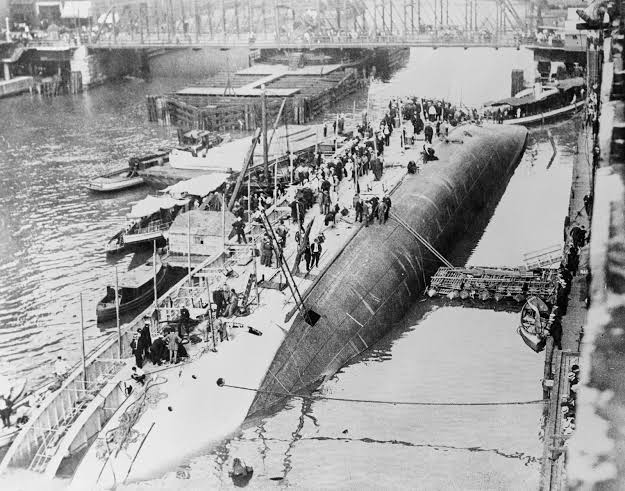
On the morning of July 24, 1915, thousands of workers and relatives gathered beside the Chicago River for what should have been a summer excursion. The steamship Eastland was still tied to the wharf when it began leaning away from the dock. Within minutes, the vessel rolled onto its port side in water scarcely twenty feet deep. People standing on the upper deck were thrown into the river. Hundreds below were trapped inside a steel hull that had become a wall.
The SS Eastland disaster killed 844 people, according to the figure now generally accepted by Chicago institutions and specialist historians. It was the deadliest single event in the city’s history and the greatest loss of life from a single shipwreck on the Great Lakes. Yet the ship never reached open water, met a storm or struck another vessel. It capsized at its berth on a calm morning.
That strange setting encouraged a simple explanation: safety rules passed after the Titanic required extra lifeboats, making the Eastland top-heavy. Added equipment did worsen its condition, but it was not the whole cause. The catastrophe grew from a vessel with a long record of instability, alterations that reduced its safety margin, regulatory failures, passenger loading and confused responsibility. Its victims were largely working-class immigrant families, a fact that also shaped how America remembered—or failed to remember—the disaster.
What Was the SS Eastland?
The Eastland was built in 1903 by the Jenks Ship Building Company at Port Huron, Michigan. Designed as a fast passenger steamer, it operated on the Great Lakes and carried excursion crowds between cities and resort destinations. The ship was about 265 feet long, with several passenger decks rising above a relatively shallow hull.
A vessel’s stability depends not simply on weight but on where that weight sits and how the hull responds when it heels. The Eastland had a comparatively high superstructure and limited internal volume low in the hull. Crowds moving between decks could change its balance noticeably. Operators used water ballast tanks to improve stability, but filling or emptying them required judgment and time.
The ship acquired a troubling reputation early. It listed during loading, and previous incidents prompted complaints and operating restrictions. These warnings did not prove that a fatal capsize was inevitable, but they showed that the vessel had little tolerance for unfavorable loading conditions. Its instability was not discovered for the first time in 1915.
A Company Picnic for Hawthorne Works Families
Western Electric’s Hawthorne Works in Cicero employed thousands, many of them immigrants or children of immigrants from Central, Eastern and Northern Europe. The annual company picnic was an important social event. For the 1915 outing, chartered steamers were to carry employees, relatives and friends from Chicago to Michigan City, Indiana.
The Eastland was the first vessel scheduled to depart. Passengers began boarding early, dressed for a day of music, games and dancing. Entire households came together. Many carried food or picnic belongings, while musicians and company organizers prepared for the celebration. The crowd represented the dense family and neighborhood networks surrounding the Hawthorne plant.
Calling the passengers merely “factory workers” hides their diversity and the scale of the family loss. Czech and other immigrant communities in Cicero and Chicago were hit especially hard. Some streets lost residents from several homes; twenty-two entire families were reportedly wiped out. The disaster was at once an industrial-community tragedy and a maritime one.
The Final Minutes at the Chicago River Wharf
Boarding took place along the south bank of the Chicago River between Clark and LaSalle Streets. By about 7:10 a.m., roughly 2,500 passengers were aboard. The vessel had not cast off. As people settled on the decks, the Eastland developed a list to port, away from the wharf.
A small list could sometimes be corrected with ballast or by shifting passengers. On this morning the angle increased, eased and then returned. Crew members attempted to respond, but the ship’s stability margin was dangerously small. At approximately 7:28, the vessel rolled sharply and came to rest on its port side in the river.
The capsize happened so quickly that many people had little chance to understand what was occurring. Those on the exposed starboard side clung to rails or climbed onto the hull. Those thrown into the river struggled in crowded water beside the ship. Below deck, stairways, doors and windows rotated out of their familiar positions as furniture and people fell across the compartments.
Why Shallow Water Became a Death Trap
The river was shallow enough that much of the overturned ship remained visible. That fact made the death toll seem incomprehensible, but depth was not the decisive issue for passengers trapped inside. Once the Eastland lay on its side, the lower port-side openings were underwater and the starboard side rose above them. Corridors became vertical shafts, while doors and staircases were blocked by bodies, furniture and debris.
Many passengers had gone below because the morning was cool and damp. They were inside enclosed decks when the ship rolled. Heavy objects—including tables and a piano—shifted violently. Some victims drowned; others were crushed or suffocated in spaces rescuers could not reach quickly.
The steel hull also obstructed access. Rescuers broke through plates and cut openings, but every decision carried risk for survivors within. A capsize at a dock was not a gentle settling. It was a sudden reorientation of a crowded interior, turning ordinary fittings into obstacles and leaving air pockets that could vanish as water entered.
Rescue on the River
The response began immediately. Nearby vessels moved alongside the exposed hull, allowing survivors to climb or jump to safety. Tug crews, police officers, firefighters, divers and ordinary bystanders pulled people from the water. Workers used ropes, ladders and improvised bridges. Others smashed windows or cut into the ship to reach compartments.
Western Electric nurse Helen Repa became one of the best-known responders. She reached the scene, climbed onto the hull and helped organize medical assistance and the movement of victims. Her later account, published in the company’s memorial issue, offers valuable testimony, though no single witness saw every part of the chaotic rescue.
Temporary treatment areas and morgues appeared in nearby buildings. The Reid, Murdoch & Company warehouse received victims, while the Second Regiment Armory became the principal place for identifying the dead. Families moved among lists and rows of bodies seeking relatives. The work continued after the possibility of rescue had largely become recovery.
Who Died in the Eastland Disaster?
The accepted death toll is 844: 841 passengers and three crew members in many modern tabulations, although older publications sometimes give different totals. Variations resulted from incomplete passenger records, initial confusion and later corrections. A precise count should not be replaced by contemporary newspaper estimates that reached or exceeded one thousand.
Women and children formed a large share of the dead. This was not simply because they were physically weaker, as some period commentary implied. Families had gathered in particular passenger spaces, many people were below deck, clothing could impede movement in water, and the capsize created different escape opportunities depending on exact location.
The victims’ names reveal the immigrant geography of industrial Chicago. Czech families suffered particularly heavy losses, alongside Polish, German, Norwegian, Swedish, Irish, Italian, Hungarian and other communities. Their identities challenge the habit of narrating disasters only through famous individuals. The Eastland carried few wealthy celebrities, but it devastated neighborhoods.
The Ship’s Long Record of Instability
The Eastland had displayed alarming behavior years before the disaster. Crowds moving to one side could cause pronounced listing, and the ship nearly capsized during an earlier incident at South Haven. Inspectors, owners and crews therefore had repeated opportunities to recognize that passenger distribution and ballast demanded unusual care.
Historian George W. Hilton’s detailed study, based on technical and legal records, argued that the ship was stable when completed but became only marginally stable after early modifications. Changes to cabins, deck arrangements and other structures altered the relationship between the center of gravity and the hull’s ability to right itself.
Stability is not a fixed label of “safe” or “unsafe.” It changes with fuel, ballast, passengers, cargo and modifications. A vessel may perform acceptably underway yet become vulnerable while loading. That complexity allowed warning signs to be normalized: because earlier lists had been corrected, operators could treat them as manageable rather than evidence of a shrinking safety margin.
Did Titanic-Era Lifeboat Rules Cause the Disaster?
After the Titanic sank in 1912, public pressure produced stronger lifesaving requirements. The 1915 Seamen’s Act required vessels to carry adequate boats and rafts. Shortly before the picnic, the Eastland received additional lifeboats and liferafts high on its decks. Their weight raised the center of gravity and worsened an existing stability problem.
This connection is real, but “lifeboats sank the Eastland” is an oversimplification. The law did not design the ship, make its earlier alterations or erase its documented history of listing. Owners and regulators had options, including limiting passenger capacity or demanding stability changes. Safety equipment became dangerous only within a system that treated one requirement separately from the vessel’s overall condition.
The disaster therefore illustrates unintended consequences without proving that regulation itself was misguided. Rules aimed at one hazard—too few escape boats after a sinking—interacted with another hazard, transverse instability. Effective safety oversight has to evaluate the complete system rather than count equipment.
Ballast, Passenger Movement and the Immediate Trigger
Investigators examined whether ballast tanks were properly filled and whether passenger movement initiated the final roll. The ship needed ballast low in the hull, but ballast operations could not instantly compensate for a large shifting crowd. Testimony differed over tank conditions and the sequence of crew decisions.
Passengers did gather on upper decks and moved as the ship leaned. Yet blaming them mistakes a normal excursion crowd for an abnormal hazard. A licensed passenger vessel should retain an adequate margin when passengers occupy permitted spaces. Their movement may have influenced the final moments without being the underlying cause.
There was no single dramatic impact or mechanical explosion. The immediate capsize emerged from interacting factors: marginal stability, high weight, loading pattern, ballast response and a crowded vessel near its licensed capacity. Historians can reconstruct those conditions more confidently than they can identify one person’s action at one exact second.
Investigations, Trials and Divided Responsibility
Local and federal investigations began almost immediately. The ship’s officers, owners, charterers and federal steamboat inspectors all faced scrutiny. Prosecutors pursued criminal cases, and civil litigation continued for years. The abundance of proceedings did not produce a simple, universally accepted assignment of blame.
Chief engineer Joseph Erickson became a major target because ballast management fell within his responsibilities. Later historical analysis has often treated him as a convenient individual on whom a systemic failure could be concentrated. Captain Harry Pedersen, company officials and inspectors likewise defended their decisions by pointing to licenses, practices or other actors.
Criminal convictions did not provide the sweeping accountability many families expected. Legal standards required proof tied to particular defendants, while the disaster arose from accumulated design and regulatory decisions distributed across institutions. The gap between historical responsibility and courtroom liability is central to understanding the aftermath.
Compensation and the Limits of Legal Recovery
Western Electric contributed relief funds and community organizations supported bereaved families. But charity did not replace lost wages, parents or children. Many households depended on Hawthorne Works income, so emotional catastrophe and economic insecurity arrived together.
Maritime law also limited avenues for compensation. Ship owners sought to restrict liability, and claims became entangled in arguments about ownership, charter arrangements, seaworthiness and negligence. Years of litigation could exhaust families with fewer resources than the corporations and insurers involved.
The aftermath resembles other technological disasters in which responsibility is spread among designers, operators and regulators. As with the later St. Francis Dam disaster, technical failure cannot be separated from institutional confidence and the question of who was empowered to stop an unsafe system.
The Eastland’s Second Life as USS Wilmette
The overturned vessel was raised from the Chicago River, repaired and sold to the United States Navy. Renamed USS Wilmette, it served on the Great Lakes, principally as a training ship. Modifications removed much of the passenger superstructure and changed the stability characteristics that had made the excursion steamer dangerous.
This second life produced one of the story’s strangest contrasts. A hull associated with Chicago’s deadliest day remained in service for decades and survived the Second World War era before being scrapped in 1947. The ship itself did not vanish with its victims.
The conversion also demonstrates that the 1915 catastrophe cannot be explained by a cursed or inherently doomed object. Engineering configuration and operating purpose mattered. Altered for naval use, with a different profile and loading regime, the vessel could function. The disaster belonged to a particular technical and institutional arrangement.
Why the Eastland Was Overshadowed
The Eastland capsized between the sinking of the Titanic in 1912 and the torpedoing of the Lusitania in May 1915. Those ships became international symbols: one of technological arrogance, the other of wartime violence. The Eastland had no ocean crossing, iceberg or enemy submarine to anchor a global narrative.
Its victims were mainly working-class immigrant families rather than prominent travelers. The catastrophe also occurred while Europe was at war, when newspapers rapidly shifted attention. Local communities remembered intensely, but national culture gave the event less durable space.
There was another difficulty: the disaster lacked a satisfying ending. No single villain was conclusively punished, reforms could not restore families, and the salvaged ship returned to service under another name. Memory often favors stories with clear heroes, enemies or lessons. The Eastland offered painful evidence of ordinary institutions failing together.
What Is Confirmed, Disputed and Mythologized?
Confirmed: the Eastland capsized while tied to the Chicago River wharf on July 24, 1915; approximately 2,500 people were aboard; 844 died; and the ship had a documented history of listing. Added lifesaving equipment increased high-level weight shortly before the disaster.
Strongly supported: the vessel had only a marginal stability reserve by 1915, and modifications, loading, ballast and passenger distribution interacted to cause the rollover. Responsibility extended beyond the people operating the ship that morning to owners, inspectors and a regulatory system that approved its capacity.
Disputed or uncertain: the exact condition of every ballast tank, the precise sequence of movements immediately before the final roll and how much blame belongs to each individual. Court testimony was adversarial, and later reconstructions depend on incomplete technical evidence.
Mythologized: claims that lifeboats alone caused the catastrophe or that passengers foolishly rushed to one side and sank a sound ship. The extra boats mattered, and people moved, but both explanations conceal the vessel’s prior instability and institutional warnings.
Conclusion: A Catastrophe Before Departure
The SS Eastland disaster is haunting because it overturned familiar expectations. The vessel was at the dock, the river was shallow and the passengers were beginning a holiday. None of those facts protected them when a marginally stable ship rolled onto its side in minutes.
The added lifeboats remain an important irony, but they are not a sufficient explanation. The Eastland carried years of warnings, physical alterations, regulatory compromises and institutional assumptions. On July 24, those accumulated risks met a full excursion crowd. The catastrophe was sudden; its causes were not.
Remembering the dead also requires seeing the Hawthorne Works families rather than only the overturned hull. Their immigrant neighborhoods bore losses on a scale that national memory often reserved for wealthier or more famous travelers. The Eastland is therefore more than a maritime curiosity. It is a study in engineering margins, fragmented responsibility and whose tragedies a country chooses to remember.
Research and Further Reading
- National Archives, “Steamship Eastland Disaster” — federal case records, photographs and an overview of the disaster.
- Library of Congress, “The Wreck of the Eastland, 1915” — contemporary panoramic photography and event context.
- George W. Hilton, Eastland: Legacy of the Titanic — the major technical and historical study, published by Stanford University Press.
- National Archives NHPRC, Eastland Disaster Collection — archival materials on victims, survivors and remembrance.
- Smithsonian Magazine, “The Eastland Disaster” — synthesis based substantially on Hilton’s archival research.
- Eastland Disaster Historical Society — passenger records, family histories and specialist public history resources.