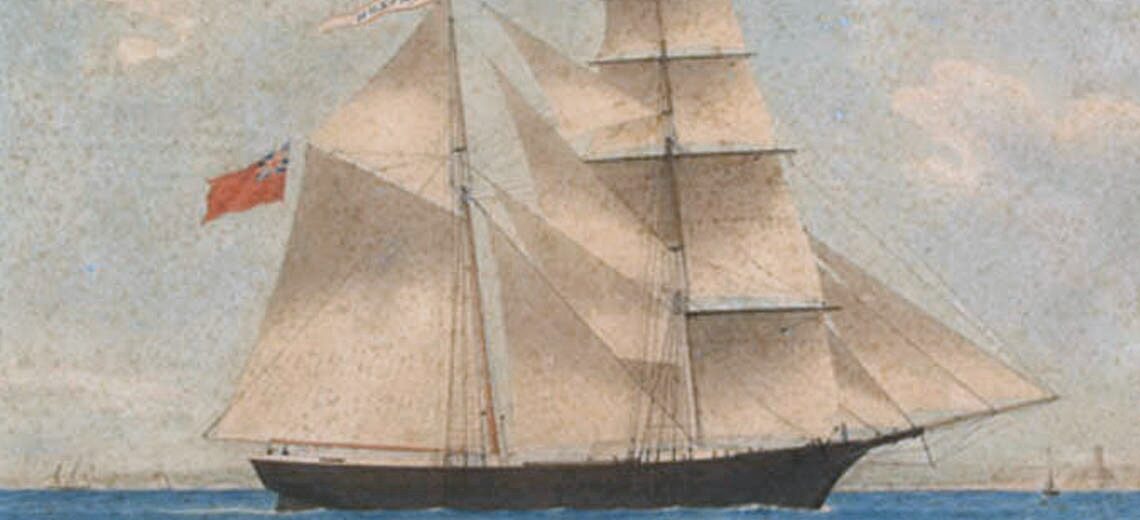
Mary Celeste mystery is a revealing historical subject because it opens a clear path into the people, events, and wider changes that shaped its era.
Few maritime stories have survived as stubbornly, and as vividly, as the mystery of the Mary Celeste. On the surface, she was just another 19th-century merchant vessel: sturdy, practical, and designed for the long, uncertain business of hauling cargo across the Atlantic. Yet when she was discovered adrift in 1872, she had become something far stranger than an ordinary ship. Her sails were partly set, her cargo was intact, and there was no sign of violence aboard. But her captain, his family, and the crew had vanished without explanation. That single contradiction transformed the Mary Celeste into history’s most famous ghost ship.
What makes the case so enduring is not simply that people disappeared. Ships and sailors vanished all the time in the age of sail. The true fascination lies in the way the evidence seems to invite certainty while withholding it at every turn. The vessel was not found in a storm-battered ruin, nor in the grip of obvious mutiny or piracy. Instead, she appeared oddly ordinary, as though the crew had only just stepped away. That gap between the ship’s calm condition and the absence of her passengers created a mystery that historians, journalists, and storytellers have been trying to solve ever since.
To understand why the Mary Celeste became a legend, it helps to look beyond the popular myth of a cursed ship and into the practical world of 19th-century Atlantic commerce. Her story sits at the intersection of trade routes, insurance anxieties, navigation risks, and maritime law. It is also a reminder that unexplained events often persist not because the facts are absent, but because the facts are incomplete. The Mary Celeste survives in history as both a real ship and a powerful symbol of uncertainty at sea.
The ship before the mystery: a very ordinary merchant vessel
The Mary Celeste did not begin as a legend. Built in the early 1860s and originally launched under another name, she was a commercial brigantine designed for the hard, practical demands of transatlantic trade. Like many ships of her era, she changed hands and names before her most famous voyage. By the time she entered the historical spotlight, she was simply one more working vessel in the busy Atlantic world, carrying industrial goods and raw materials between ports on both sides of the ocean.
That ordinary beginning matters, because it shows how unremarkable the ship really was before the mystery attached itself to her. She was not a luxury liner or a naval vessel, and she was not renowned for disaster before 1872. Instead, she operated in the middle of the merchant marine system that connected factories, mills, and overseas markets. This was an age when ships like the Mary Celeste helped knit the modern economy together, moving alcohol, manufactured goods, textiles, and other cargoes in a maritime network that depended on weather, discipline, and timing. For context, the same Atlantic world that made vessels like this profitable also made them vulnerable, and other stories of disappearance, from Rungholt: the medieval North Sea town that vanished to later sea mysteries, remind us how often water could erase the ordinary.
By the late 19th century, merchant ships were also deeply entangled in insurance concerns. A vessel could be profitable one month and a financial liability the next, and insurers watched losses carefully. That backdrop is important, because when a ship turned up abandoned, experts immediately asked not only what happened, but whether a claim might be fraudulent or whether some kind of sea emergency had been concealed. The Mary Celeste was therefore more than a mystery; she was a legal and commercial puzzle as well. The ship’s fate would be examined by captains, underwriters, and investigators who were used to translating maritime events into questions of risk, responsibility, and damage assessment.
In other words, the ghost story was built on a very real commercial world. The ship was familiar, the trade was normal, and the route was well traveled. That normality is exactly what makes the later disappearance so unsettling. Historians still return to the case because it begins in such an unremarkable place: a standard merchant voyage, a standard cargo, and a standard Atlantic crossing that should have ended in a standard arrival.
The final voyage and the discovery that changed everything
In November 1872, the Mary Celeste left New York bound for Genoa with a cargo of denatured alcohol. Captain Benjamin Spooner Briggs commanded the ship, and he was traveling with his wife, Sarah, and their young daughter, Sophia. That detail alone gives the case an extra layer of emotional weight. This was not merely a crew disappearance; it was a family vanishing together at sea. Briggs was experienced and respected, the sort of master one would expect to handle an Atlantic passage with competence and caution.
Then, on December 4, the vessel was found drifting in the Atlantic by the Dei Gratia, another merchant ship. What the crew saw was unsettling precisely because it looked, at first glance, so intact. The Mary Celeste was seaworthy enough to be brought under control, but she was adrift and apparently unmanned. The sails were in a confusing state, some set and some not, as if the ship had been adjusted in a hurry. Onboard, investigators found cargo largely undisturbed, personal effects still present, and little to suggest a struggle. Yet the lifeboat was gone, the ship’s papers were missing, and the people who had been living aboard had vanished completely.
The discovery generated immediate suspicion and fascination. In a period before radio, satellite tracking, or modern rescue systems, a missing ship was already difficult to reconstruct. The Mary Celeste was found not wrecked, but abandoned; not destroyed, but empty. That distinction matters, because it prevented the case from becoming a straightforward maritime tragedy. Instead, it became a problem of interpretation. Was the crew lost to panic? Did they abandon ship fearing an explosion? Had they been taken by violence or deception? Or was the answer stranger still?
The ship’s condition also fed the later mythology. People hear “ghost ship” and imagine something supernatural, but the real shock came from the normality of the evidence. The table was set by the life of the vessel, not by death. The cargo remained. The hull was afloat. The weather had not obviously annihilated the ship. She was, in every sense, a puzzle left behind on the water. It is this combination of order and absence that has kept the Mary Celeste at the center of maritime history for more than a century.
What historians know from the evidence aboard
The strongest historical approach to the Mary Celeste is to begin with what can actually be documented. There was no clear sign of piracy. There was no mass bloodshed. There was no visible evidence that the vessel had been struck by another ship in a catastrophic collision. The cargo of alcohol, which later inspired much speculation, was not found in the kind of explosive state that popular retellings often imply. The ship was damaged in ways that suggested rough conditions at sea, but not in a manner that automatically explains the disappearance of everyone aboard.
One of the most important facts is that the lifeboat was missing, which strongly suggests that the crew left the ship intentionally or under the impression that leaving was safer than staying. That does not mean they made the right decision, only that they likely did not vanish all at once from a violent onboard attack. Another important point is that the Mary Celeste had enough remaining seaworthiness to continue afloat, which means the ship itself was not in immediate danger of sinking when she was found. The absence of her people, rather than the destruction of the vessel, is what created the mystery.
Modern historians also take care to separate surviving testimony from later embellishment. Over the decades, the story accumulated dramatic flourishes: mutinous crews, murderous pirates, sea monsters, conspiracies, and supernatural causes. Yet the closer one gets to the original evidence, the less dramatic and the more frustrating the case becomes. The facts point to a frightened or compelled abandonment, but not to a neat conclusion. This is why the Mary Celeste has such lasting power. Like other enduring enigmas, including the Dyatlov Pass incident, it sits in the uneasy space between evidence and interpretation.
Maritime investigators of the 19th century worked under different standards than modern forensic teams, but they were not naive. They examined the ship, the cargo, the rigging, and the paperwork. They looked for signs of theft, sabotage, and fraud. What they did not find was a definitive cause. That absence of proof is central. The case remains famous not because someone produced a supernatural explanation, but because no explanation has fully mastered the available facts.
Competing explanations: from alcohol fumes to panic at sea
Over time, the Mary Celeste inspired a wide range of theories, some practical and some wildly imaginative. One of the most persistent ideas is that fumes from the cargo of alcohol created a fear of explosion, prompting the captain to order an evacuation into the lifeboat. This theory has a certain logic. If crew members believed the hold might ignite, abandoning the ship temporarily could seem like a rational choice. A sudden shift of weather or the failure to secure the lifeboat afterward could then have turned caution into catastrophe.
Another explanation centers on water inside the ship. If the crew believed the vessel was taking on more water than she actually was, they might have launched the lifeboat in hopes of regrouping nearby and returning later. That would fit the evidence of an abandoned but not sunk vessel. It would also explain why the ship’s papers were missing: perhaps the captain took them with him in case he needed to claim salvage or document the voyage after an emergency.
More sensational theories have always flourished around the Mary Celeste, including piracy, mutiny, and even paranormal intervention. But these ideas struggle against the lack of supporting evidence. A pirate attack would likely have left more obvious signs of plunder. Mutiny would usually have created evidence of conflict. Supernatural claims, while memorable, are not historical explanations in any meaningful sense. They tell us more about later audiences than about the ship itself.
The most responsible historical position is probably humility. The crew may have abandoned ship because of a perceived threat that seemed immediate and deadly at the time. They may have tried to save themselves and then lost the lifeboat in the open Atlantic. Storm conditions, poor visibility, and bad luck could have finished the story off the record. In that sense, the mystery may be less about impossible events than about the limits of reconstruction. The Atlantic is vast, and the sea keeps its own archives poorly.
This is one reason the Mary Celeste remains so compelling in comparison with other famous maritime disappearances, such as the SS Baychimo: the Arctic ghost ship that vanished. Each case contains enough evidence to invite explanation and enough uncertainty to resist closure. That combination is the fuel of historical mystery.
Why the Mary Celeste still haunts history
The lasting fame of the Mary Celeste says as much about storytelling as it does about maritime history. In the 19th century, newspapers, magazines, and later popular books helped turn the event into a sensation. The name itself became shorthand for abandonment and eerie emptiness. Over time, the ship was transformed from a commercial brigantine into a cultural icon, a vessel that seems to drift not only across the Atlantic, but across the border between fact and legend.
The story endured because it solved a deeper narrative desire: the wish to find a single, unforgettable image that can stand in for the unknown. An empty ship is that image. It captures both human vulnerability and the incomprehensibility of the sea. Readers can imagine the captain at the helm, the family below deck, the crew scanning the horizon, and then nothing. That silence is more frightening than an obvious wreck, because it refuses the closure that disaster usually provides.
At the same time, the Mary Celeste remains historically valuable because it reveals how maritime worlds really worked. Trade depended on confidence, but confidence was always shadowed by uncertainty. Insurance existed because danger was constant. Investigations existed because blame and profit had to be sorted out after every loss. The abandoned ship was therefore not just a ghost story but a case study in the fragility of global commerce. In the same broad historical imagination that looks at lost communities like Norse Greenland disappearance, the Mary Celeste reminds us that disappearance often leaves behind systems of explanation as well as unanswered questions.
And that is why the mystery has endured. Historians know a great deal about the ship, her route, her cargo, and the circumstances of her discovery. They know enough to reject the most extravagant myths. Yet they do not know enough to close the case completely. The Mary Celeste remains suspended between fact and uncertainty, a real vessel that has become a symbol. More than 150 years later, she still drifts through our imagination, not because we believe she was haunted, but because the evidence she left behind is haunting enough on its own.
In the end, the Mary Celeste is famous not simply because nobody came home, but because everything else about the ship looked so normal. That contrast is what makes the story unforgettable. She was a merchant ship in a merchant age, a working vessel on an ordinary route, and yet her final chapter still resists complete explanation. For historians and readers alike, that unresolved gap is exactly what makes her the most famous ghost ship in history.
Research and further reading
For readers who want to verify details or continue researching this subject, these external reference collections provide useful starting points: