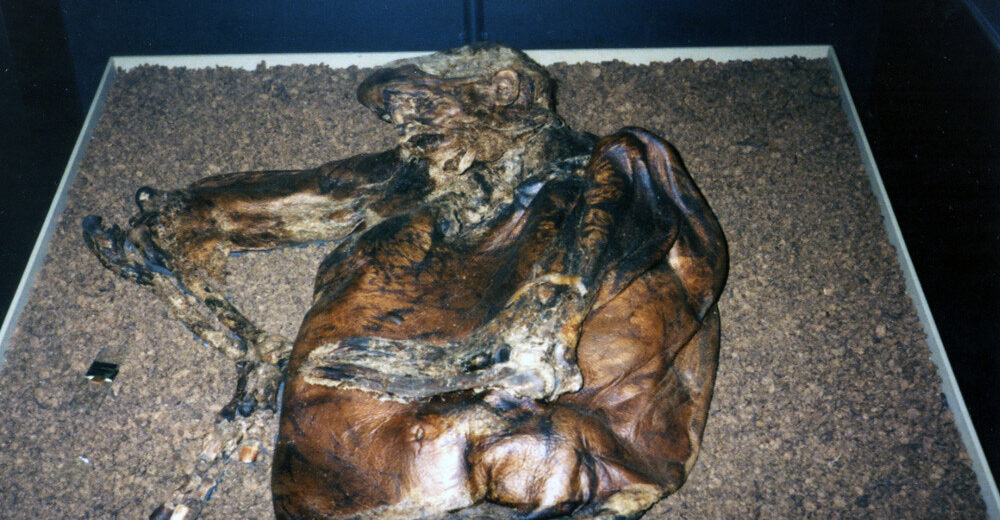
When people think of archaeology, they often imagine broken pots, buried walls, or the slow piecing together of a vanished settlement. Lindow Man is different. He was not a house, a temple, or a hoard of objects. He was a person, preserved almost intact by a peat bog, emerging from the ground in 1984 with a face, hair, skin, and a story that forced British archaeology to rethink what the past could look like when it was suddenly, and unforgettably, human.
Known as one of Britain’s most famous bog bodies, Lindow Man was discovered in Cheshire and quickly became far more than a sensational find. His body sparked debates about Iron Age ritual, violence, preservation, scientific dating, and the ethics of studying human remains. It also captured public imagination in a way that few archaeological discoveries do. Like Sutton Hoo in an earlier generation, Lindow Man changed how a country saw its ancient past—not as a collection of distant abstractions, but as something physically present, fragile, and deeply human.
What makes his story so compelling is that it sits at the intersection of science and mystery. Researchers examined his bones, tissues, stomach contents, and injuries with remarkable care, yet no single explanation has ever fully settled the question of who he was or why he died. That uncertainty is part of the fascination. Lindow Man remains one of the clearest examples of how archaeology can transform a chance discovery into a national conversation about identity, ritual, and the treatment of the dead.
The 1984 discovery that stunned British archaeology
Lindow Man was discovered in August 1984 in Lindow Moss, a peat bog near Wilmslow in Cheshire. The find was made during peat cutting, a process that had already produced fragments of human remains, but nothing quite like this. At first, the discoverers did not realize they had found one of the best-preserved bog bodies ever uncovered in Britain. The body was removed and examined, and as scientists began to understand what they had, the scale of the discovery became clear. Here was a man from the Iron Age whose skin and soft tissues had survived in astonishing detail because of the bog’s cold, acidic, oxygen-poor environment.
The excitement around the discovery was not simply because the body was old. Archaeology often deals with traces of the dead, but Lindow Man seemed to collapse the distance between the modern observer and the ancient individual. His features were recognizable enough to feel immediate. His head, preserved with hair and beard, made him feel less like a relic and more like a witness from another world. For the public, this was gripping. For archaeologists, it was both thrilling and sobering, because the find offered extraordinary evidence but also posed difficult questions about excavation, conservation, and interpretation.
The circumstances of discovery also highlighted a recurring truth in archaeology: some of the most important finds come from landscapes shaped by industry, drainage, and peat extraction, not by planned excavation. In that sense, Lindow Man belongs to a wider story of accidental discoveries that forced scholars to act quickly and carefully. The body was eventually transferred for preservation and study, and his remains became central to museum display, research, and public engagement. The fact that he survives in the national imagination today owes much to that moment in 1984, when a peat bog in Cheshire unexpectedly produced one of the most important human discoveries in British archaeology.
What scientists learned from the body itself
Once Lindow Man had been recovered, scientific analysis began to reveal the details hidden inside the preserved body. Archaeologists and pathologists studied his bones, soft tissue, and organs, and each layer added another piece to the puzzle. One of the most remarkable aspects of the find was the survival of his stomach and intestinal contents. This made it possible to infer something about his last meals, which appear to have included cereal-based food, likely a simple and earthy Iron Age diet. The evidence suggested he had eaten relatively recently before death, helping researchers reconstruct a final day rather than merely a final century.
Physical examination also revealed that he was an adult male, and although his exact age at death has been debated in broad terms, he was likely in early middle adulthood. He was not, in other words, an elderly man at the end of a long natural life. His body also showed signs of hard living: worn teeth, evidence of a robust but demanding existence, and traces consistent with manual labor or an active rural life. In a region and era where daily survival depended on land, livestock, and seasonal work, this is hardly surprising, but the body made those generalities vividly specific.
Perhaps the most important scientific contribution was the certainty that came from preserving the body rather than merely cataloguing bones. Bog bodies are rare precisely because they preserve soft tissue, and that offers a different kind of archaeological evidence. The results let researchers ask questions that would otherwise be impossible: what had he eaten, how had he been physically stressed, and what sequence of injuries did he suffer? This made Lindow Man a landmark case in bioarchaeology long before the field became familiar to the wider public. His remains demonstrated that ancient human bodies can serve as detailed archives of diet, health, and death, not just as symbolic relics.
Dating debates and the problem of interpreting an Iron Age death
As with many famous archaeological finds, establishing the date of Lindow Man was not simply a matter of placing him neatly in a century. Radiocarbon dating placed him in the late Iron Age, broadly around the first century CE, but the process of dating bog bodies can invite debate because preservation conditions, contamination concerns, and the interpretation of associated evidence can complicate the picture. Scientists worked to refine the chronology, and while the broad placement in the later pre-Roman Iron Age has held firm, the exact framing of his death has remained a subject of scholarly discussion.
The dating mattered because it shaped interpretation. If Lindow Man belonged to the period just before or during the early years of Roman rule in Britain, his death might be read against a backdrop of cultural change, tension, and evolving ritual practice. That does not prove a direct connection to Roman conquest, but it does place him in a period of transition, when local communities were negotiating older traditions and new political realities. Archaeology often works this way: a date is never just a number. It changes the story we think we are telling.
At the same time, Lindow Man’s discovery highlighted the limits of certainty. Even with extraordinary preservation, archaeology cannot always explain motive. The body can tell us what happened physically, but not always why. This is where interpretation becomes careful and contested. Was he a victim of violence? A ritual offering? An executed criminal? Some combination of these, or something entirely different? Scholars have explored each possibility, and the debate has never been idle speculation. It reflects a serious archaeological problem: human remains from the past often sit at the edge between evidence and meaning. That tension is part of what made Lindow Man so transformative for British archaeology. He did not provide a simple answer; he made the questions harder, and therefore more interesting.
In that respect, the discovery sits alongside other world-famous archaeological finds that changed the discipline by forcing a rethink of assumptions, whether about symbolism, science, or the use of new techniques. The key lesson was that interpretation must move carefully between laboratory results and cultural context, never assuming that one automatically solves the other. Lindow Man became a masterclass in exactly that balance.
Injuries, death, and the possibility of ritual sacrifice
One reason Lindow Man has remained so famous is the set of injuries found on his body. These were not random marks of decay. He had suffered multiple blows and wounds, including trauma to the head, neck, and upper body. His throat had been cut, and there was evidence suggesting strangulation or pressure around the neck. Together, these injuries created a disturbing picture of a violent death. The sequence of trauma has been studied intensely because it may indicate a deliberately staged killing rather than an accidental death or a simple murder.
This has led many scholars to consider the possibility of ritual sacrifice. In Iron Age studies, bog bodies are often discussed as part of a broader pattern of exceptional treatment of the dead. Some were placed in wetlands, possibly as offerings in liminal landscapes associated with the gods, the ancestral dead, or both. The bog itself may have been seen as a boundary zone, a place neither fully land nor water, and therefore appropriate for special deposition. Lindow Man’s injuries have often been interpreted in this context: a head blow, strangulation, and throat cutting could be seen as a sequence with ritual significance, perhaps intended to ensure death in more than one way.
That said, caution is essential. Ritual explanations can become too convenient if every unusual death is placed under that label. Archaeologists have to weigh the evidence for deliberate killing against the possibility of execution, interpersonal violence, or a politically charged death. What makes Lindow Man so powerful is not that he proves one theory beyond dispute, but that he reveals how complex such cases are. The body suggests intention, ceremony, or at least carefully arranged violence, yet the exact meaning remains elusive. This is one reason bog bodies matter so much to archaeology: they expose the gap between physical evidence and cultural explanation.
For readers interested in how unusual objects and burials reshape our understanding of the past, the same principle can be seen in finds like a Roman grave marker, where inscription, placement, and material form all carry layered meaning. Lindow Man’s body, however, goes even further because the evidence is not carved stone but the body itself. That makes the interpretation more intimate and more unsettling.
Why bog bodies still matter: ritual, memory, and the public imagination
Lindow Man’s importance extends well beyond his own death. He changed British archaeology because he showed how a single find can connect scientific analysis, ancient ritual, museum practice, and public memory. Bog bodies are so compelling partly because they resist the neatness we often expect from archaeology. They are not cleanly arranged burials or richly furnished tombs. They are bodies, shaped by peat, time, and often violence, preserved in a landscape that seems almost designed to keep secrets. That combination makes them uniquely powerful evidence for Iron Age ritual practice, especially when scholars try to understand the relationship between wetlands, offerings, and concepts of sacred space.
At the same time, bog bodies raise profound ethical questions. To study Lindow Man is to study a dead human being whose body was never meant for a museum case. Archaeologists and curators have had to balance research with respect, and that issue has become increasingly important in modern museum ethics. The display and conservation of human remains now require sensitivity to both scientific value and human dignity. Lindow Man helped push those conversations into the mainstream, long before they became standard practice.
His enduring fame also shows how archaeology can capture the public imagination when the evidence feels personal. People do not simply see an ancient corpse; they see a man with a face, a diet, wounds, and perhaps a final act of ritual meaning. That immediacy is part of why bog bodies continue to fascinate readers, visitors, and researchers alike. They remind us that the past is not made only of monuments and artifacts. It is made of people whose lives ended in circumstances we may never fully understand, but whose remains can still change how we think.
In the end, Lindow Man’s legacy lies in that rare ability to unite mystery and method. He taught archaeologists that extraordinary preservation can reveal extraordinary detail, but also that interpretation must remain humble. He showed the public that Iron Age Britain was not remote or abstract, but inhabited by real people whose deaths could be violent, meaningful, or both. And he proved that one bog body, lifted from the peat in 1984, could permanently alter the story British archaeology tells about the ancient dead.
Research and further reading
For readers who want to verify details or continue researching this subject, these external reference collections provide useful starting points: