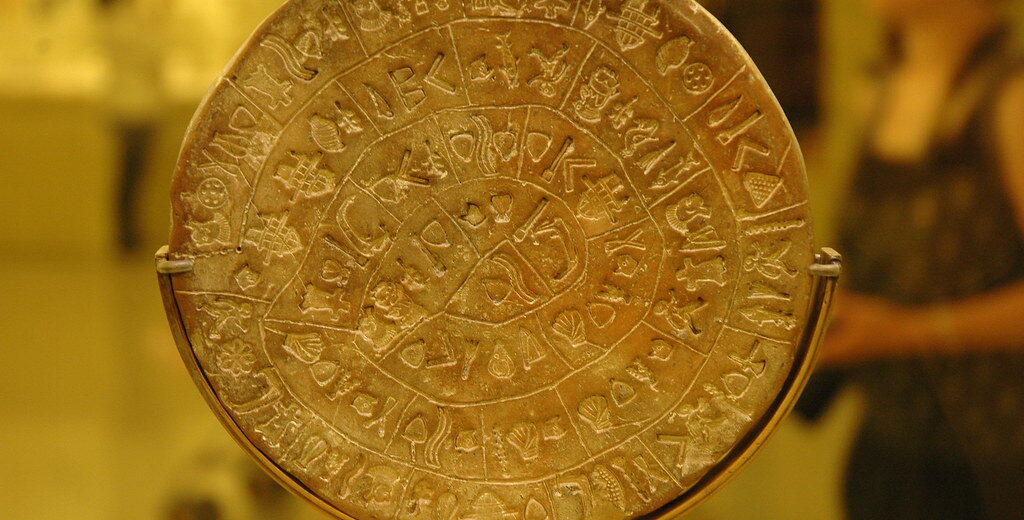
Among the great archaeological mysteries of the ancient world, few objects have captured the imagination quite like the Phaistos Disk. Small enough to fit in a hand, made of fired clay, and covered in a spiral of stamped symbols no one has definitively read, it stands at the crossroads of archaeology, linguistics, and enduring human curiosity. More than a century after its discovery on Crete, the disk remains one of the most discussed artifacts in Minoan studies, not because it has been solved, but because it has not. That unresolved quality is precisely what gives it such power. The Phaistos Disk is not simply a relic; it is a challenge left behind by a vanished civilization.
For visitors drawn to the category of Archaeology & Discoveries, the disk offers an ideal case study in how a single object can reshape scholarly debate. It raises questions about writing systems, ritual life, exchange networks, and the limits of interpretation itself. Was it a prayer? A game? A tablet of political authority? A memory aid? Or something else entirely? The answer is still uncertain. Yet the search for that answer has illuminated much about Minoan Crete and the methods archaeologists use when evidence is fragmentary, context is imperfect, and certainty is out of reach.
The 1908 discovery that turned a clay object into a world-famous puzzle
The story of the Phaistos Disk begins in 1908 at the Minoan palace site of Phaistos in southern Crete, where Italian archaeologist Luigi Pernier uncovered the object during excavations. It was found in a storage area associated with the palace, alongside other remains that suggested administrative and domestic activity, though the exact archaeological circumstances remain debated. The disk itself is modest in size, but its significance quickly became immense. Unlike broken pots or ordinary tools, it appeared to carry writing or signs arranged with deliberate care. The discovery came at a moment when excavations in Crete were transforming understanding of Bronze Age Aegean civilization, and the disk instantly stood out as unusual even in a landscape already rich in surprises.
What made it so striking was not only its condition but its method of production. The symbols were not scratched by hand in a casual way. They were stamped into the clay, one by one, using individual seals or punches, creating a precision and regularity that suggested planning and perhaps standardization. This feature alone set it apart from many contemporary inscriptions. The arrangement followed a spiraling path inward from the edge, dividing the surface into segments separated by lines. The result looked intentional, almost designed for reading, but in a form unlike the better-known scripts of the region.
From the beginning, scholars understood that they were dealing with something extraordinary. Yet the object’s context also introduced problems. It was found in a palace environment, but not in a clear archival deposit like later tablets from the Aegean or Near East. Without a larger cache of matching texts, comparison became difficult. The disk therefore entered scholarly life as both artifact and enigma, the kind of find that can elevate a site into legend. In archaeological terms, it is a reminder that discovery is only the first step. Meaning depends on context, and context can be partial, damaged, or forever incomplete.
Why the Phaistos Disk is unlike almost any other Minoan inscription
The Phaistos Disk occupies a special place in the study of Minoan writing because it is so unlike the familiar evidence from Crete. The Minoans used several writing systems, most famously Linear A, which remains undeciphered, and later Linear B, which was successfully read as an early form of Greek. The disk, however, does not fit neatly into either category. Its symbols are highly distinctive, and while some resemble figures seen elsewhere in Aegean iconography, the overall system appears unique. This uniqueness has helped fuel fascination, but it has also complicated every serious attempt at interpretation.
The disk contains a limited number of signs, repeated in a sequence that looks structured but offers too little material for easy decipherment. Scholars have long noted that the signs were impressed rather than inscribed, implying an intentional reproduction of symbols. That feature raises intriguing questions about technology and literacy in the Minoan world. Were these signs part of a broader but now lost tradition? Was the disk a one-off experiment? Or did it belong to a specialized script used in a narrow context, such as ritual or administration? Because no other comparable object has been securely found, each possibility remains open.
Its uniqueness is also why the disk has become a touchstone in broader archaeological discussions. The artifact demonstrates how writing can survive without being understood, and how an inscription can be visually legible while linguistically opaque. The Minoans left behind a civilization of palaces, frescoes, seals, and ceremonial spaces, but their written record is incomplete and fragmented. In that sense, the disk is emblematic of Minoan studies as a whole: rich in clues, short on answers. It stands alongside other famous puzzles of the ancient world, such as the Nebra Sky Disc, where symbolism and function remain deeply debated despite decades of attention.
For archaeologists, the disk’s importance is not limited to whether it can be “read.” Its value lies in the questions it forces us to ask about communication in ancient societies. Who created it? Who was meant to see it? What kinds of knowledge were encoded in it? When an object resists easy classification, it can reveal how much modern scholarship depends on pattern recognition, comparison, and assumption. The Phaistos Disk tests all three.
Decipherment attempts, bold theories, and the limits of interpretation
Few artifacts have inspired as many imaginative readings as the Phaistos Disk. Since its discovery, scholars, amateurs, and self-styled codebreakers have proposed translations ranging from religious hymns to royal decrees, calendars, magical formulas, and even board games. Some theories have been careful and methodical, while others have leaned heavily on speculation. The persistence of these efforts shows how strongly people are drawn to a mystery that appears, at first glance, as though it should be solvable. After all, the signs are repeated. The layout is ordered. The object is singular. But those same features are also what frustrate decipherment.
One difficulty is statistical. A text this short provides limited data. Even if the language behind the signs were known, the sparse sample would still make certainty difficult. Another problem is that there is no bilingual “Rosetta Stone” equivalent to anchor the reading. Researchers have tried comparing the disk’s signs with Linear A, Linear B, Anatolian languages, Semitic languages, and many others, but no proposal has won consensus. Some proposed readings rely on identifying the object as a hymn or ritual object, while others interpret the spiral as a sequence meant to be followed ceremonially. None has proved definitive.
The history of decipherment attempts is itself part of the disk’s legacy. It shows how archaeology and linguistics can become entangled with desire: the desire to solve, to name, to close the case. Yet the most responsible scholarship often accepts the opposite. The Phaistos Disk may not yield to a single solution because the surviving evidence is too thin, or because its script is not a language in the way we expect, or because the piece was never intended to function as a conventional text at all. The artifact therefore serves as a caution against overconfidence. It reminds us that interpretation must remain humble when the evidence is small.
For readers interested in other archaeological discoveries that have inspired similar debates, the pattern is familiar. Objects can become famous precisely because they resist neat explanation. Like Girsu archaeology: the forgotten Sumerian city that resurfaced, the Phaistos Disk demonstrates how excavation can open more questions than it answers, and how those questions can define a field for generations.
What the disk reveals about Minoan Crete, even without a translation
Even though the Phaistos Disk cannot yet be read with confidence, it still tells us something important about the society that produced it—or preserved it. Minoan Crete was not a primitive or isolated world. It was sophisticated, connected, and creative, with palatial centers that managed goods, rituals, and social order across a complex island landscape. The disk belongs to that environment of experimentation and symbolic communication. Its very existence suggests that the Minoans worked with systems of marks and signs that were more varied than a single script can capture.
The object also points to the importance of writing as a social technology. Writing is never just about recording speech. It can organize authority, shape identity, preserve ritual, and mark ownership or status. If the Phaistos Disk was created for ceremonial use, it may have functioned less as a document to be read in the modern sense and more as a material object with power in its own right. In many ancient societies, inscriptions mattered not only for what they said, but for what they did. They could sanctify, legitimize, or formalize action. The disk may belong to that broader world of performative text.
Its craftsmanship also reveals something about Minoan skill and aesthetics. The stamped signs were carefully arranged, implying a maker who cared about order and visual presentation. That attention to form fits well with the broader Minoan preference for elegance in frescoes, seals, and metalwork. The disk may have been functional, but it was also designed to be seen. In that sense, it bridges administration and art, utility and symbolism. Even without a translation, it gives us a glimpse into how the Minoans may have blended the practical and the ceremonial in everyday elite culture.
There is a larger lesson here as well. Archaeology often advances not through a single breakthrough, but through the slow accumulation of context. A unique object can act as a lens onto an entire civilization. The Phaistos Disk does this brilliantly. It reminds us that ancient writing systems were not merely technical codes. They were cultural expressions embedded in political, religious, and artistic life. And when one such system remains unreadable, the mystery itself becomes part of the historical record.
Why the Phaistos Disk continues to matter in archaeology today
The enduring appeal of the Phaistos Disk lies in the balance it strikes between evidence and uncertainty. It is real, not legendary; excavated, not imagined; studied, not forgotten. Yet despite all of that, its message remains elusive. That combination makes it unusually valuable in public history. It offers a clear example of how archaeology works when the past does not cooperate. Excavation can recover the object, but interpretation depends on surviving traces, comparative material, and often a great deal of patience.
Modern archaeology increasingly emphasizes context, provenance, and methodological caution, and the disk fits that outlook perfectly. Its fame should not be reduced to the romance of an unsolved puzzle. Instead, it should be seen as a case study in how fragile ancient knowledge can be. A single object, removed from its full communicative world, may survive for millennia while the system that made it meaningful disappears almost entirely. That is one reason the disk still attracts scholars. It is not just a curiosity; it is a test of what archaeological interpretation can responsibly claim.
Its continuing popularity also reflects a broader human fascination with lost writing. We are drawn to scripts we cannot read because they represent a border between presence and absence. They show us that people long before us had records, beliefs, and institutions that may never be fully recovered. In this respect, the Phaistos Disk occupies the same imaginative space as other celebrated objects that preserve mystery in material form. It reminds us that discovery does not always end with understanding. Sometimes it begins with a question that cannot be answered quickly, or perhaps ever.
That is why the disk remains essential to the history of archaeology. It is a small clay object with a giant afterlife, a symbol of both scholarly ambition and scholarly restraint. More than a century after its unveiling in Crete, the Phaistos Disk still invites new eyes, new theories, and new humility. And perhaps that is its true legacy: not a solved puzzle, but a lasting invitation to keep looking, keep questioning, and keep admitting how much the ancient world still withholds.
In the end, the Phaistos Disk endures because it refuses to become ordinary. It is not just an artifact from Minoan Crete; it is a reminder that history is often most compelling where it is least complete. The mystery of its symbols has outlived empires, scholarly fashions, and countless attempts at explanation. That may be frustrating, but it is also what makes archaeology so powerful. Every generation inherits the same object, but not the same certainty. And so the disk keeps speaking, if not in words, then in wonder.
Research and further reading
For readers who want to verify details or continue researching this subject, these external reference collections provide useful starting points: