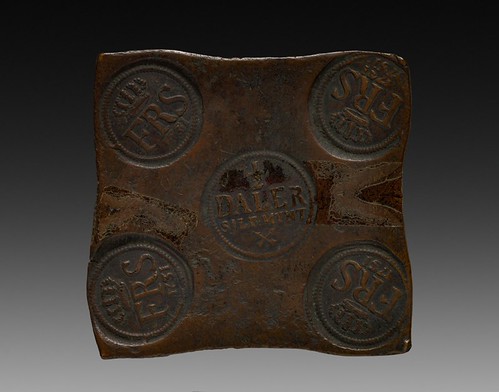
Swedish copper plate money is a revealing historical subject because it opens a clear path into the people, events, and wider changes that shaped its era.
Imagine trying to carry your money to market and needing a cart, not a coin purse. That was the extraordinary reality behind Sweden’s giant copper plate money, one of the strangest and most revealing experiments in economic history. In an age when most societies wanted coinage to be small, portable, and trusted, Sweden briefly went in the opposite direction. Because it had abundant copper but limited silver, the kingdom created money in the form of massive rectangular plates stamped with royal authority. Some weighed several pounds; the largest examples were so heavy that they tested not just the imagination of merchants, but the practical limits of what a currency could be.
This story is not just a curiosity about oversized metal pieces. It is about scarcity, state power, inflation, war finance, and the constant tension between a currency’s face value and its physical reality. Sweden’s plate money was an answer to a problem that many states have faced in different forms: what happens when the materials for money become scarce, or when a government needs to stretch the value of its metal beyond what the metal itself can comfortably support? The result in Sweden was a currency that was official, ingenious, and deeply inconvenient. It worked for a time, then became a burden so heavy that the system itself could not carry it any longer.
Why Sweden Chose Copper Instead of Silver
To understand plate money, it helps to begin with Sweden’s place in the European economy. In the seventeenth century, Sweden was not yet the modest Nordic welfare state the modern world knows, but a major Baltic power with military ambitions and expanding trade. Like other early modern states, it needed reliable money to pay soldiers, finance administration, and support commerce. Silver was the preferred metal for much of Europe’s higher-value coinage, but Sweden had a persistent problem: it did not have enough of it. Copper, by contrast, was plentiful. The country’s mines, especially those associated with Falun, made copper one of Sweden’s most important strategic resources.
That abundance created an opportunity and a headache. If a state can mine a metal in large quantities, it may be tempted to use that metal as the basis of currency. Sweden did precisely that, but with a twist. Copper was less valuable than silver, so a coin made of copper had to be much larger to represent the same monetary value. Small copper coins were possible for everyday transactions, but when larger denominations were needed, normal coin sizes became impractical. The solution was plate money: thin, broad copper slabs stamped with denomination and royal markings. In theory, the metal itself embodied value; in practice, its size was a compromise between monetary theory and the brute facts of metallurgy.
There was also a political dimension. States often prefer currencies they can control, especially in periods of military strain. By basing money on a domestic resource rather than depending entirely on imported silver, Sweden could draw on its own mines and assert monetary independence. But the choice of copper also reflected deeper conditions of scarcity. Currency systems are not just abstract rules; they are material arrangements shaped by what a country can actually produce. In that sense, Sweden’s plate money belongs in the same broad history as other unusual media of exchange, from cowrie shell money in other parts of the world to more local forms of substitute money created when standard currency was unavailable. In every case, money had to fit the realities of supply, geography, and trust.
How Plate Money Was Valued and Used
Sweden’s copper plate money was not simply a giant hunk of metal with a random price attached. It was part of an official monetary system in which the state assigned the plate a value far above the raw worth of the copper it contained. The plate might carry an inscription indicating its denomination, and its acceptability depended on royal authority and public confidence. This is an important point in economic history: money is never just metal or paper. It is a promise, a convention, and an enforced social agreement. The stamp of the crown mattered because it transformed copper into currency.
For everyday transactions, however, the system was awkward. Plate money could be used for large payments, especially in a world where taxes, state contracts, and bulk trade required substantial sums. But unlike silver coins that could be counted out in small amounts and tucked into a purse, these copper slabs had to be hauled, stored, and verified. The larger the denomination, the more the money resembled a commodity in transit than a convenient medium of exchange. A merchant receiving payment might need a wagon or strongmen to move the plates. A household saving wealth might store them in chests, vaults, or other secure spaces rather than in ordinary cupboards.
Because plate money was so cumbersome, it encouraged specialized handling. The system rewarded people with secure storage and transport capacity, while disadvantaging those who needed liquid money for daily use. That meant plate money worked better for institutions than for individuals. It was a currency for a state, for wholesalers, for tax authorities, and for large-scale exchange. But it was much less suitable for ordinary commerce. In that sense, it resembles other forms of quasi-money or restricted-value money in history, including forms of token currency that only functioned within a bounded system. The deeper problem is familiar even from later centuries: whenever money is tied too closely to a specific use or issuer, its usefulness can narrow sharply, as seen in systems like company scrip, where monetary convenience was subordinated to control.
Sweden’s plate money was valuable not because it was portable, but because it was recognized. Yet value that is too burdensome to move begins to undermine its own purpose. A medium of exchange must circulate. Copper plates could circulate, but only with effort, planning, and muscle.
The Logistics of Carrying a Currency That Weighed a Ton
The most famous feature of Sweden’s copper plate money is the sheer absurdity of its bulk. The phrase “weighed a ton” captures the spirit of the thing, even if individual plates varied in weight and were not all literally that heavy. The point remains the same: this was a currency whose physical mass made ordinary use difficult. A person could own substantial wealth in plate money and yet remain constrained by the practical problem of how to move it from one place to another. If money is supposed to make exchange easier, Sweden’s plates sometimes did the opposite.
Transport depended on carts, wagons, and organized labor. Security mattered as much as muscle. A valuable shipment of copper plates was a tempting target, so moving money involved risk, expense, and planning. Storing plate money also demanded space and protection from theft or damage. The result was a money supply that was materially “sticky.” It did not move effortlessly through the economy the way smaller coins do. That stickiness may sound like a minor inconvenience, but in financial life it is a major defect. When money cannot travel quickly, trade slows, credit relationships become more complicated, and market participants begin searching for substitutes.
There is a useful lesson here for economic history more broadly. Money works best when it is simultaneously trusted and easy to use. If it is trusted but not easy to use, it becomes a burden. If it is easy to use but not trusted, it becomes worthless. Sweden’s plate money managed the first half of that equation for a while, but the second half was always in tension with the first. The state could stamp a value on copper, yet it could not make copper light. And physical weight matters in commerce. This is why later monetary systems moved toward smaller coins, paper notes, bank credit, and eventually digital transactions. Each step in that long history was partly about reducing friction.
For ordinary people, the problem was not abstract. A market purchase could require planning around transport. A transfer of wealth might feel more like moving building materials than spending cash. Even if plate money was fully accepted, its inconvenience made it behave differently from conventional currency. In a sense, the very object lesson of Sweden’s copper plates is that money must be practical as well as official. The state can define value, but it cannot repeal gravity.
Inflation, War, and the Limits of Monetary Design
Sweden’s plate money did not fail because the concept was ridiculous from the start. It failed because the economic environment changed faster than the system could adapt. Sweden’s seventeenth-century state was deeply involved in warfare and imperial competition, and like many war-faring governments, it needed resources faster than ordinary taxation could supply them. When states face fiscal pressure, they often turn to creative monetary policies. Sometimes that means debasement; sometimes it means over-issuing notes; sometimes it means stretching the relationship between commodity and value. Sweden did all of this within the constraints of a copper-based currency, and the strain eventually became severe.
Inflation undermined the logic of plate money. If the state needs more money than the economy can comfortably absorb, it may issue more units or adjust valuations, but that can weaken confidence. Once people begin to suspect that official money is no longer a stable store of value, they seek alternatives. In Sweden, the problem was compounded by the fact that copper’s market price did not always align neatly with the government’s assigned values. When the nominal value of plate money drifted away from the underlying metal value, trust became fragile.
This is a classic economic history problem: the state’s need for revenue collides with the public’s need for a stable medium of exchange. The result can be monetary distortion. Sweden’s copper plates were not alone in this broader story. Across history, governments have manipulated coinage or created substitute forms of money to deal with shortages. Some systems endure for a while because they are convenient or because users have little choice. Others collapse quickly when confidence breaks. The border between practical adaptation and monetary failure is thin.
That collapse is the key to understanding plate money as more than a novelty. It shows that currency design has limits. Money can be symbolic, precious, or state-backed, but if it becomes too costly to use or too detached from economic reality, it begins to erode its own usefulness. In Sweden’s case, the challenge was not merely that the plates were heavy. It was that the broader fiscal and monetary system could not sustain a currency so dependent on extraordinary assumptions.
What Sweden’s Copper Plates Tell Us About Money Today
Sweden eventually moved away from plate money and toward a more conventional monetary system, but the historical importance of the experiment remains. The copper plates reveal something enduring about the nature of money: it is always a balancing act between material, authority, and utility. A currency can be backed by precious metal, by a government decree, or by confidence in a financial system, but it must still function in the real world. It has to be countable, transferable, and suited to the needs of everyday exchange. When any one of those qualities is missing, the system becomes vulnerable.
That is why Sweden’s giant copper money is so compelling to historians. It compresses, in one dramatic object, the entire struggle of economic institutions to make value portable. The plates remind us that money has had many forms: shells, metals, paper, ledger entries, and digital balances. Each form solves one problem and creates another. Copper plates solved the problem of a copper-rich but silver-poor kingdom needing official currency. They also created the problem of a currency so heavy that it sometimes felt absurd. The same tension appears, in different ways, in other monetary arrangements across history, including trade tokens, localized credit systems, and substitute monies that only worked within narrow boundaries.
Today, we tend to think of inconvenience in money as a minor design flaw. But the Swedish example shows that inconvenience can shape an entire economy. If money is too bulky, too scarce, or too hard to move, it changes who can participate easily in trade and who must bear the cost. If it loses credibility, it ceases to be money at all. Sweden’s plate money survived because people needed it and because the state stood behind it. It failed because no monetary system can forever ignore the limits of logistics, trust, and value.
That is the enduring lesson of Sweden’s copper plate money: economic history is not just about ideas on paper. It is about the weight of objects, the pressure of war, the scarcity of resources, and the stubborn fact that money must be carried by people. In Sweden, that burden became literal. The experiment eventually collapsed, but its story remains one of the most vivid demonstrations of how far a society can push a currency before physics, markets, and common sense pull it back.
Research and further reading
For readers who want to verify details or continue researching this subject, these external reference collections provide useful starting points: