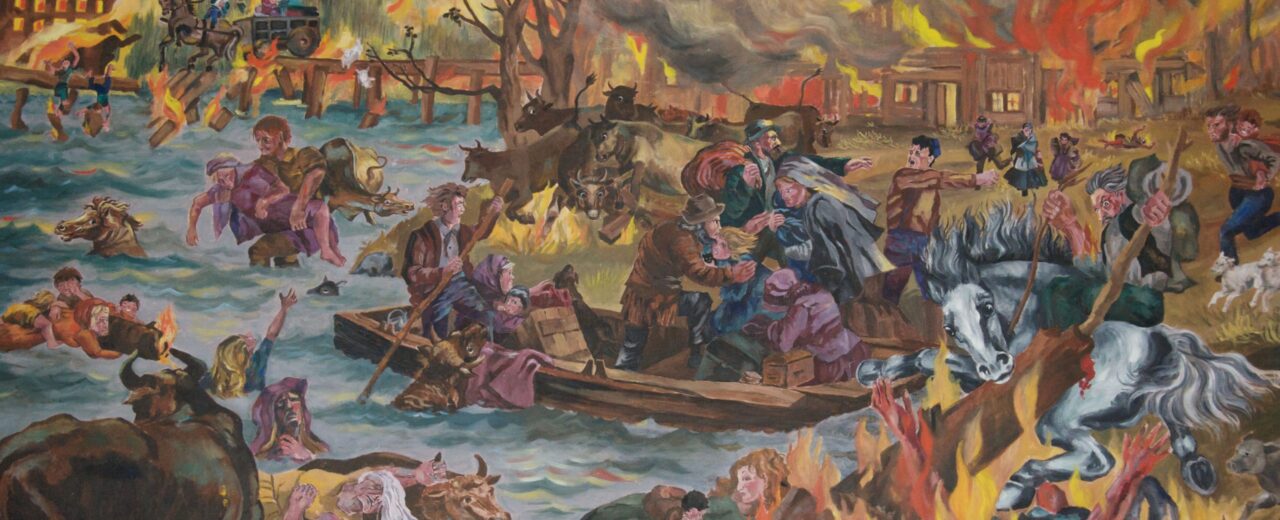
On the evening of October 8, 1871, families in northeastern Wisconsin saw the sky turn red and heard a roar that survivors compared to a freight train. Wind drove burning debris ahead of a wall of flame. Wooden houses ignited, wagons jammed the roads, and people ran toward the Peshtigo River because there was nowhere else to go. By morning, the town of Peshtigo had been largely erased.
The Peshtigo Fire is generally regarded as the deadliest wildfire in United States history. Estimates commonly range from about 1,200 to 2,500 deaths across the affected region, yet no exact total is possible. It began on the same night as the Great Chicago Fire, which received far more attention and relief. Peshtigo’s story is not simply about a forgotten blaze. It reveals how drought, industrial logging, routine burning, extreme wind, vulnerable settlement, and limited communications combined into a disaster larger than any one spark.
Peshtigo before the fire
Peshtigo stood near Green Bay in a region transformed by the nineteenth-century lumber economy. Forests supplied timber for expanding American cities, railroads, mines, farms, and factories. Sawmills attracted workers and encouraged rapid settlement. By 1871, the community contained homes, boarding houses, stores, churches, workshops, and a large mill complex, with a population often estimated at roughly 1,700 to 2,000.
Almost everything about the built environment increased fire risk. Buildings were wooden. Roads could be surfaced with sawdust, bark, or other combustible material. Mill operations produced piles of wood waste. Logging left branches, treetops, stumps, and unwanted vegetation scattered across recently cut land. Rail lines, fences, bridges, and stored lumber created additional paths along which fire could travel.
This did not make the residents uniquely careless. Fire was an ordinary tool in a landscape being converted from forest to farms and industrial sites. Settlers burned brush to clear land, while logging camps and locomotives generated sparks. Small fires were familiar enough to seem manageable. The danger came when everyday ignition sources met an extraordinary accumulation of dry fuel and weather capable of turning many local burns into a regional catastrophe.
The drought that prepared the landscape
The upper Midwest experienced prolonged dryness during the summer and early autumn of 1871. Streams and wells fell, vegetation withered, and organic material dried deeply. Smoke from scattered fires had hung over parts of Wisconsin and Michigan for weeks. Residents sometimes worked through haze without interpreting it as a warning of a single approaching disaster.
Drought alone does not ignite a forest, but it changes what a spark can do. Leaves, slash, fences, buildings, and peat-like organic soil become easier to burn. Repeated small fires may smolder, merge, or remain active until wind arrives. The dense debris left by logging added fuel at ground level and allowed flames to intensify rapidly.
Modern accounts sometimes search for one moment when the Peshtigo Fire “started.” The surviving evidence does not identify a single proven ignition point. Land-clearing fires, logging activity, railroads, and other human sources were all present in the region. It is more accurate to describe an existing fire landscape suddenly driven into extreme behavior than to imagine one isolated match creating the entire catastrophe.
October 8, 1871: when the wind changed everything
On October 8, a powerful low-pressure system and advancing cold front produced strong, shifting winds across the Great Lakes. The same broad weather pattern affected fires in northeastern Wisconsin and parts of Michigan. As winds intensified, separate burns could spread faster, throw embers over barriers, and converge across a dry landscape.
Survivors described a rapidly approaching roar, darkness, violent gusts, and airborne debris. Some saw fire moving through the treetops; others recalled balls or sheets of flame. Houses appeared to ignite almost at once because wind carried embers into roofs, cracks, yards, and fuel piles before the main front arrived. Escape plans based on an ordinary surface fire became useless.
The catastrophe is often called a firestorm, a term describing an intense fire that creates powerful inward and upward air movement through its own heat. Extreme convection can generate violent winds and rotating columns of flame. The exact atmospheric structure at Peshtigo cannot be reconstructed with modern instruments, and “fire tornado” should not be treated as a confirmed diagnosis for every dramatic survivor description. What is certain is that wind and heat produced fire behavior far beyond residents’ experience.
The town’s desperate flight to the river
Peshtigo had little time to evacuate. People loaded children and possessions onto wagons, but roads quickly became blocked by traffic, fallen material, frightened animals, and fire. Horses refused to move or collapsed. Residents who waited for clearer information discovered that the blaze was already cutting off routes.
Many fled toward the Peshtigo River. Entering the water offered protection from direct flame but not complete safety. Survivors endured intense radiant heat, smoke, flying embers, and burning objects falling into or crossing the river. Clothing and hair could ignite when people lifted themselves above the surface. Some drowned, succumbed to smoke, or died from burns after reaching the banks.
Others survived in wells, cleared ground, marshes, or open fields, depending on local conditions. A refuge that saved one person could kill another if oxygen disappeared or structures collapsed. There was no universally safe action once the firestorm engulfed the town. Testimonies emphasize families becoming separated in darkness, parents losing children, and people making decisions in seconds with almost no reliable sense of where the fire was moving.
Father Peter Pernin’s eyewitness account
One of the best-known witnesses was Peter Pernin, a Catholic priest serving Peshtigo and nearby Marinette. He tried to save sacred objects and eventually entered the river with other residents. His later narrative describes the noise, heat, panic, and physical suffering of the night in unusually vivid detail. It remains essential because official records were destroyed and many witnesses did not survive.
Pernin interpreted the catastrophe within a religious framework, but he also observed material conditions carefully. He described drought, smoke before the disaster, combustible debris, chaotic flight, and the behavior of people in the river. Historical testimony need not be either spiritual or factual; nineteenth-century witnesses commonly explained natural events through both direct observation and faith.
Like every survivor account, his memoir has limits. Trauma affects memory, publication shapes narrative, and one person can see only part of a vast disaster. Dramatic phrases repeated from eyewitnesses should not automatically be converted into precise measurements of wind speed or temperature. Pernin is most reliable when read alongside other testimonies, weather evidence, land-use history, and the geography of destruction.
How many people died in the Peshtigo Fire?
The National Weather Service describes the fire as claiming more than 1,200 lives. Broader historical estimates sometimes rise to 2,500. The large range exists because the disaster destroyed records, entire households vanished, and the affected population included lumber workers, migrants, travelers, and settlers who may never have appeared in a local census or church register.
Peshtigo was not the only place burned. Communities and rural settlements across northeastern Wisconsin suffered devastating losses, including areas around the Door Peninsula and Green Bay. Bodies were burned beyond identification, while others were never recovered. A mass grave at the Peshtigo Fire Cemetery contains the remains of people who could not be individually named.
It is therefore misleading to present one exact number as if a complete death ledger survived. The phrase “deadliest wildfire in U.S. history” rests on the lowest widely accepted estimates already exceeding other American wildfire death tolls, not on certainty about the final individual victim. The range of 1,200 to 2,500 communicates both the established scale and the archival destruction that prevents precision.
Was the fire hot enough to melt sand?
Popular accounts often state that temperatures reached about 2,000 degrees Fahrenheit, caused sand to turn into glass, or made people burst into flame without contact. Such claims are repeated because they convey the fire’s intensity, but the exact temperature of the moving front was not measured in 1871. Materials can deform, fuse, or appear glassy under conditions influenced by composition and exposure time, so a damaged object does not provide a simple thermometer.
Extreme wildfire heat can ignite structures ahead of visible flames through embers and radiant energy. Clothing, wood, and dry vegetation can catch rapidly. Strong convection may lift burning debris and produce showers of sparks that make ignition seem spontaneous. These mechanisms are terrifying without requiring every legendary detail to be literally true.
The responsible conclusion is that Peshtigo experienced exceptional fire behavior and lethal heat, while specific temperature figures remain reconstructions or later claims. Separating measured fact from memorable language does not weaken the history. It helps explain what actually killed people: smoke, radiant heat, direct flame, collapsing structures, debris, drowning, and burns suffered during escape.
The comet theory and the search for one spectacular cause
A persistent alternative theory claims that fragments of Biela’s Comet ignited fires across the Midwest on the same night. Supporters point to simultaneous outbreaks and reports of objects or “balls of fire” in the sky. The theory has popular appeal because it supplies one dramatic external cause for a geographically widespread disaster.
There is no accepted physical or historical evidence that comet fragments caused the Peshtigo, Chicago, or Michigan fires. The region was already extremely dry and smoky, numerous human-set fires were active, and strong winds affected a broad area. Airborne embers and intense fire behavior readily explain many descriptions of fiery objects. Meteorites also arrive cold at the ground in many cases after losing heat during atmospheric passage, making widespread ignition an implausible assumption without evidence.
Simultaneous disasters do not require an extraterrestrial trigger when they share climate, land use, and weather. October 8 brought severe wind to landscapes covered with dry vegetation and human-created fuel. The comet story should be identified as a fringe hypothesis, not presented as an unresolved alternative equal to the documented combination of drought, fire, logging debris, and wind.
Why Chicago overshadowed Peshtigo
The Great Chicago Fire began the same night and destroyed a major American city. Chicago was a transportation, commercial, and newspaper center with strong telegraph links and national importance. Its famous buildings, wealthy residents, and rapid reconstruction generated a compelling urban narrative. News organizations could reach Chicago more easily and distribute reports quickly.
Peshtigo lost communications as the fire destroyed telegraph infrastructure, roads, bridges, and records. Survivors were scattered, and outside communities initially struggled to understand the scale of destruction. Relief supplies and reporters often moved through systems already focused on Chicago. Even today, many Americans know the story of Mrs. O’Leary’s cow—a tale historians reject as the proven cause of Chicago’s fire—while never learning the name Peshtigo.
The difference was not simply that journalists cared more about a city. Chicago offered concentrated damage that could be photographed, mapped, financed, and narrated through surviving institutions. Peshtigo’s losses were dispersed across rural settlements, forests, and unnamed workers. Attention follows communication and power. The wildfire’s relative obscurity illustrates how disasters affecting less visible communities can disappear behind events that are easier for a national audience to picture.
A regional catastrophe, not an isolated Wisconsin fire
Fires also devastated parts of Michigan on October 8 and 9, including communities near Lake Michigan and in the state’s “Thumb” region. Holland, Manistee, Port Huron, and numerous smaller settlements suffered fire or severe threat during the broader period. Not every outbreak was part of one physically continuous flame front, but they developed under related drought and wind conditions.
Recognizing this regional pattern changes the story. Peshtigo was the deadliest center of a Great Lakes fire crisis produced by rapid resource extraction and extreme weather. Logging converted forests into commercial landscapes while leaving combustible slash. Settlers used flame to clear land. Towns built from wood expanded faster than firefighting systems or evacuation planning.
The event was “natural” in the sense that drought, wind, and fire are environmental processes. It was also human-made in the distribution of fuels and exposure. That combination resembles many modern disasters: climate and weather create a hazard, while development patterns determine who and what stand in its path. Blaming nature alone erases the economic history written across the burned landscape.
Relief, recovery, and the problem of rebuilding
Survivors emerged with burns, respiratory injuries, little clothing, and no shelter. Food stores, livestock, tools, mills, and homes had vanished. Medical treatment was limited, and burned roads slowed assistance. Neighboring towns, charitable organizations, churches, and public authorities sent supplies once the scale of the emergency became known.
Relief efforts had to identify orphaned children, reunite families, bury victims, and prevent hunger and exposure. The loss of property records and local documentation complicated claims and reconstruction. As with other nineteenth-century disasters, aid depended heavily on private donations and voluntary networks rather than a modern federal emergency system.
Peshtigo rebuilt because its location and lumber economy still held value. Reconstruction can suggest recovery while concealing permanent loss. Families remained fragmented, many victims stayed unnamed, and the new town occupied a landscape whose economic system had contributed to the catastrophe. Memorials and the fire cemetery preserved local memory even as the event faded from the wider national story.
What changed after the Peshtigo Fire?
It would be convenient to say that Peshtigo immediately transformed American wildfire policy. The actual change was slower. Nineteenth-century firefighting remained oriented toward towns and buildings, while forest fire prevention developed unevenly through state agencies, federal forestry, rail regulation, public education, and later professional fire science.
The disaster contributed to awareness that slash, careless burning, and drought could create catastrophic regional fires. Yet logging continued, and other lethal fires followed. The Hinckley Fire in Minnesota in 1894 and the Great Fire of 1910 in the northern Rockies again demonstrated how weather, heavy fuel, railroads, and settlement could overwhelm communities. Policy often advances through repeated disasters rather than one decisive lesson.
Comparisons with urban conflagrations are useful but limited. The earlier Great Fire of Meireki reshaped Edo through new firebreaks, relocations, and reconstruction policies. Peshtigo involved a wider forest-industrial landscape with no single municipal plan capable of controlling it. Its legacy belongs to wildfire management, land use, industrial safety, weather forecasting, communications, and emergency response at once.
What modern fire science adds to the survivor stories
Today, meteorologists and fire scientists can interpret many experiences that seemed almost supernatural in 1871. Strong winds accelerate flames and tilt them toward unburned fuel. Embers travel ahead of the main front and ignite structures from multiple directions. Intense heat creates rising columns that draw in air, generate turbulence, and may form rotating vortices. Smoke reduces visibility and disorients people before flames arrive.
These mechanisms explain why residents reported a fire that leaped roads, arrived from several directions, and seemed to create its own wind. They also clarify why rivers and clearings were imperfect refuges. Radiant heat can cross open space; smoke can suffocate; embers can ignite clothing; and a sudden wind shift can expose a location that appeared safe moments earlier.
Science should not be used to strip eyewitness language of value. Comparisons to tornadoes, trains, or an approaching sea conveyed phenomena for which residents had no technical vocabulary. The task is to translate testimony without forcing it into exaggerated certainty. Survivor accounts describe the human scale of the event; fire behavior research explains how such experiences could occur.
What the evidence can support
The Peshtigo Fire killed at least 1,200 people and possibly many more because several forms of vulnerability converged on October 8, 1871. Months of drought dried the region. Logging and land clearing created immense fuel loads. Routine fires were already burning. Powerful winds drove flames and embers through wooden settlements with little warning, limited escape routes, and no coordinated emergency system.
The disaster does not need a comet, a precise 2,000-degree temperature, or one identified match to be historically compelling. Its causes were ordinary enough to be overlooked until they combined into extraordinary fire behavior. The uncertain death toll reflects the destruction of people and records, not doubt about the catastrophe’s scale.
Chicago’s fire became a national legend, while Peshtigo remained largely a regional memory. Restoring Peshtigo to the wider history of American disasters matters because it exposes a recurring pattern: environmental hazards become catastrophes through the ways societies extract resources, build communities, communicate danger, and value different victims. The flames lasted a night; the warning has never stopped being relevant.
Research and further reading
For readers who want to verify details or continue researching this subject, these external reference collections provide useful starting points: