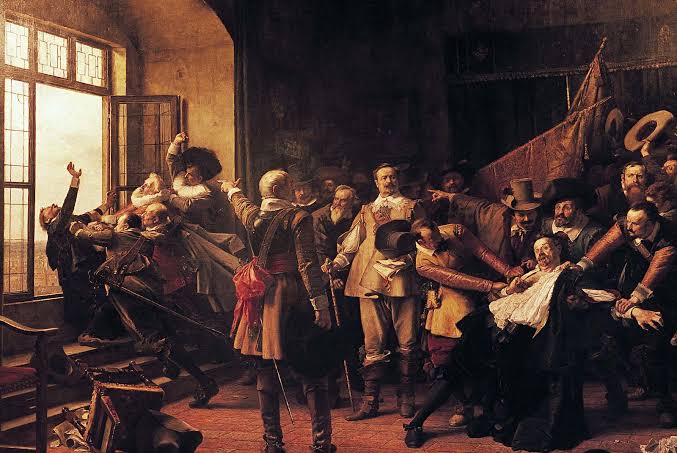
On May 23, 1618, a group of armed Protestant nobles climbed the stairs of Prague Castle and entered the Bohemian Chancellery. Their confrontation with two Catholic royal governors turned into a trial conducted on the spot. Within minutes, the governors and their secretary were hurled through a high window. All three survived the fall. Europe would not be so fortunate.
The Defenestration of Prague became the symbolic opening of the Bohemian Revolt and the immediate catalyst for the Thirty Years’ War. Yet the famous window scene is often detached from the struggle that made it possible. It was not a spontaneous quarrel about theology, the victims did not demonstrably land in a convenient manure pile, and one violent morning did not by itself cause three decades of European war. The event mattered because it converted a constitutional and religious crisis into rebellion.
Why throwing someone from a window had a history in Prague
The word “defenestration” comes from Latin roots meaning “out of a window.” Prague did not invent the act, but the city made it historically famous. On July 30, 1419, followers of the reforming preacher Jan Želivský threw municipal officials from the New Town Hall, helping ignite the Hussite Wars. Another violent seizure of municipal power in 1483 also included victims cast from windows.
For that reason, the 1618 event is called the Second Defenestration of Prague in many English accounts, counting the great episodes of 1419 and 1618. Other historians call it the Third because they include 1483. The numbering is a matter of convention, not evidence that one event has been invented or omitted.
By 1618, defenestration carried a specifically Bohemian political memory. Throwing officials from a civic or royal building did more than attack their bodies: it rejected the authority exercised through that building. The nobles at Prague Castle were drawing on a tradition in which public violence could announce that rulers or magistrates had broken the accepted religious and political order.
Bohemia’s unusual political and religious landscape
The Kingdom of Bohemia belonged to the lands of the Bohemian Crown and formed part of the Holy Roman Empire. Its estates—nobles, knights, and representatives of royal towns—possessed substantial corporate privileges. Kings ruled through negotiation with these bodies rather than through an unlimited centralized monarchy. Questions of taxation, officeholding, succession, and religion were therefore constitutional as well as personal.
Bohemia had a distinctive religious history. The Hussite movement of the fifteenth century had created traditions of reform before Martin Luther. By the early seventeenth century, the kingdom contained Catholics, Utraquists, Lutherans, members of the Unity of the Brethren, and other Protestant communities. Confessional boundaries did not map perfectly onto one social class or political position, but a large part of the nobility defended non-Catholic worship as both faith and privilege.
The Habsburg dynasty, Catholic and increasingly associated with Counter-Reformation policies, held the Bohemian crown. This did not make conflict inevitable. Estates and monarchs had reached compromises before, while individual nobles cooperated across confessional lines. The danger arose when each side began to interpret disputes over churches and royal powers as evidence that the other intended to destroy the entire settlement.
The 1609 Letter of Majesty
In 1609, Emperor Rudolf II issued the Letter of Majesty to the Bohemian estates under intense political pressure. The document protected significant religious rights for non-Catholic estates and recognized arrangements for Protestant worship. It also helped establish a body of Defensors charged with protecting those rights. To Protestant nobles, the letter was a constitutional guarantee, not a temporary favor.
Its language did not eliminate ambiguity. Disputes arose over whether Protestant churches could be built on lands controlled by the crown but administered by Catholic ecclesiastical institutions. Churches at Broumov and Hrob became flashpoints. Catholic authorities closed one and destroyed the other, arguing that the legal protections did not apply as Protestants claimed.
The quarrel concerned buildings, but the stakes were much larger. If royal officials could interpret the Letter of Majesty narrowly, Protestant leaders feared that every protected liberty might gradually disappear. Catholic rulers, meanwhile, believed estates were stretching privileges into a power to resist lawful authority. Both sides used legal arguments; neither regarded the dispute as merely local.
Ferdinand of Styria and the fear of Catholic restoration
In 1617, the estates accepted Ferdinand of Styria as king of Bohemia, preparing the succession to the childless Emperor Matthias. Ferdinand was known for vigorous Catholic restoration in his hereditary lands. He would later reign as Emperor Ferdinand II. Protestant leaders feared that his accession meant a systematic rollback of the religious settlement.
Ferdinand was not yet personally ruling every daily decision in Prague, and later rebel propaganda could assign him a fully developed master plan more neatly than contemporary administration allowed. Nevertheless, his reputation mattered. Political actors act on expectations as well as completed policies. The prospect of a determined Catholic monarch changed how Protestant nobles interpreted church closures and official obstruction.
In 1618, Protestant estates summoned a meeting to discuss grievances. Royal authorities restricted or prohibited the assembly. The ban appeared to confirm that legal petition was being closed. Count Jindřich Matyáš Thurn, known in German as Heinrich Matthias von Thurn, emerged as a leading organizer of resistance. The conflict now centered on whether royal governors had violated the Letter of Majesty and whether the estates possessed a right to punish them.
What happened inside Prague Castle on May 23, 1618
Armed nobles and their supporters entered Prague Castle and confronted four royal governors in the Bohemian Chancellery. The rebels focused their accusations on Vilém Slavata of Chlum and Jaroslav Bořita of Martinice, both prominent Catholics regarded as enemies of Protestant liberties. Two other governors were allowed to leave or were spared after the assembly judged them less responsible.
The confrontation resembled a political trial, but it lacked neutral procedure and had an armed crowd as judge. The nobles demanded answers about royal letters and the suppression of their meeting. Slavata and Martinice denied guilt or defended the government’s actions. The attackers declared them responsible for violating the kingdom’s laws and religious settlement.
Slavata and Martinice were seized and thrown through a chancellery window. Their secretary, Philip Fabricius, followed. Accounts differ on the precise height, often estimated at around 15 to 20 meters. The fall was unquestionably dangerous. That the victims survived provided immediate material for rival explanations and later legend.
Did the victims land in a pile of manure?
Catholic accounts credited divine protection, sometimes specifically the intervention of the Virgin Mary or angels. Protestant versions mocked that interpretation and claimed the men had landed on a dung or refuse heap. The manure pile became the most popular modern detail because it gives the story a darkly comic ending.
No surviving evidence proves a neat, soft mound positioned directly beneath the window. The men may have fallen onto sloping ground, accumulated waste, or material near the castle wall, and heavy clothing could have reduced injury. Martinice reportedly escaped quickly, while Slavata was badly hurt and required help. Their survival does not require a miracle, but the exact physical combination cannot be reconstructed with certainty.
Fabricius also survived and reached the imperial court with news of the attack. He was later ennobled with a title commonly translated as “of the High Fall,” a detail that helped turn the episode into legend. The responsible distinction is simple: three men were thrown from a high window and survived; competing claims about angels and manure belong to confessional storytelling unless stronger evidence is supplied.
From political theater to organized rebellion
The defenestrators understood that there could be no easy return to normal administration. Attacking royal governors amounted to rebellion against Habsburg authority. Protestant estates created a provisional government directed by a committee, raised troops, sought money, and appealed for allies. The revolt moved from Prague into a military contest for control of Bohemia.
The rebels initially achieved important successes, while the Habsburg government faced other pressures. In 1619, Emperor Matthias died and Ferdinand inherited a broader dynastic crisis. The Bohemian estates deposed him as king and offered the crown to Frederick V, Elector Palatine, a Calvinist prince connected to Protestant networks and married to Elizabeth Stuart, daughter of James I of England.
Frederick accepted the crown, but the coalition behind him was weaker than its symbolic reach suggested. Lutheran and Calvinist interests did not always align. Foreign Protestant rulers calculated risks carefully, and James I did not commit the decisive support his son-in-law needed. The rebels had transformed a defense of privileges into a change of dynasty without securing the military and financial base necessary to sustain it.
The “Winter King” and the Battle of White Mountain
Frederick’s short reign in Prague earned him the nickname “Winter King,” implying rule for only one winter. The label was originally hostile propaganda and should not be mistaken for his chosen title. His government faced financial shortages, internal divisions, and the challenge of maintaining an army while Catholic forces assembled.
Ferdinand gained support from the Catholic League and from Habsburg allies. On November 8, 1620, imperial and League forces met the Bohemian army near Prague at the Battle of White Mountain. The battle was relatively brief. The rebel army collapsed, and Frederick fled the capital. The Bohemian phase of the conflict had been decided far faster than the wider war it helped begin.
White Mountain was not simply Catholics defeating Protestants in a clean religious contest. Dynastic interest, money, military organization, regional loyalties, and political calculation shaped both coalitions. Nevertheless, the victory allowed Ferdinand to impose a Catholic and Habsburg settlement on Bohemia with consequences far beyond the battlefield.
Executions, confiscations, and re-Catholicization
On June 21, 1621, twenty-seven leaders of the revolt were executed in Prague’s Old Town Square. The victims included nobles, knights, and townsmen. Public execution announced that resistance had been defeated and warned remaining estates against renewed opposition. Other participants lost property, titles, or freedom, while some escaped into exile.
Large confiscations transferred land from rebel families to loyalists and foreign Catholic nobles. Political authority became more concentrated under the Habsburg monarchy. Protestant clergy were expelled or restricted, non-Catholic worship was suppressed, and subjects faced pressure to convert or leave. The process unfolded through decrees, institutions, property transfers, and migration rather than in one instant after the battle.
Czech national histories later remembered White Mountain as the beginning of an age of darkness, while older Habsburg and Catholic narratives presented restored order and religious unity. Both traditions selected facts for later political purposes. The defeat undeniably transformed the kingdom’s elite, confessional life, and constitutional relationship with the dynasty, but its social effects varied by region and class.
Did the defenestration cause the Thirty Years’ War?
The window fall is often said to have started the Thirty Years’ War, and chronologically it was the conflict’s immediate spark. The Bohemian Revolt forced Habsburg rulers, Catholic League princes, Protestant estates, and neighboring powers to make military choices. Fighting that might have remained a constitutional crisis inside Bohemia became an international struggle.
Yet one morning did not create all the war’s causes. The Holy Roman Empire contained unresolved confessional tensions after the Peace of Augsburg of 1555. Calvinism had no secure place in that settlement. Imperial institutions faced disputes over church property and princely power. The Habsburg dynasties pursued strategic interests across Europe, while the Dutch Revolt, rivalry with Spain, Baltic politics, and competition involving France, Denmark, and Sweden created wider pressures.
The defenestration should therefore be called a catalyst rather than a complete explanation. It committed Bohemian leaders to rebellion and presented other powers with opportunities and threats. Similar to the Nika Riots that nearly overthrew Justinian, an explosive urban confrontation revealed deeper weaknesses in a political system. The difference is that Prague’s crisis connected directly to rival states capable of sustaining war across a continent.
How a Bohemian revolt became a European war
After White Mountain, fighting continued in the Palatinate, Frederick’s hereditary territory. What began as the Bohemian-Palatinate phase expanded as new powers entered. Christian IV of Denmark intervened and was defeated. Gustavus Adolphus brought Sweden into the war with a formidable army and political ambitions in the Empire. His death at Lützen in 1632 did not end Swedish involvement.
Catholic France eventually fought openly against the Catholic Habsburgs. Cardinal Richelieu and his successors treated Habsburg encirclement as a strategic danger more important than confessional solidarity. This fact alone disproves the idea that the Thirty Years’ War remained a simple Catholic-versus-Protestant crusade from beginning to end.
Armies lived from occupied territories, spreading hunger, disease, displacement, and destruction. Mortality varied enormously by region, and older claims that a fixed proportion of all Germans died should be handled cautiously. Some areas were devastated repeatedly while others suffered less. The war ended through the Peace of Westphalia in 1648, a series of negotiations that addressed territory, imperial politics, and religious rights without creating the modern sovereign state system in one magical moment.
What the sources can and cannot prove
Accounts of the defenestration were written by participants and supporters who needed to justify either rebellion or royal punishment. Protestant authors depicted governors as traitors to legal religious freedoms. Catholic writers emphasized sacrilege, illegitimate violence, and providential survival. Later historians inherited stories already shaped for propaganda.
The core facts are secure: the date, location, principal victims, survival of all three men, formation of a rebel government, and rapid transition to war. Details of speeches, gestures, the exact sequence at the window, and the landing place vary. Those vivid elements should be attributed rather than narrated as if recorded by an impartial observer.
The same caution applies to motives. Some nobles acted from sincere religious fear; others defended estate privileges, offices, family interests, or political influence. These motives could coexist. Early modern people did not necessarily separate religion from law and power in the way modern summaries do. Confession defined communities, legitimacy, education, property, and allegiance as well as personal belief.
Why the Defenestration of Prague still matters
The event matters because it shows how institutions fail when both sides believe compromise will lead to their own destruction. The Protestant estates interpreted church closures and assembly restrictions as steps toward elimination. Royal authorities interpreted resistance as an attempt to strip the crown of lawful power. Once officials were thrown from the window, each side could present violence as proof of what it had feared all along.
It also demonstrates the power of political symbolism. The attack killed no one, yet it was more consequential than many deadly clashes. By punishing governors inside the royal castle, the rebels claimed the right to judge the king’s representatives. The physical act made constitutional argument impossible to ignore and almost impossible to reverse.
Finally, its legends reveal how memory works. Angels gave Catholic victory a providential preview; manure turned Protestant enemies into objects of ridicule; the “Winter King” reduced a failed reign to a slogan. These stories endured because they made a complicated crisis memorable. Historical analysis does not need to discard them, but it must identify who told them and what purpose they served.
Why this episode still matters
The Defenestration of Prague did not begin with three men unexpectedly flying from a window. It began with decades of argument over religious freedom, estate privilege, royal succession, and the meaning of the 1609 Letter of Majesty. On May 23, 1618, Protestant nobles transformed those disputes into rebellion by judging and throwing two governors and a secretary from Prague Castle.
The victims’ survival became legend, but the political consequences were real. Bohemia rejected Ferdinand, crowned Frederick V, lost at White Mountain, and endured executions, confiscations, exile, and forced Catholic restoration. The conflict then expanded as dynastic rivalry and international strategy carried war far beyond its Bohemian origins.
A manure pile did not cause the Thirty Years’ War, and neither did one window. The defenestration mattered because it crossed the boundary between resistance and revolution at a moment when Europe’s religious and political order was already unstable. The three officials survived their fall; millions of people across the continent would live with what followed.
Research and further reading
For readers who want to verify details or continue researching this subject, these external reference collections provide useful starting points: