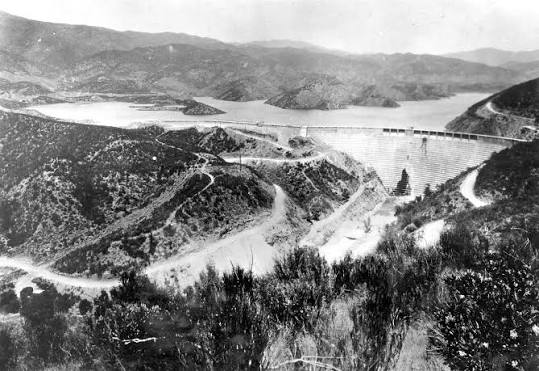
Minutes before midnight on March 12, 1928, a concrete dam in a canyon north of Los Angeles broke apart. More than twelve billion gallons of water rushed into the darkness, carrying pieces of the structure weighing thousands of tons. The flood travelled through communities, work camps, orchards, and river valleys before reaching the Pacific Ocean. By morning, hundreds of people were dead.
The St. Francis Dam disaster ended the career of William Mulholland, the celebrated engineer who had helped bring water to Los Angeles. It also exposed a dangerous weakness in the way major public works were designed and approved: the same powerful organization could plan, build, inspect, and defend its own project. The failure is sometimes reduced to one bad foundation or one man’s arrogance. The evidence reveals a more instructive combination of geology, design decisions, institutional confidence, and inadequate independent review.
Why Los Angeles built the St. Francis Dam
Los Angeles grew rapidly during the early twentieth century, and its local water supply could not support the city that boosters, developers, and officials envisioned. The Los Angeles Aqueduct, completed in 1913, brought water south from the Owens Valley. It was a remarkable engineering achievement, but a long aqueduct remained vulnerable to drought, interruption, maintenance problems, and deliberate damage.
The city therefore needed storage closer to its population. A reservoir in San Francisquito Canyon could hold aqueduct water and release it when the main system was disrupted. The site lay roughly forty miles northwest of downtown Los Angeles and connected naturally with the aqueduct’s hydroelectric and distribution infrastructure. It appeared to provide both emergency security and operational flexibility.
Construction began in 1924 under the Los Angeles Bureau of Water Works and Supply. The structure was a curved concrete gravity dam, designed to resist the reservoir largely through its own weight. It rose about 200 feet above its foundation and stretched across the canyon for several hundred feet. Water impoundment began before all work was finished, and the dam was completed in 1926.
The project belonged to a broader story often called the California water wars. Los Angeles’s acquisition of Owens Valley water generated lasting conflict, and portions of the aqueduct were dynamited during the 1920s. That background later made sabotage seem plausible to many people. It also meant that the dam was not merely an engineering structure; it symbolized the political power of a growing metropolis.
William Mulholland and the danger of earned confidence
William Mulholland had risen from an immigrant laborer to become one of the most influential water engineers in the American West. He learned largely through work rather than formal university training. His intimate knowledge of Los Angeles’s water system and his leadership of the aqueduct project earned public admiration. Success gave his judgments exceptional authority inside city government.
That record should neither be ignored nor allowed to excuse the St. Francis design. Mulholland was not an ignorant amateur improvising a small private dam. He led an experienced public agency and had access to the engineering knowledge of his period. The project was built under his direction without an independent board examining the site, foundation, and calculations before construction.
The dam’s planned height increased during construction. Each increase enlarged the pressure of the reservoir, yet the base was not widened in proportion to every change. Later analysis found that the resulting cross section provided an inadequate margin against uplift—the upward water pressure acting beneath a concrete structure. Drainage and foundation treatment were also insufficient for the conditions.
A canyon with two different geological hazards
San Francisquito Canyon looked narrow enough for a dam, but its opposing sides presented different weaknesses. The eastern abutment rested against Pelona Schist, a metamorphic rock that could be deeply weathered, fractured, and prone to losing strength. The western side included the remains of an ancient landslide within the sedimentary Modelo Formation. Neither condition received the investigation it required.
A gravity dam transfers enormous forces into its foundation and abutments. It is not enough for the concrete wall itself to remain strong. If the rock beneath it lifts, slides, deforms, or becomes saturated along weak surfaces, sections of the dam can lose support. Water finding paths through fractures may increase pressure and reduce resistance at exactly the places carrying the reservoir load.
The important point is not that geology alone made failure inevitable. A properly investigated site might have been rejected, redesigned, treated more extensively, or monitored differently. Dangerous geology became catastrophic when it met a design and approval process that did not fully identify or accommodate it.
Warning signs before the collapse
Cracks and leaks appeared as the reservoir filled. Some cracking in large concrete dams can be expected as temperature changes and the structure settles, and not every seep indicates imminent failure. Workers routed certain leaks through pipes and monitored them. This has encouraged a popular narrative in which obvious warnings were simply ignored, but the historical record requires more precision.
The most alarming report came on the morning of March 12, when the dam keeper observed muddy water. Clear seepage could be reservoir water passing through concrete joints; muddy discharge might indicate foundation material being eroded. Mulholland and his chief assistant, Harvey Van Norman, inspected the dam that day. They concluded that the discoloration came from a road slide and that the structure remained safe.
The reservoir had recently reached near its highest level. Greater depth increased loading and forced water farther into weaknesses. The dam stood through the evening, giving no public alarm before the structure began to fail close to midnight.
The night the dam broke
The commonly accepted time of failure is approximately 11:57 p.m. A power interruption at a station downstream helps fix the chronology. There were few eyewitnesses able to see the dam itself in darkness, so investigators reconstructed events from clocks, electrical records, survivor testimony, debris, and the final arrangement of enormous concrete sections.
The dam did not dissolve as one uniform wall. Parts rotated, slid, and broke away in a rapid sequence. A tall central section remained standing after the flood, earning the later nickname “the Tombstone,” while the canyon around it was transformed. Water released from the reservoir accelerated through San Francisquito Canyon as a destructive flood wave.
The initial wall of water was exceptionally high near the dam and diminished as it spread downstream, but it remained lethal for many miles. It demolished power facilities, bridges, farms, homes, and workers’ camps. Darkness magnified the danger. People sleeping in low ground had little time to understand the roar, locate relatives, or climb to safety.
Accounts sometimes give the wave one precise height and speed for its entire journey. That is misleading. Flood depth and velocity changed with canyon width, bends, elevation, obstacles, and distance. The water followed San Francisquito Creek into the Santa Clara River valley and continued west for roughly fifty-four miles before reaching the ocean near Ventura.
Who died, and why the number remains uncertain
The disaster killed more than 400 people. A figure of at least 431 is widely used today, but older monuments, reports, and histories give totals ranging around 400 to more than 450. This is not a minor accounting error that can easily be corrected. Some bodies were carried great distances, buried in sediment, or swept into the ocean and never recovered.
Recordkeeping also reflected inequality. The flood destroyed temporary work camps occupied by employees and families, including many Mexican and Mexican American residents. Names could be misspelled or duplicated, migrants might not appear in local records, and relatives sometimes lived far away. An official list built from identified bodies could not necessarily include everyone who vanished.
Southern California Edison’s Camp 2 was among the places devastated. Families sleeping near the river were struck with little warning. Other victims lived on ranches or in small communities scattered along the flood path. The geography of employment and housing placed working people directly in harm’s way.
Survivor accounts record extraordinary rescues, but hero stories should not obscure structural vulnerability. Telephone operators, law officers, power workers, and residents warned downstream communities after the break became known. Those warnings saved lives. They could not reach everyone, and no coordinated dam-failure evacuation system existed for a catastrophe unfolding over only a few hours.
Rescue, recovery, and a landscape of debris
Emergency response began in darkness and expanded after sunrise. Police, firefighters, medical workers, National Guard personnel, utility crews, local residents, and volunteers searched wreckage and mud. Roads and bridges were damaged, communications failed, and the flood path extended across jurisdictional boundaries. Rescuers had to reach isolated areas while the ground remained unstable.
Recovery continued for weeks and, in practical terms, much longer. Search teams found victims far downstream from their homes. Identification was difficult when personal documents had been lost and bodies were badly injured. Families moved between hospitals, temporary morgues, and relief stations seeking information.
The material destruction was immense. Orchards were uprooted, livestock lost, railway and highway links damaged, and fertile ground buried or scoured. Hydroelectric equipment and transmission infrastructure were wrecked. Compensation could replace some property, but it could not restore communities whose members, homes, and workplaces disappeared together.
The scale places St. Francis among America’s most consequential infrastructure failures. It belongs beside disasters such as the Great Molasses Flood of 1919, another event in which a failed storage structure exposed the human cost of weak engineering oversight. Their materials and mechanisms differed, but both changed expectations about who must prove that a large structure is safe.
The investigations and their limits
California Governor C. C. Young appointed an expert commission within days. Its report, issued rapidly, concluded that the foundation was defective and that failure began at or near the eastern abutment. Other bodies investigated as well, including a coroner’s jury, engineering organizations, city officials, and outside specialists. The ruins became an open laboratory for competing explanations.
The investigations agreed that the disaster was not caused by an earthquake or an enemy attack. They found fundamental failures in siting and design. The governor’s commission stated that responsibility rested with the engineering organization responsible for the work, while recognizing that accepted dam practice itself required improvement.
Speed was both useful and limiting. Officials urgently needed findings that could guide other reservoirs and reassure the public. Investigators worked before modern soil mechanics, rock mechanics, computer modeling, and forensic standards existed. Some early reports treated “bad foundation” as a complete explanation without fully examining how design geometry, uplift, geological discontinuities, and construction changes interacted.
Sabotage, dynamite, and a persistent legend
Sabotage rumors appeared immediately. The Los Angeles Aqueduct had been dynamited repeatedly during conflict with Owens Valley residents, and the St. Francis reservoir formed part of the same water system. Some residents recalled sounds or suspicious activity. A deliberate blast offered an emotionally comprehensible cause and shifted blame away from celebrated engineers.
Investigators found no persuasive evidence of explosives. The pattern of failure, foundation conditions, and structural remains supported engineering and geological causes. No credible group claimed responsibility, and supposed blast evidence did not survive expert examination. Modern technical studies have strengthened the non-sabotage explanation.
The legend persists because it connects the disaster to a genuine political conflict. Los Angeles did obtain water through methods that generated anger, economic disruption, and resistance. Acknowledging that history does not require assigning the dam collapse to attackers. True grievances and a false causal claim can coexist.
Another oversimplification says Mulholland knowingly kept a doomed dam operating. Evidence shows serious errors and excessive confidence, but not proof that he expected imminent collapse. The stronger historical criticism is institutional: he approved a structure whose design and foundation had not been tested by independent expertise, then relied on his own organization’s judgment when troubling seepage appeared.
Mulholland’s responsibility and the end of a career
Mulholland testified before the coroner’s inquest and accepted personal responsibility in moral terms. He did not try to blame the dam keeper or invent an external enemy. At the same time, neither he nor another official was convicted of a crime. The inquest treated the failure as an error of engineering judgment rather than criminal intent.
His willingness to bear blame has sometimes been turned into a redemptive scene, but accountability requires more than dignified testimony after hundreds die. Mulholland had concentrated authority over design, construction, and evaluation. His confidence helped permit the project to proceed without the independent geological and engineering review that might have challenged it.
The disaster effectively ended his public career. He retired later in 1928 and never recovered his former standing. Historians continue to assess him through two realities: the aqueduct system transformed Los Angeles, and the St. Francis Dam was an avoidable failure built under his leadership. Neither achievement nor catastrophe erases the other.
Focusing entirely on one famous man can also hide the system around him. City officials, professional norms, legal rules, and public enthusiasm for rapid growth all shaped the environment in which the dam was approved. Mulholland’s authority was real, but institutions had allowed one authority to become too decisive.
How the disaster changed engineering oversight
St. Francis accelerated changes in California dam safety. The state expanded its authority to review designs and supervise dams affecting public safety. Large municipal projects could no longer rely so easily on exemption from outside inspection. Independent review became a central lesson: public ownership did not guarantee technical safety.
California also strengthened professional engineering regulation in 1929. It would be too simple to say that one disaster created modern licensure by itself, since regulation was already developing. The collapse supplied overwhelming evidence that engineering decisions affecting entire valleys required defined qualifications and public accountability.
Technical lessons were equally important. Engineers paid greater attention to foundation geology, uplift pressure, drainage, abutment stability, spillway and reservoir behavior, instrumentation, and the consequences of design changes. A dam could not be judged by its concrete face alone. The rock and soil carrying its forces had to be treated as parts of the structure.
Modern dam safety also considers downstream consequences, emergency action plans, inundation maps, warning systems, and continual reassessment. These practices do not make failures impossible. They create layers of defense so that one mistaken assumption, one respected expert, or one unusual leak is less likely to decide the fate of thousands.
Ruins, memorials, and the ethics of remembering
For years the broken remains lay in San Francisquito Canyon, where visitors climbed over fragments and collected pieces. The central standing block was later demolished because authorities feared that sightseers might be injured. Large sections of concrete remain scattered through the landscape, making the site an unusual combination of grave, ruin, and engineering evidence.
Congress established the Saint Francis Dam Disaster National Memorial and National Monument in 2019. The designation recognized both the victims and the national significance of the engineering lessons. Interpretation at the site continues to develop under federal land management, while local historians and descendants have worked for decades to recover names and stories.
Memory matters because early narratives often centered Mulholland more than the dead. The engineer’s fall is dramatic, but the catastrophe was experienced by families in camps, ranch houses, and small communities. Mexican and Mexican American victims were especially vulnerable to disappearance from incomplete lists and English-language reporting.
The ruins invite humility. They are not proof that early engineers knew nothing; many contemporaries immediately identified serious faults. They show instead how knowledge can fail to influence a project when authority, schedule, ambition, and institutional habits prevent uncomfortable questions from receiving power.
What survives beyond the popular version
The St. Francis Dam failed because a vulnerable site and an inadequate design were joined by deficient investigation and review. Water pressure exploited weaknesses in the foundation and structure until the dam broke late on March 12, 1928. The resulting flood killed at least 431 people, devastated communities for more than fifty miles, and ended William Mulholland’s career.
No single explanation is sufficient. The western ancient landslide mattered, as did the fractured rock of the eastern abutment. Uplift and changes to the dam’s dimensions mattered. So did the absence of a genuinely independent authority able to examine assumptions before the reservoir filled. “Bad geology” becomes an excuse if it hides the human duty to discover and design for geology.
The disaster’s legacy is visible in dam inspection, engineering licensure, foundation analysis, monitoring, and emergency planning. These protections were not gifts from inevitable progress. They were strengthened because families downstream paid the cost of an institution’s confidence.
That is why St. Francis remains more than a story of a wall of water or a famous engineer brought low. It is a warning about how technical authority should work. Expertise is essential, but the greater the potential consequence of error, the more expertise must be tested by evidence, independent judgment, and the willingness to stop.
Research and further reading
For readers who want to verify details or continue researching this subject, these external reference collections provide useful starting points: