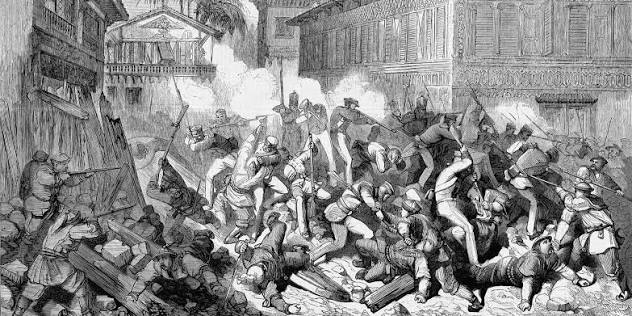
In March 1853, an army born in the hills of southern China entered Nanjing and renamed the old Ming capital Tianjing, the “Heavenly Capital.” Its leaders claimed that a sacred order had arrived. They destroyed Manchu institutions, separated men from women, issued commandments against opium and adultery, and prepared to replace the Qing dynasty. At their head stood Hong Xiuquan, a failed examination candidate who believed that visions had revealed him to be the younger brother of Jesus Christ.
The Taiping Rebellion was not a marginal uprising or an exotic footnote. From 1850 to 1864, it became a vast civil war that drew in millions of soldiers and civilians, devastated some of China’s richest provinces, and forced the Qing state to reinvent how it raised armies and revenue. Yet familiar summaries are often misleading. The movement drew on Christianity without being orthodox Christianity. It announced radical social reforms, but practice contradicted proclamation. It caused extraordinary loss of life, but no precise death toll can be proved. Understanding it requires holding those tensions together.
Why Qing China Was Vulnerable
The rebellion grew from overlapping crises rather than one cause. China’s population expanded dramatically during the eighteenth and early nineteenth centuries, while cultivable land did not keep pace. Families competed for smaller plots, tenants faced pressure, and migrants searched for work in mines, transport, and marginal agriculture. Local feuds and armed associations multiplied where officials lacked resources to maintain order.
The First Opium War of 1839–1842 did not directly cause the Taiping movement, but defeat damaged Qing prestige and deepened fiscal problems. Indemnities, changing silver flows, disrupted regional economies, piracy, corruption, and ethnic conflict strained an administration designed for a smaller population. Guangxi, where the movement became an army, was especially combustible. Its rugged terrain sheltered miners, migrants, bandits, and militias. Conflict divided established communities from Hakka settlers, a Han Chinese subgroup that included Hong and several important followers. Hong supplied a compelling religious language, but it spread because it addressed communities already living with insecurity and exclusion.
Hong Xiuquan and the God Worshippers
Hong was born in 1814 near Guangzhou into a Hakka family that invested in his education. Success in the civil service examinations could transform a family’s fortunes, but he repeatedly failed the provincial-level test. After an unsuccessful attempt in 1837, he suffered an illness accompanied by visions. Years later, after rereading Christian tracts distributed by the Protestant evangelist Liang Fa, Hong identified figures in those visions as God the Father and Jesus. He concluded that he was Jesus’s younger brother, commanded to destroy demons and restore true worship.
Calling Hong simply a Christian convert obscures his highly unorthodox synthesis of Protestant pamphlets, personal revelation, Chinese moral language, and hostility to idols. Missionaries later recognized biblical elements but rejected his divine kinship and alterations to scripture. During the 1840s, Hong and Feng Yunshan organized the Society of God Worshippers in Guangxi. It attracted Hakka farmers, charcoal burners, miners, and others seeking protection as well as salvation. Confrontations with local militias and government troops transformed the society into an insurgent force. In January 1851, at Jintian, it proclaimed the Taiping Tianguo—the Heavenly Kingdom of Great Peace—with Hong as Heavenly King.
From Mobile Army to Heavenly Capital
The Taiping survived early encirclement by moving out of Guangxi through Hunan toward the Yangzi valley. Its disciplined organization initially contrasted with the uneven performance of Qing troops. Units included families as well as combatants, so the movement was both an army and a migrating society. It took towns, captured supplies, recruited willing followers, and coerced others. Major losses, including the deaths of Feng Yunshan and Xiao Chaogui in 1852, did not stop the advance.
After capturing Wuchang in January 1853, the army moved down the Yangzi and seized Nanjing in March. The city remained the rebel capital for more than eleven years. Yet this success was not a straight road to victory. A northern expedition approached the region south of Beijing but outran its supplies and was destroyed by 1855. Authority elsewhere shifted among armies, fortified cities, waterways, and contested countryside. Villages might pay one side while hiding grain from both. The war was a changing mosaic of sieges, raids, local bargains, and competing claims rather than a clean front line.
The Taiping Social Program and Its Limits
The Taiping published a striking program of moral and social transformation. The 1853 “Land System of the Heavenly Dynasty” described distributing land by household size, storing surpluses in communal granaries, and organizing society through linked military and administrative units. Official rules prohibited opium, tobacco, gambling, alcohol, prostitution, and foot-binding. These proclamations have encouraged depictions of the rebels as agrarian egalitarians or proto-communists.
That interpretation confuses ideals with implementation. The land document is important evidence of Taiping ambitions, but historians dispute whether systematic redistribution occurred. Constant war, unstable control, the need for revenue, and reliance on existing local practices made the program difficult to enforce. Taxes and rents continued in altered forms. The treatment of women was likewise contradictory. Women served in separate units early in the war, foot-binding was condemned, and women reportedly sat at least one examination. Yet strict sexual segregation divided families, palace women endured harsh control, and Hong and other kings maintained polygynous households. The movement challenged some conventions without creating modern equality.
Government and Daily Life in Nanjing
Nanjing gave the Heavenly Kingdom storehouses, workshops, a bureaucracy, and enormous symbolic legitimacy. The regime built royal palaces, printed documents, administered examinations based on approved texts, and reorganized ritual life around worship of Shangdi. Its leaders revised both Chinese classics and biblical writings to make them conform to Taiping doctrine. Power was divided among kings with sacred titles, creating a hierarchy that sat uneasily beside promises of common abundance.
Daily life is difficult to reconstruct because evidence comes from participants with conflicting motives. Taiping publications defended heavenly rule; Qing writers depicted monstrous heretics; defectors justified their choices; missionaries measured the movement against their own theology. Some regulations were aspirational, while others were enforced with severe punishment. Comparing these sources reveals a government capable of surviving for years, but also a society marked by conscription, surveillance, scarcity, factional fear, and the coercive needs of war. Neither official utopia nor hostile caricature describes the whole city.
The Tianjing Incident Broke the Leadership
The most damaging internal crisis came in 1856. Yang Xiuqing, the Eastern King, claimed that God the Father spoke through him and had accumulated authority over administration and military affairs. Hong had increasingly withdrawn into palace life. When Yang reportedly demanded still higher status, Hong summoned other commanders to Nanjing. The North King, Wei Changhui, killed Yang and massacred his household and supporters. Further violence followed; after Shi Dakai protested, Hong ordered Wei’s execution.
Exact casualty figures and the sequence of personal rivalries remain disputed, but the political result is clear. The Tianjing Incident destroyed much of the founding leadership and the trust holding it together. Shi eventually led a large force away and was captured by Qing troops in 1863. Younger commanders such as Li Xiucheng later revived Taiping fortunes, so the massacre did not end the war. It nevertheless exposed a structural danger: leaders claimed supernatural authority, leaving no safe institution for settling disagreement. A political contest could become sacrilege, and sacred judgment could license mass killing.
Zeng Guofan and the Reinvention of Qing Warfare
Banner forces and the regular Green Standard Army repeatedly failed against the rebels. The court therefore allowed scholar-officials to organize locally financed forces. Zeng Guofan built the Xiang, or Hunan, Army around regional recruitment, personal loyalty, Confucian discipline, and local elite networks. Officers selected subordinates, soldiers depended on commanders, and provincial revenues and commercial levies paid the bills. Zeng combined field armies with naval forces on the Yangzi and pursued a slow strategy of fortified positions and encirclement.
Li Hongzhang later organized the Huai Army on similar principles. These forces saved the dynasty while changing it: armed power and revenue shifted toward provincial networks that remained influential after the war. This was not restoration of the old order. Earlier weaknesses in Qing authority can also be seen in the era of the pirate leader explored in the story of Ching Shih, but the Taiping challenge was continental in scale. Survival required the dynasty to mobilize local gentry, improvise taxes, and tolerate armies less directly controlled by Beijing.
Foreign Powers and the Changing War
Foreign attitudes evolved. Protestant missionaries were initially intrigued by Taiping use of the Bible and hostility to idols, but direct contact brought disappointment over Hong’s claims and revised scriptures. Britain, France, and the United States did not immediately form a pro-Qing coalition. Their merchants and diplomats prioritized treaty rights, trade, and Shanghai. During the Second Opium War of 1856–1860, Britain and France fought the Qing government while the Taiping civil war continued.
After new treaties expanded foreign privileges and Taiping armies threatened Shanghai, Western interests aligned more closely with Qing authorities. Foreign-officered units helped defend the treaty-port region. Frederick Townsend Ward organized the force later known as the Ever Victorious Army, and the British officer Charles George Gordon commanded it after Ward’s death. Modern arms, steamships, advisers, and Shanghai’s resources mattered in the lower Yangzi. They did not, however, win the entire war. Chinese provincial armies bore its main burden, and Zeng Guofan’s forces conducted the decisive siege of Nanjing.
The Fall of Nanjing
By the early 1860s, the balance had shifted. Taiping commanders won important cities in Jiangsu and Zhejiang but failed to take Shanghai. The Qing recovery of Anqing in 1861 opened the route toward Nanjing. Zeng Guofan’s brother Zeng Guoquan entrenched outside the capital, cut supply lines, and subjected its inhabitants to a prolonged siege.
Hong Xiuquan died in June 1864, weeks before the final assault. A Taiping account connected his death to eating wild plants described as heavenly sustenance; historians have proposed illness or poisoning from contaminated vegetation. Suicide is often asserted online, but the evidence does not permit certainty. On July 19, Qing troops breached the walls using mines. Capture was followed by mass killing, looting, and destruction. Li Xiucheng escaped with Hong’s young successor but was caught and executed. Scattered Taiping forces continued fighting after the capital fell, yet the Heavenly Kingdom had ceased to function as an alternative state.
Why the Death Toll Cannot Be Exact
The conflict is often called history’s deadliest civil war, accompanied by totals of 20 million, 30 million, or more. Those figures express the disaster’s magnitude, but they are reconstructions, not body counts. Nineteenth-century China had no system capable of recording every battlefield death, massacre, famine victim, or person killed by disease. Population registers are difficult to compare because war caused flight, tax evasion, destroyed records, and administrative change. An absent person might have died, migrated, or simply vanished from official accounting.
Tens of millions of excess deaths are plausible in many scholarly estimates, and the devastation of the middle and lower Yangzi is indisputable. Precision beyond the evidence is not. Combat was only one cause: siege, scorched farmland, epidemic disease, food-system collapse, and forced migration multiplied mortality. Violence came from Taiping armies, Qing and allied forces, and local militias pursuing communal enemies. Uncertainty does not minimize the catastrophe. It prevents a dramatic headline number from concealing the many ways civil wars kill.
Religion, Peasant Revolution, and Historical Debate
Interpretations have changed with politics. Qing officials called the movement heterodox rebellion and banditry. Protestant observers debated whether it was corrupted Christianity or an opening for evangelization. Later nationalists sometimes presented the Taiping as anti-Manchu predecessors, while Marxist historians emphasized peasant class struggle and land reform. Each view captures part of the movement, but none is sufficient alone.
The Taiping cause was religious: Hong’s revelations, sacred kinship, commandments, and worship of Shangdi shaped behavior and authority. It was revolutionary: its followers sought to destroy the Qing and remake society. It was also a civil war sustained by regional armies, taxation, local vendettas, and competition for supplies. Even “peasant rebellion” is incomplete. Rural cultivators supplied much of the manpower, but the coalition included miners, boat people, migrants, artisans, local elites, and professional fighters. People joined through conviction, protection, coercion, livelihood, revenge, and opportunity—often in combinations that shifted over time.
Reconstruction After the War
Peace did not simply return when Nanjing fell. Refugees sought missing relatives and abandoned land; surviving households disputed ownership with newcomers; officials tried to reconstruct tax registers that no longer matched the people on the ground. In some badly damaged districts, authorities encouraged migration and offered incentives to cultivate empty fields. Rebuilding walls, irrigation works, granaries, temples, schools, and markets required years of local labor and negotiation.
The destruction also reshaped memory. Loyalist families commemorated officials and militia members who had died defending the dynasty, while communities preserved stories of Qing reprisals and Taiping occupation. Written accounts often served moral or political purposes, identifying martyrs and villains rather than neutrally recording experience. Later regimes reinterpreted the same events again. This layered remembrance explains why the rebellion can appear as heroic revolution, religious catastrophe, anti-Manchu resistance, or national trauma depending on the narrator.
What the Rebellion Changed
The Qing survived until 1911, but victory accelerated deep changes. Provincial commanders and their patronage networks became more powerful. Taxes on internal commerce funded armies and administration. Officials associated with Zeng Guofan and Li Hongzhang later supported arsenals, shipyards, translation projects, and schools in the Self-Strengthening Movement. These were improvised responses to domestic and foreign crises, not a single modernization plan, but the war proved that old military arrangements were inadequate.
The social consequences lasted generations. Depopulated districts attracted migrants; landholding and urban economies were reorganized; temples, libraries, and family archives disappeared. Communities rebuilt while remembering atrocities selectively. The rebellion also belongs in global nineteenth-century history. Christian print, treaty-port commerce, imported weapons, and diplomacy intertwined with local inequality and Chinese state traditions. At the same time as civil war reshaped the United States and European empires expanded, China experienced a conflict of even wider demographic reach.
What the evidence can support
The Taiping Rebellion began with Hong’s visions, but visions alone could not have moved armies across an empire. Its rise depended on demographic pressure, local conflict, religious innovation, weak institutions, and the organizing power of marginalized communities. Its defeat followed strategic failures, catastrophic infighting, effective Qing regional mobilization, and later foreign-supported resources.
The Heavenly Kingdom offered moral certainty and social transformation while imposing severe discipline, reproducing hierarchy, and committing violence. Qing defenders preserved imperial rule through brutal campaigns and empowered armies that altered the dynasty they saved. The story cannot be reduced to madness, Christian revolution, peasant liberation, or Western intervention. For fourteen years, the Taiping governed millions and forced the Qing order to remake itself in order to survive. The exact number of dead will never be known, but the political and human rupture is unmistakable. Its legacy remained visible in military institutions, regional power, reform programs, ruined landscapes, and competing memories long after the last rebel armies disappeared.
Research and further reading
For readers who want to verify details or continue researching this subject, these external reference collections provide useful starting points: