When eighteenth-century excavators tunneled into a buried Roman villa near Herculaneum, they found hundreds of black cylinders that looked like lumps of charcoal. Some were discarded or damaged before anyone understood what they were. The objects were books: papyrus rolls carbonized by the eruption of Mount Vesuvius in 79 CE.
The Herculaneum Papyri form the only substantial library to survive from the ancient Greco-Roman world. Roughly 1,800 fragments, representing perhaps 800 original rolls, were recovered from the building now called the Villa of the Papyri. Many preserve Greek philosophy, particularly works connected with the Epicurean thinker Philodemus.
The same heat that made the scrolls unreadable also preserved them. Attempts to cut, scrape, peel, and physically unroll the papyri destroyed portions while revealing others. Today, X-ray imaging, computer vision, and machine learning are beginning to read unopened rolls without touching their fragile layers. The story is not a sudden triumph of “AI,” but a 270-year collaboration among excavators, conservators, engineers, and scholars.
Herculaneum Before the Eruption
Herculaneum was a prosperous Roman town on the Bay of Naples, smaller than nearby Pompeii but filled with houses, shops, baths, shrines, and public buildings. Its coastal position attracted wealthy residents and villa owners. The town’s preservation would later offer an unusually intimate view of Roman architecture and domestic life.
Mount Vesuvius erupted in 79 CE. While Pompeii is famous for ash and pumice, Herculaneum was struck by extremely hot pyroclastic surges and flows. Buildings were filled and buried under volcanic material that eventually hardened to great depth. Organic objects that usually decay—wood, food, textiles, and papyrus—could survive in carbonized form.
The eruption’s exact calendar date remains debated. The traditional date of 24 August derives from manuscript versions of Pliny the Younger’s letters, while archaeological evidence has encouraged autumn dates. That dispute does not change what happened to the library: intense heat charred the rolls, and rapid burial limited oxygen and later decomposition.
The Villa of the Papyri
The library belonged to a vast luxury residence outside the ancient town. The villa stretched toward the sea and contained colonnaded gardens, reception rooms, mosaics, wall paintings, and a celebrated collection of bronze and marble sculpture. Its ancient owner is not securely known.
Scholars have often associated the villa with Lucius Calpurnius Piso Caesoninus, Julius Caesar’s father-in-law and a patron of Philodemus. The hypothesis fits the Epicurean texts and elite setting, but it is not an inscription naming the owner. The identification should therefore remain probable or possible rather than confirmed fact.
The building gained its modern name from the papyri found within it. Only part of the complex was explored, largely through underground tunnels. Portions remain unexcavated beneath modern Ercolano and thick volcanic deposits, raising the possibility that other rooms—or even another library containing different texts—still exist.
Discovery Through Dangerous Tunnels
Herculaneum was rediscovered gradually through wells, shafts, and Bourbon-era excavations. In the 1750s, workers led by the Swiss engineer Karl Weber explored the villa through a network of tunnels. Their objective was often to recover impressive art for the royal collections rather than to document every archaeological context by modern standards.
Between 1752 and 1754, the excavators encountered shelves, boxes, or piles containing blackened rolls. At first, the objects could be mistaken for burned wood or fishing nets. Recognition that they were papyrus books transformed the site into a literary discovery as well as an artistic one.
Records from the excavation are imperfect, and early handling separated objects from some of their original contexts. Nevertheless, plans and reports allow scholars to reconstruct where many finds occurred. The library was not a single pristine room frozen for modern study; it was a damaged assemblage recovered under difficult conditions.
How Many Scrolls Survive?
Numbers vary because a “scroll” is not the same as a catalogued object. One ancient roll may now exist as several pieces, while one inventory number may contain multiple fragments. The Herculaneum Society describes about 1,800 excavated fragments representing perhaps 800 original volumes.
More than a thousand carbonized rolls or parts of rolls are often cited in museum accounts. Several hundred remain unopened. Others were partly or completely unrolled, sometimes leaving separate layers, drawings, and transcriptions that must be studied together.
Popular headlines occasionally call every fragment a lost book. That exaggerates the collection. Some pieces preserve only a few letters, several rolls contain multiple copies or related works, and not all texts are unique. Yet even small fragments can restore unknown lines, titles, names, and arguments.
Why the Scrolls Were Preserved
Papyrus is made from strips of the papyrus plant pressed into sheets. In ordinary damp conditions it decays, which is why most surviving ancient papyri come from arid regions. Herculaneum’s library survived through an exceptional sequence of destruction.
Heat carbonized the plant material, chemically changing it without consuming every layer in flame. Burial then sealed the rolls within an environment that restricted oxygen and biological activity. The result resembles charcoal: stable enough to endure underground, but extremely brittle when exposed or manipulated.
Preservation was not uniform. Rolls were compressed, twisted, crushed, and fused. Their internal layers may be distorted like tangled fabric rather than neatly concentric cylinders. The black carbon-based ink is often nearly the same density as the carbonized papyrus, creating a major challenge for X-ray detection.
The First Attempts to Open the Papyri
Eighteenth-century scholars desperately wanted to know whether the villa contained lost works of Greek and Roman literature. Early experiments included slicing rolls lengthwise, shaving away layers, soaking them, or trying to peel sheets apart. Some techniques exposed text but sacrificed the rest of the object.
Antonio Piaggio, a Vatican conservator, developed a mechanical unrolling machine in the 1750s. Silk threads attached to the outer layers applied slow tension while backing material supported the exposed papyrus. The process could take months or years and still produced torn, incomplete sheets.
Piaggio’s method was more controlled than destructive cutting, but no physical approach could remove the basic risk. Carbonized layers stick together and break with minute force. Success depended on the individual roll, the operator, and luck. Many scrolls were damaged beyond recovery during generations of experimentation.
Drawing Text Before It Disappeared
As papyri were opened, artists copied the visible writing. Engravers then prepared facsimiles for publication. These drawings sometimes preserve letters from surfaces that later deteriorated, making the copies historical evidence in their own right.
The process also introduced errors. Copyists might know little Greek or mistake cracks and fibers for strokes. Engraving could reverse or regularize uncertain characters. Modern editors therefore compare drawings, earlier transcripts, photographs, and surviving papyrus rather than assuming any one representation is perfect.
This layered archive explains why “reading a scroll” is rarely a single act. A text may exist across the physical fragment, eighteenth-century sketches, nineteenth-century editions, multispectral photographs, and new digital models. Scholarship reconstructs the ancient work by evaluating all of them.
Philodemus and the Epicurean Library
Many legible rolls contain works by Philodemus of Gadara, a Greek-speaking Epicurean philosopher and poet active in the first century BCE. His writings discuss ethics, music, rhetoric, poetry, religion, household management, and the history of philosophical schools.
Epicureanism is often reduced to indulgence, but the school emphasized freedom from disturbance, rational understanding of nature, friendship, and measured pleasure. Philodemus’ texts illuminate how Epicurean thinkers debated education, art, emotion, and social conduct in the late Roman Republic.
The concentration of his works suggests a working scholarly collection, perhaps associated with Philodemus himself or his patron. Drafts, corrections, and multiple copies may preserve intellectual activity rather than only finished books. Yet the library was not necessarily exclusively Epicurean, and its surviving contents may reflect which room happened to be excavated.
Are Lost Masterpieces Waiting Inside?
The unopened scrolls inspire hopes for lost works by Aristotle, Sophocles, Sappho, Livy, or other canonical authors. Ancient literature survives only in a fraction of what once existed, so any unopened library naturally encourages dramatic possibilities.
No evidence currently proves that a specific famous lost masterpiece lies inside. The readable collection is heavily philosophical and Greek, with Philodemus strongly represented. Future rolls may broaden that pattern, but promising a missing tragedy or historical epic turns reasonable hope into speculation.
Less famous discoveries can be equally transformative. An unknown philosophical treatise, a better copy of a damaged work, or a named author known only from references can alter scholarship. The value of the papyri does not depend on producing a modern bestseller from antiquity.
From Infrared Photography to Digital Enhancement
Once scrolls had been opened, photography offered new ways to distinguish ink from blackened fibers. Multispectral and infrared imaging can exploit differences invisible under normal light. Text that appears lost on a dark surface may become readable when photographed at selected wavelengths.
Digital processing improves contrast, aligns fragments, and allows scholars in different countries to examine the same surface. It has produced major advances for already exposed papyri. These methods, however, cannot directly photograph writing sealed deep inside an unopened roll.
The Herculaneum Papyri thus presented two problems: revealing ink and reaching hidden layers. A successful non-destructive method had to model the scroll’s internal geometry, locate the writing surface, detect ink, and flatten the surface digitally without confusing adjacent wraps.
What Virtual Unwrapping Actually Does
Virtual unwrapping begins with three-dimensional X-ray computed tomography. The scan records internal structures as a volume of tiny units. Software then identifies a papyrus surface within the mass, traces it through the roll, and creates a digital representation.
Next, algorithms flatten the curved surface into a two-dimensional image. Ink detection marks likely writing. The result can be examined like an opened sheet even though the physical roll remains sealed. Each stage must remain linked to the scan data so that scholars can verify where a letter came from.
The phrase can sound effortless, but segmentation is exceptionally difficult. Layers touch, split, fold, and change direction. A computer may accidentally jump from one wrap to another or flatten a surface incorrectly. Human review and reproducible methods are therefore essential.
Why Carbon Ink Is So Difficult to Detect
Some ancient and medieval inks contain metals that contrast strongly with organic writing surfaces in X-ray scans. Most Herculaneum texts use carbon ink on carbonized papyrus. Both can respond similarly to X-rays, so the writing does not simply glow against the page.
Researchers instead look for subtle patterns associated with ink, including changes in surface texture and X-ray response. Machine-learning models can be trained on fragments where visible ink corresponds to known scan features, then search hidden layers for comparable signals.
This is why descriptions such as “AI translated the scrolls” are misleading. Machine learning helps detect ink and recover letter shapes. Papyrologists still determine whether marks are Greek characters, join them into words, compare linguistic forms, establish readings, and interpret damaged passages.
The Vesuvius Challenge Breakthrough
In March 2023, researchers led by Brent Seales at the University of Kentucky joined technology entrepreneurs Nat Friedman and Daniel Gross to launch the Vesuvius Challenge. They released scans, software, and technical guidance while offering prizes for measurable progress.
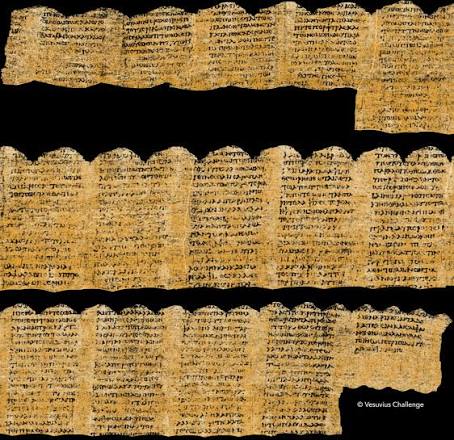
Contestants around the world improved segmentation and ink detection. In 2023, the first letters and then passages of Greek emerged from an unopened scroll. The grand-prize team of Youssef Nader, Luke Farritor, and Julian Schilliger recovered multiple readable passages totaling more than 2,000 characters from the scanned material.
The achievement was independently examined by expert papyrologists. It demonstrated that writing could be recovered non-destructively from inside a Herculaneum roll. It did not mean that every scroll was suddenly readable or that the entire library had been decoded.
What Has Been Read So Far
The first major virtually unwrapped passages concerned Epicurean philosophical themes, including pleasure, perception, and goods such as food or music. The content fit the known character of the library while adding text unseen for nearly two millennia.
By June 2026, the University of Kentucky reported an end-to-end recovery of extended material from multiple scrolls, including nearly 1.5 meters from PHerc. 1667 and more than seventy columns from PHerc. 172. Some texts were attributed to Philodemus, including parts of works on vices and gods.
These are current scholarly results, not final editions. Letter recognition, column order, attribution, and translation require continued review. Announcements of “complete reading” may refer to the surviving scanned portion rather than an undamaged ancient roll from first line to last.
Humanities and Computing Must Work Together
The recovery process combines high-energy imaging, materials science, geometry, software engineering, machine learning, Greek paleography, papyrology, philosophy, and conservation. No single field can solve the problem alone.
Computer scientists need scholarly feedback to distinguish ink from noise and to prioritize useful surfaces. Classicists need transparent technical evidence before accepting a reading. Conservators determine whether scanning, transport, and environmental conditions are safe for irreplaceable objects.
Open data and prize competitions accelerated progress by inviting unconventional contributors. They also require strong standards. A visually plausible letter sequence is not enough; results should be reproducible, traceable to scan coordinates, and reviewed by specialists who can recognize linguistic impossibilities.
A Library Unlike the Library of Ashurbanipal
The Herculaneum collection is often called the only surviving library from classical antiquity, but that statement needs definition. The much older Library of Ashurbanipal survives in thousands of clay tablets from ancient Nineveh. Other ancient archives preserve inscriptions, papyri, and tablets.
What makes Herculaneum exceptional is the survival of a substantial Greco-Roman book collection in papyrus-roll form within its architectural setting. Clay tablets withstand conditions that destroy papyrus; carbonized rolls preserve a different technology of reading, copying, and organizing texts.
Comparing the two libraries reveals how material determines survival. Ashurbanipal’s fire-baked tablets became more durable. Herculaneum’s rolls were preserved through carbonization and sealing. In both cases, catastrophe destroyed living institutions while accidentally protecting their texts.
Unexcavated Rooms and Ethical Choices
Because the Villa of the Papyri has not been fully excavated, scholars continue to debate further exploration. Another library room could contain Latin works or different genres. Modern imaging of the ground may help identify spaces before intrusive digging.
Excavation is not automatically preservation. Removing volcanic material can destabilize structures, expose fragile surfaces, and create permanent conservation obligations. Modern Ercolano also stands above parts of the ancient site. Archaeologists must balance discovery against safety, cost, and community impact.
The unopened papyri pose the same ethical principle at a smaller scale. Earlier generations sacrificed objects to obtain text. Virtual methods reverse the priority: preserve the physical scroll while extracting information non-invasively. Patience is now a research tool.
Conclusion: A Library Becoming Legible Again
The Herculaneum Papyri survived because Vesuvius almost destroyed them completely. Heat converted flexible books into brittle carbon; burial protected that carbon for seventeen centuries; excavation exposed it to new dangers. Every readable line carries the history of both ancient catastrophe and modern intervention.
The library is not a sealed treasure chest certain to contain the lost masterpieces people most want. Its known core is a philosophical collection rich in Philodemus and Epicurean thought. That alone makes it unique evidence for ancient intellectual life.
Virtual unwrapping has changed the question from whether closed scrolls can be read to how quickly and reliably their texts can be recovered. Machines reveal patterns, but human scholars establish language and meaning. The greatest achievement is not that artificial intelligence replaced classical scholarship; it is that technology allowed scholarship to reach pages that can never safely be opened.
Sources and Further Reading
- The Herculaneum Society, “Papyri”.
- J. Paul Getty Museum, “Buried by Vesuvius: The Villa dei Papiri at Herculaneum”.
- University of Kentucky, Herculaneum virtual-unwrapping project.
- University of Kentucky Digital Restoration Initiative, “Herculaneum Papyrus Scrolls”.
- Vesuvius Challenge, project data and results.