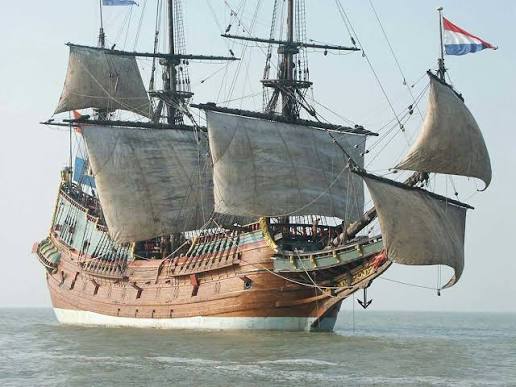
Before dawn on 4 June 1629, the Dutch East India Company ship Batavia struck a coral reef off the coast of Western Australia. The impact destroyed a new, heavily armed vessel on its maiden voyage, but most people aboard escaped the wreck. What followed was deadlier than the collision.
While senior merchant Francisco Pelsaert sailed for help, under-merchant Jeronimus Cornelisz built a regime among the stranded survivors. His followers isolated groups, controlled weapons and supplies, used sexual violence, and killed more than one hundred men, women, and children. A company soldier named Wiebbe Hayes organized resistance on another island. When a rescue ship finally appeared, both sides raced to reach it first.
The broad outline is documented in Pelsaert’s journal, interrogations, confessions, and later archaeology. Yet the record was produced by officials who tortured suspects, assigned guilt, and defended their own decisions. The Batavia shipwreck is therefore both a well-documented atrocity and a lesson in reading colonial sources critically.
What Was the Batavia?
Batavia was a Dutch East India Company, or VOC, retourschip: a large ocean-going vessel built to carry people, silver, trade goods, and supplies between the Dutch Republic and Asia. Launched in 1628, it departed on its maiden voyage for the VOC headquarters at Batavia, present-day Jakarta.
The company was not merely a merchant association. It possessed state-granted powers to make treaties, wage war, build forts, administer colonies, and use violence in pursuit of monopoly. The ship’s destination linked it to the same commercial system that imposed Dutch control on the spice-producing islands, explored in the Banda Islands Massacre.
Authority aboard was divided. Francisco Pelsaert, the senior merchant, commanded the commercial expedition, while Ariaen Jacobsz served as skipper and controlled navigation. Jeronimus Cornelisz, a former Haarlem apothecary, sailed as under-merchant. That hierarchy would matter after disaster removed the ordinary structure holding hundreds of strangers together.
A Troubled Voyage Across the Indian Ocean
The voyage followed the Brouwer Route, which used strong westerly winds across the southern Indian Ocean before ships turned north toward Java. The route cut travel time but demanded accurate judgment of longitude, something seventeenth-century sailors could not measure reliably at sea. A delayed turn could carry a ship dangerously close to Australia’s west coast.
Surviving accounts describe tension between Pelsaert and Jacobsz. A group associated with the skipper and Cornelisz was later accused of planning mutiny before the wreck. An assault on passenger Lucretia Jans was interpreted as an attempt to provoke disciplinary conflict and create conditions for seizing the ship.
Those accusations cannot be treated as neutral transcripts. They come largely from the investigation after the massacre, when suspects faced torture and officials wanted to reconstruct a conspiracy. There may have been a genuine pre-wreck plot, but its scale, readiness, and relationship to the later killings remain disputed.
The Wreck on Morning Reef
In the early hours of 4 June, Batavia ran onto Morning Reef in the Wallabi Group of the Houtman Abrolhos. The coral tore into the hull. Attempts to free the vessel failed, and waves began breaking it apart.
Boats and makeshift transfers moved most passengers and crew to nearby low islands. Some died during the wreck and evacuation, but the majority survived the initial catastrophe. Western Australian Museum summaries count 322 people aboard and only 122 who ultimately reached the Dutch East Indies, though historical totals vary because manifests and later accounts do not align perfectly.
The survivors faced a landscape with little obvious fresh water, limited shelter, and scattered food. They had salvaged supplies, but no certainty that water could sustain the population. Their islands were within sight of one another, yet reefs and channels made movement difficult enough for control of boats to become control of life.
Pelsaert’s Voyage for Help
Pelsaert, Jacobsz, and a selected party left in a longboat to search first for water and then for rescue. They sailed along the unknown coast before crossing to Java, an open-boat journey of roughly 1,500 nautical miles. Remarkably, the party reached Batavia without losing a person.
The decision to leave has been judged both heroic and irresponsible. The voyage required exceptional seamanship and brought the only realistic rescue. At the same time, senior officers departed with a useful boat and left no commanding authority strong enough to prevent Cornelisz from taking control.
VOC officials supplied Pelsaert with the yacht Sardam and ordered him back to the wreck. Finding the low islands and reef took far longer than the outward boat journey. By the time the rescue vessel returned, the survivors’ community had been transformed by organized violence.
How Jeronimus Cornelisz Took Control
Cornelisz remained for a time on the disintegrating wreck and reached the survivors after it finally broke apart. He then became the central political figure on what Europeans called Batavia’s Graveyard, now Beacon Island. He built a loyal inner group through oaths, privileged access, and shared responsibility for crimes.
His faction controlled weapons, boats, wine, and much of the salvaged food. Potential opponents were separated and sent to other islands under false pretences. Cornelisz could reduce the number of people on the main island while preventing a single rival group from forming.
Popular retellings describe him immediately declaring himself a king. The reality was less theatrical and more dangerous: authority emerged through the company hierarchy, access to resources, deception, and gradual complicity. His regime did not need a formal crown to decide who ate, moved, lived, or died.
The Murders on Batavia’s Graveyard
Cornelisz and his followers began killing people they considered burdens, threats, or inconvenient witnesses. Victims were drowned, strangled, stabbed, beaten, or taken away in boats on fabricated errands. Whole families were attacked. The pattern was systematic rather than a single riot.
Pelsaert’s record attributes more than one hundred murders to the mutineers. Exact totals remain difficult because some people died in the wreck, from injuries, illness, dehydration, or other causes. Archaeological graves do not automatically identify the manner of death for every body.
Even with that caution, the massacre is not a later legend. Confessions, lists of victims, eyewitness testimony, and skeletal trauma support organized killing. The responsible uncertainty concerns particular acts, motives, and numbers—not whether mass violence occurred.
Women, Coercion, and Sexual Violence
Women were a minority among the survivors and became targets of coercion. Several were killed. Others were assigned to senior mutineers as sexual partners under conditions where meaningful consent was impossible. Lucretia Jans was reserved for Cornelisz and survived to testify.
Older narratives sometimes used euphemisms such as “companions” or “mistresses.” Those terms can conceal captivity, threats, and repeated sexual assault. The source record was also written by men who focused on mutiny and murder more readily than survivors’ experiences of sexual violence.
Jans was not the cause of the disaster or the mutiny. Stories that place a beautiful woman at the center of male conflict reproduce a familiar narrative device. The evidence presents her primarily as a passenger assaulted during the voyage, held captive after the wreck, and questioned when authority returned.
Wiebbe Hayes and the Defenders
Before the killings became obvious, Cornelisz sent Wiebbe Hayes and a group of soldiers to West Wallabi Island, supposedly to search for water. He may have expected thirst to remove trained fighters without open confrontation. Instead, the soldiers found freshwater sources and food, including wallabies and seabirds.
Escapees brought news of the murders. Hayes organized a defensive camp, and the soldiers built low stone structures and improvised weapons. Their position attracted survivors fleeing Cornelisz, increasing both their numbers and their need for supplies.
The remains are often called Australia’s earliest European-built structures. That description is defensible in a narrow archaeological sense, but they were emergency defences, not the beginning of a planned colony. Australia already had tens of thousands of years of Indigenous occupation, architecture, land management, and political life.
The Battle Between Survivors and Mutineers
Cornelisz could not tolerate an armed rival community. His men launched attacks on Hayes’s island, attempting negotiation, surprise, and direct force. The defenders repelled them despite having fewer conventional weapons.
During one failed encounter, Cornelisz was captured. Command of the remaining mutineers passed to Wouter Loos, a soldier who organized another attack using muskets. The struggle was still underway when sails appeared on the horizon.
This resistance complicates a story centered entirely on Cornelisz. Hayes and his group were not passive victims waiting for rescue. They gathered intelligence, received refugees, secured water, constructed defences, and preserved an alternative authority under extreme conditions.
The Race to Reach the Rescue Ship
When Sardam arrived, defenders and mutineers each sent a boat toward it. Whoever reached Pelsaert first could frame the situation and possibly seize the rescue vessel. Hayes’s men arrived first and warned him.
Pelsaert armed the ship, demanded surrender, and recovered control without allowing the mutineers to board in force. Cornelisz was already a prisoner. The remaining faction surrendered, ending months of killing.
The timing created a dramatic conclusion, but the rescue was not the end of suffering. Survivors still faced interrogations, trials, executions, transport, illness, and return to a company system more concerned with discipline and lost cargo than modern ideas of trauma care.
Trials, Torture, and Executions
Pelsaert convened proceedings on the islands. Suspects were questioned under torture, a legally accepted but unreliable practice in the Dutch system. Cornelisz and six other men were executed there after mutilation; Cornelisz had both hands cut off before hanging.
Other prisoners were taken to Batavia for further trial and punishment. The skipper Jacobsz was investigated over navigation and the alleged earlier conspiracy. The surviving record does not resolve every accusation against him.
Wouter Loos and cabin boy Jan Pelgrom were marooned on the Australian mainland as punishment. Their fate is unknown. They are sometimes called Australia’s first European settlers, but “marooned prisoners whose survival was never recorded” is more accurate than “founders” or voluntary colonists.
Pelsaert’s Journal as Evidence
The principal narrative source is Pelsaert’s journal, incorporating daily notes, testimony, interrogations, sentences, and lists. It is extraordinarily detailed and indispensable. It is also a document produced by the official who led the rescue and prosecution.
Pelsaert had reasons to demonstrate that the killings resulted from wicked conspirators rather than failures of VOC command. Suspects spoke under threat and torture. Statements may contain truth, self-protection, accusation, coached answers, and attempts to reduce punishment.
A critical reading does not require dismissing the journal. Instead, historians compare its claims internally and against archaeology. Specific testimony gains strength when it matches grave locations, weapon injuries, survivor movements, or material traces that the writers could not have invented for modern excavation.
Was the Massacre Planned Before the Wreck?
The standard account links a planned seizure of Batavia during the voyage to Cornelisz’s regime after the wreck. Pelsaert believed the massacre continued an existing conspiracy: reduce the survivors, capture a rescue ship, and turn pirate.
A 2025 study by Jaco Koehler re-examined the case using scenario analysis. It questioned whether torture-derived confessions prove a mature pre-wreck plan and proposed that scarcity, social collapse, and events after the wreck may explain more of the violence than historians have allowed.
The revision is important but contested. Critics note that survivors occupied several islands, some with food and water, and that the killings appear selective and organized rather than merely desperate competition for calories. The responsible conclusion is that pre-wreck mutiny evidence deserves scrutiny, while starvation alone does not explain the documented pattern.
What Archaeology Adds to the Written Record
The wreck was located in 1963, and Western Australian Museum excavations in the 1970s recovered cannon, anchors, cargo, artifacts, and a substantial section of hull. Work on Beacon Island identified camps, graves, and human remains connected to the disaster.
Forensic study has found sharp-force and blunt-force trauma on some individuals. Multiple burials show how bodies were treated, but not every communal grave is a massacre pit. One orderly group may contain people who died soon after the wreck, before Cornelisz’s killing campaign began.
Recent research led by the University of Western Australia and the museum has combined skeletal analysis, DNA, dental study, geophysics, archival work, and landscape archaeology. These “silent witnesses” sometimes confirm violence and sometimes resist the tidy categories imposed by Pelsaert’s narrative.
The Ship, Cargo, and VOC World
Recovered hull timbers reveal how a large Dutch East Indiaman was built for long-distance cargo and defence. A reconstructed stern section is displayed at the WA Shipwrecks Museum in Fremantle, allowing visitors to see the scale behind the human story.
The cargo included silver, coins, trade goods, weapons, and dressed stone intended for buildings in Batavia. Divers and archaeologists recovered parts of a sandstone portico, later reconstructed at the museum. The company shipped architecture as well as merchandise across the empire.
The material places the catastrophe inside a global corporate system. Like later schemes described in the Darien Scheme, oceanic ambition depended on finance, navigation, hierarchy, supplies, and the ability to impose authority far from home. At the Abrolhos, that machinery failed in concentrated form.
Rediscovery and the Birth of Maritime Archaeology
Fishers and divers found Dutch artifacts around the islands before the wreck was securely identified. The location of Batavia in 1963 intensified concern that historic wrecks could be stripped for souvenirs or commercial salvage.
Western Australia introduced protective legislation in 1964 and developed one of the world’s early government maritime archaeology programs. Excavation from 1972 onward treated the wreck as a site to document rather than a treasure chest to empty.
That approach preserved hull structure, artifact associations, and evidence from the survivor islands. The Batavia site therefore influenced not only interpretations of 1629 but the development of underwater heritage protection in Australia.
Common Oversimplifications
Cornelisz is often portrayed as a modern clinical “psychopath.” His actions were calculated and brutal, but a diagnosis made centuries later from hostile records is not established medical fact. Religious heterodoxy and association with controversial ideas have likewise been used to create a simple intellectual cause for murder.
The phrase “first European settlement in Australia” can also mislead. The survivors built and occupied camps before later British colonization, but they did so unintentionally and briefly. The episode did not begin continuous European settlement, and it occurred in a continent with ancient Indigenous societies.
Finally, not every skeleton from Beacon Island was murdered, and not every confession is equally reliable. The strongest account combines documents and physical evidence rather than forcing either source to answer questions it cannot.
What Is Confirmed and What Remains Disputed
It is confirmed that Batavia wrecked on 4 June 1629, that most aboard survived the impact, that Pelsaert’s party reached Java, and that Cornelisz’s faction carried out organized killings. Hayes’s group resisted, Sardam returned, trials followed, and executions occurred.
The precise pre-wreck conspiracy, Cornelisz’s ultimate goal, the responsibility for every death, and the voluntariness of particular confessions remain disputed. Survivor totals vary, while graves continue to refine the sequence of natural deaths, wreck casualties, resistance, and murder.
These uncertainties are not reasons to treat the whole story as legend. They define the difference between a documented event and a perfectly knowable one.
Conclusion: Disaster, Power, and Survival
The Batavia shipwreck became a massacre because maritime disaster destroyed normal authority without destroying hierarchy. Cornelisz and his allies converted access to boats, food, weapons, and information into power. Their violence was organized, not inevitable.
Resistance was equally organized. Hayes’s soldiers found resources, welcomed escapees, built defences, and prevented the mutineers from controlling every survivor. Pelsaert’s rescue voyage then succeeded through extraordinary navigation, even as his later court used methods that make parts of its evidence difficult to trust.
Four centuries later, the most responsible history remains neither a morality play about one monster nor a survival tale stripped of crime. It is a layered reconstruction built from a partisan journal, coerced testimony, a broken hull, stone defences, scattered possessions, and human remains. Together they show how quickly a corporate voyage could become a struggle over who possessed the right—and the force—to rule.
Sources and Further Reading
- Francisco Pelsaert, The Batavia Journal — English translation of the principal primary narrative and trial record.
- Western Australian Museum, “The Wreck of Batavia” — official overview of the voyage, massacre, artifacts, and burials.
- Western Australian Museum Maritime Archaeology Database, “Batavia” — wreck-site history and excavation record.
- Australian National Maritime Museum, “The Batavia Shipwreck Disaster” — museum account of the ship and survivors.
- University of Western Australia, “Silent Witnesses” — archaeological and forensic findings from Beacon Island.
- Jaco Koehler, “The Batavia Disaster: A New Scenario to Explain What Happened,” International Journal of Maritime History — recent reassessment of the evidence and traditional conspiracy narrative.