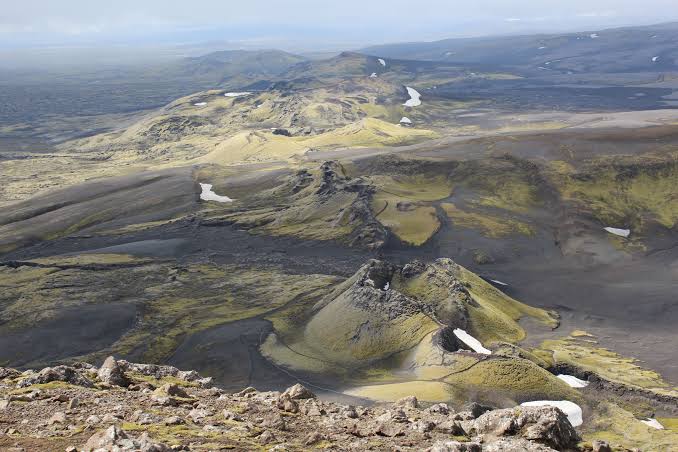
On June 8, 1783, the ground opened in southern Iceland. Fire fountains rose above a chain of fissures, lava poured across river valleys, and a poisonous haze began a journey far beyond the island. The eruption continued in pulses for eight months. By the time it ended, it had created one of the largest lava flows in recorded history, devastated Icelandic farming, and placed a sulfurous veil over much of the Northern Hemisphere.
The Laki eruption is often squeezed into a dramatic one-line story: an Icelandic volcano poisoned Europe and helped cause the French Revolution. The real history is more revealing. Laki was not a single mountain exploding, its effects changed over time and place, and its political consequences cannot be reduced to a direct line from volcano to revolution. What can be established is extraordinary enough: a long fissure eruption turned geology into a crisis of food, health, climate, and government.
What erupted at Laki in 1783?
Laki is a volcanic fissure system in Iceland’s Eastern Volcanic Zone, associated with the Grímsvötn volcanic system. The Icelandic name Lakagígar means the craters of Laki. That name matters because the event was not a conventional eruption from the summit of the mountain Laki. Instead, a fissure approximately 27 kilometers long opened on both sides of it, eventually producing more than 100 vents and craters.
The eruption, known in Iceland as the Skaftáreldar, or Skaftá Fires, began on June 8, 1783. Activity occurred in episodes as fissures opened progressively along the line. Fire fountains fed enormous sheets and channels of basaltic lava. The main eruptive phase lasted into early 1784, conventionally ending in February. Grímsvötn also experienced explosive activity during this broader sequence, making reconstruction more complicated than the convenient label “Laki eruption” suggests.
Modern geological estimates put the lava volume near 14.7 cubic kilometers. The flows covered roughly 565 square kilometers, filling the gorges of the Skaftá and Hverfisfljót river systems and advancing across farms and grazing land. These figures carry normal scientific uncertainty, but they establish Laki as an exceptional flood-basalt event by historical standards. Its global importance, however, came less from ash than from gases released alongside the lava.
Jón Steingrímsson and the “Fire Mass”
The most important eyewitness was Jón Steingrímsson, a Lutheran pastor at Kirkjubæjarklaustur. His written account, commonly known in English as Fires of the Earth, records earthquakes, darkness, ash, burning landscapes, contaminated pasture, illness, and the terror of communities living near the advancing flows. Like other eighteenth-century observers, he interpreted events through both practical observation and religious belief. His testimony remains invaluable, but it should be read in its own intellectual world rather than treated as a modern scientific report.
On July 20, 1783, Jón led a church service while lava threatened the district. Later tradition called it the “Fire Mass.” The famous version says that his sermon miraculously stopped the lava before it destroyed Kirkjubæjarklaustur. The community did survive, and a lava front ceased advancing near the settlement, but there is no evidence that the service physically halted the eruption. Lava supplies fluctuate, channels change, and individual flow fronts stop while activity continues elsewhere.
Dismissing the episode simply as a myth would also miss its historical meaning. The service occurred amid a genuine emergency and became a story through which survivors understood endurance. Jón was not merely preaching while passively awaiting fate. His writings show close attention to weather, livestock, water, ash, and human behavior. The Fire Mass is best understood as a documented act of communal leadership surrounded by a later miraculous interpretation—not as either pure invention or geological proof of divine intervention.
A lava disaster became a gas disaster
Laki’s lava destroyed land and disrupted rivers locally, but sulfur emissions expanded the catastrophe. Researchers estimate that the eruption released approximately 120 million tonnes of sulfur dioxide, along with fluorine compounds and other gases. Precise totals depend on geological models, yet the order of magnitude is clear. The sulfur reacted in the atmosphere to form sulfate aerosols: tiny particles capable of scattering sunlight and harming respiratory health.
Near the vents, fluorine contamination was especially destructive. Fluoride settled onto grass and other vegetation, then entered livestock through grazing. Animals developed symptoms consistent with fluorosis, including damaged teeth and bones, weakness, and death. Contemporary Icelanders did not know the chemistry, but they recognized that pasture and water had become dangerous. Ash, acidic fallout, and reduced sunlight further damaged hay and crops needed for the coming winter.
The eruption therefore produced several overlapping hazards. Lava was spectacular but geographically limited. Fluorine poisoned animals and undermined the food supply within Iceland. Sulfur dioxide and sulfate haze affected a much larger region. Later cooling influenced weather, but the first European experience in the summer of 1783 was often oppressive heat beneath a persistent dry fog. Treating every consequence as simple “volcanic winter” obscures the sequence through which the emergency developed.
The Haze Famine in Iceland
Icelanders called the ensuing crisis the Móðuharðindin, usually translated as the Mist Hardships or Haze Famine. The eruption struck an agrarian society dependent on livestock, haymaking, fishing, and narrow seasonal margins. Lava and ash directly damaged some districts, while toxic fallout killed animals more widely. Commonly cited national losses include around half the cattle and even larger shares of sheep and horses, although percentages vary by source and method.
With herds depleted and fodder ruined, the disaster became a famine. Malnutrition weakened people already exposed to contaminated air and harsh weather. Disease increased mortality. Roughly 9,000 Icelanders are often estimated to have died during 1783–1785, close to one fifth of the island’s population and perhaps somewhat more. Parish registers are imperfect, so the total should not be presented as an exact count, but the demographic shock is unmistakable.
People ate whatever substitutes they could find, migrated between districts, and depended on local relief that could not meet the scale of need. Denmark ruled Iceland, and officials debated assistance, trade, and even schemes to move surviving Icelanders elsewhere. Relief arrived slowly and administrative responses were constrained by distance, limited shipping, and poor information. The catastrophe revealed that famine was never only a natural event: volcanic hazards became mass mortality through economic dependence, transport limitations, social inequality, and government capacity.
The mysterious dry fog over Europe
By late June 1783, observers across Europe recorded an unusual haze. It appeared in Norway, Britain, France, the Low Countries, Germany, Italy, and beyond. The sun looked blood-red or dim, distant objects disappeared, and the air sometimes smelled sulfurous. Unlike familiar mist, the veil persisted during dry weather and was not easily dispersed by wind. Electrical storms, crop damage, and breathing complaints were reported alongside it, though not every abnormal event that summer can be attributed to Laki.
Contemporaries proposed earthquakes, meteors, industrial smoke, or distant eruptions. Benjamin Franklin, then serving in France, made one of the most famous scientific connections. In a paper presented in 1784, he described the constant dry fog of the previous summer and suggested that smoke from Iceland’s volcanoes might have obstructed sunlight and contributed to an unusually severe winter. His explanation was incomplete, but it linked distant volcanism, atmospheric transport, and climate with remarkable insight.
The haze did not respect borders, revealing an environmental connection that eighteenth-century governments could barely monitor. Ships and letters carried news far more slowly than aerosols crossed the atmosphere. Europeans experienced the effect before most understood its Icelandic source. Modern atmospheric modeling and historical observations together make the Laki connection convincing, while also showing that concentrations varied greatly with weather patterns. “Europe was poisoned” is directionally true but too uniform: exposure, symptoms, and mortality differed across regions.
Heat, cold, and the complicated climate signal
Large eruptions are popularly associated with immediate global cooling, yet Laki’s climate effects were not a simple switch from warmth to cold. Much of western Europe experienced an exceptionally hot summer in 1783 while the sulfur haze lingered near the surface. Sulfur dioxide irritated lungs and damaged vegetation even as stagnant high pressure helped trap polluted air. The sequence reminds us that air quality and temperature are related but distinct hazards.
The winter of 1783–1784 was severe in many parts of the Northern Hemisphere. Rivers froze, snow persisted, and communities experienced damaging cold. Franklin thought the volcanic fog had reduced solar heating. Modern studies generally accept that Laki aerosols affected climate, but researchers continue to debate the size, distribution, and duration of the response. Laki occurred at high latitude, and much of its sulfur remained in or near the troposphere rather than spreading exactly like material from a major tropical explosive eruption.
Weather also has many causes. Natural variability, ocean-atmosphere patterns, and other volcanic activity can strengthen or mask an eruption’s influence. Some reconstructions identify cooling into 1784 and wider circulation changes; others warn against assigning every flood, drought, or harsh season to Laki. A responsible account distinguishes a detectable climatic forcing from a claim of total control. The eruption altered probabilities and atmospheric conditions. It did not personally “cause” every extreme event reported across the world.
Did the Laki haze kill thousands in Europe?
Parish burial records in England and parts of continental Europe show unusual mortality during and after the haze. Researchers have examined summer deaths that may reflect respiratory or cardiovascular stress, followed by winter mortality related to cold and disease. Some studies propose tens of thousands of excess deaths in Britain or a larger European toll. Such estimates have made Laki one of history’s deadliest pollution events in popular accounts.
The evidence is suggestive but not a continental death certificate. Eighteenth-century registers usually record burials, not medically confirmed causes. Population baselines are uncertain, and epidemics, heat, food prices, and winter weather can produce overlapping mortality. A spike during the haze strengthens the case for harm but does not reveal exactly how many deaths were caused by sulfate pollution rather than associated conditions.
It is safest to conclude that Laki seriously degraded European air and probably contributed to excess mortality, especially among vulnerable people, without repeating one definitive number as settled fact. The distinction is important. Understatement ignores a rare long-range pollution disaster; overstatement converts statistical reconstruction into false precision. Historians and atmospheric scientists can demonstrate exposure and elevated risk more confidently than they can name an exact European death toll.
Food prices, harvests, and the French Revolution claim
Laki has often been described as a hidden cause of the French Revolution. The proposed chain runs from volcanic aerosols to abnormal weather, failed harvests, high bread prices, popular anger, and revolution in 1789. Climate certainly belongs in the history of late eighteenth-century subsistence crises. Food shortages could intensify distrust of government, and France suffered a disastrous harvest in 1788 followed by soaring prices.
The chronology, however, resists a simple Laki-to-Bastille narrative. The eruption began six years before the revolution, and the most immediate European effects occurred in 1783–1784. France’s crisis resulted from fiscal breakdown, war debts, unequal taxation, political conflict, poor harvests, market structures, and the monarchy’s failure to reform. The severe weather of 1788 cannot be assigned confidently to lingering Laki aerosols as though no other climatic forces existed.
Laki may have contributed to a difficult run of weather and agricultural stress in the wider 1780s, but “caused the French Revolution” is an exaggerated headline, not an accepted historical explanation. Environmental shocks operate through institutions. The same haze did not produce identical political outcomes in every country it reached. Volcanoes can strain economies and expose weak governments; they do not write constitutions, convene estates, or determine revolutionary ideology.
How Laki compares with Krakatoa and Tambora
Laki is sometimes grouped with Tambora in 1815 and Krakatoa in 1883, but the eruptions differed fundamentally. Tambora and Krakatoa were highly explosive eruptions that blasted ash and gas upward from major volcanic structures. Laki was predominantly an effusive fissure eruption: vast quantities of basaltic lava emerged over months, accompanied by exceptional gas emissions. Its Volcanic Explosivity Index alone therefore fails to express its historical danger.
Tambora’s tropical position and enormous explosive column produced the famous “Year Without a Summer” in 1816. Krakatoa generated devastating tsunamis and a pressure wave heard across vast distances; readers can compare that catastrophe with the site’s account of the 1883 Krakatoa eruption. Laki’s signature was different: repeated lava outpouring, fluorine poisoning in Iceland, and a sulfur haze transported over populous parts of Europe.
These contrasts explain why ranking eruptions by a single measure is misleading. Lava volume, explosivity, sulfur yield, latitude, season, population exposure, and vulnerability all affect consequences. An eruption can be locally survivable yet globally disruptive, or explosively spectacular but climatically limited. Laki’s place in history comes from the interaction of geochemistry and society rather than from one record-breaking blast.
What historians can—and cannot—know
Laki is unusually well documented for an eighteenth-century eruption. Jón Steingrímsson and other Icelanders left eyewitness narratives; Danish officials generated reports; European diaries and newspapers described the haze; meteorological observers recorded temperature and weather. Geologists can map lava fields and analyze deposits, while ice cores and tree rings preserve additional environmental signals. Combining these sources allows a reconstruction unavailable to the people who lived through the event.
Yet every evidence type has limits. Eyewitnesses used religious and premodern scientific concepts. Parish registers omit diagnoses. Tree growth reflects several environmental pressures. Climate models depend on assumptions about sulfur altitude, particle formation, circulation, and background conditions. Even the date when “the eruption ended” depends on whether researchers mean the last major fissure activity, related Grímsvötn explosions, or continuing gas release.
The best history is therefore explicit about levels of confidence. The fissure chronology, immense lava field, livestock catastrophe, famine, and European haze are firmly established. Exact mortality outside Iceland, the magnitude of global cooling, and distant political effects remain more contested. Uncertainty is not ignorance. It is the boundary between evidence and the tempting stories later generations build around it.
The lasting significance of the Laki eruption
Laki anticipated modern problems of transboundary pollution. No country could stop aerosols at a customs post, and communities far from Iceland suffered conditions they did not cause and initially could not identify. Today, satellites and atmospheric monitoring would detect such emissions quickly, but aviation, dense cities, industrial agriculture, and interconnected supply chains would create new vulnerabilities. Scientific warning does not automatically solve evacuation, livestock protection, food security, or international coordination.
The eruption also reshaped scientific thinking. Franklin’s conjecture was not the first observation of volcanic weather, nor was it fully correct, but it became an influential example of reasoning across distance. Later study of Laki helped volcanologists recognize that prolonged basaltic eruptions can produce climate and health crises even without a colossal explosive column. It also encouraged historians to connect environmental archives with written records while resisting monocausal explanations.
For Iceland, the event remains part of national memory because it joined spectacular geology to intimate loss. Farms disappeared, animals died slowly, households broke apart, and clergy and officials struggled to interpret an unprecedented emergency. The surviving crater row is visually dramatic, but its historical meaning lies equally in the communities beyond the lava’s edge whose food, lungs, and futures were affected.
Why this episode still matters
The Laki eruption was not a single explosion, not merely a lava flood, and not a supernatural punishment that one sermon stopped. It was an eight-month fissure eruption whose lava transformed southern Iceland and whose gases converted a regional geological event into an international environmental crisis. Fluorine devastated livestock, famine killed roughly a fifth of Iceland’s population, and sulfur haze traveled across Europe, damaging air quality and influencing climate.
Its wider consequences demand careful language. Laki probably contributed to excess mortality abroad and to abnormal weather, but exact death totals remain debated. It formed part of the difficult environmental background of the 1780s, yet it did not single-handedly cause the French Revolution. Those distinctions make the story stronger, not weaker.
Laki’s most important lesson is that disasters are produced where natural hazards meet vulnerable societies. Magma opened the fissures, but dependence on livestock, slow communications, limited relief, and political institutions determined much of the human cost. The haze eventually cleared. The historical questions it raised—about pollution without borders, climate shocks, scientific uncertainty, and unequal resilience—remain sharply modern.
Research and further reading
For readers who want to verify details or continue researching this subject, these external reference collections provide useful starting points: