In March 1900, the British governor of the Gold Coast entered Kumasi and asked why the Golden Stool had not been brought for him to sit upon. To British officials, the demand asserted imperial authority over a kingdom they believed had already been defeated. To the Asante, it revealed a profound failure to understand what the Stool was. It was not an ornate throne that could be surrendered with a defeated king. It embodied the soul, unity, and continuity of the Asante nation.
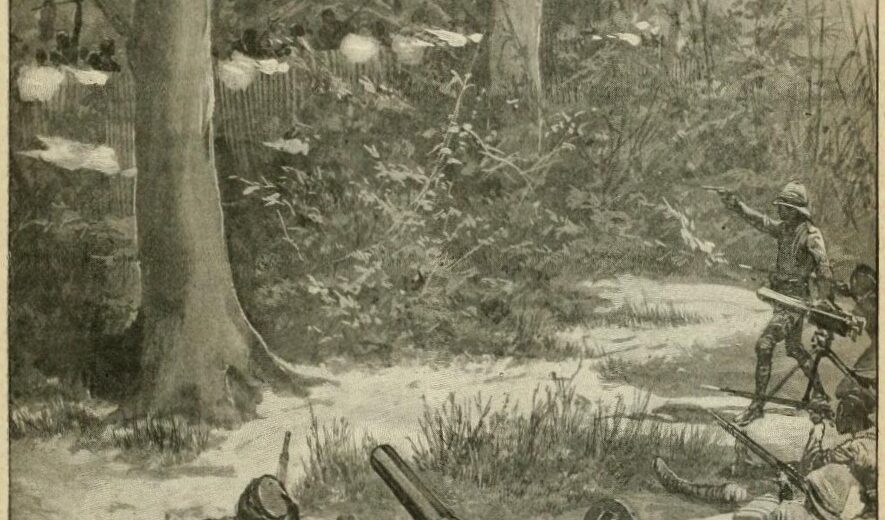
The result was the last major Anglo-Asante war, remembered in Ghana as the Yaa Asantewaa War and elsewhere as the War of the Golden Stool. Asante forces surrounded the British fort at Kumasi, fought relief columns through forest stockades, and protected the Stool from capture. Britain eventually defeated the military resistance and annexed Asante, but it never obtained the sacred object that had triggered the crisis.
The war is often retold as a confrontation between Governor Frederick Hodgson and Yaa Asantewaa, the queen mother who shamed reluctant men into fighting. Both were central figures, yet the conflict grew from decades of invasion, exile, looting, and contested sovereignty. Its most famous speeches survive mainly through later recollection. Strong history preserves the drama without turning memory into unquestioned transcript.
The Golden Stool Was More Than a Royal Seat
The Golden Stool, or Sika Dwa Kofi, occupies a unique place in Asante political and spiritual life. Tradition connects its appearance around 1700 with Okomfo Anokye, the priest and statesman associated with the founding Asantehene, Osei Tutu. The Stool was understood to contain the sunsum, or spirit, of the Asante people. It represented the union of the confederacy rather than the personal property of one ruler.
An Asantehene did not sit directly upon it. During exceptional ceremonies it was placed on its own seat and handled according to strict ritual rules. Ordinary stools could represent the authority and identity of individuals or offices, but the Golden Stool stood above them as the sacred center of Asanteman.
European descriptions frequently called it a throne, encouraging the mistaken idea that possessing it would transfer kingship like capturing a crown. Even today, museum labels must distinguish the Golden Stool, which remains in Asante custody, from other royal stools seized during colonial wars. The governor’s demand in 1900 was not merely rude protocol. It implied that an imperial official could physically occupy the collective soul of the polity.
Asante Power and the Coastal Contest
During the eighteenth and nineteenth centuries, the Asante state became a powerful West African empire centered on Kumasi. Its wealth rested on agriculture, trade, gold, tribute, and military organization. Asante authority extended over diverse subject territories, though power was continually negotiated and challenged. The Atlantic economy connected the region to firearms, manufactured goods, gold exports, and the slave trade.
British influence grew along the coast through forts, commerce, alliances, and rivalry with other European powers. Coastal African states had their own interests and were not simply British puppets. Some opposed Asante expansion or used British support in regional struggles. Britain increasingly treated control of the coast and routes inland as strategic necessities, while Asante leaders defended trade and political influence.
Decades of Anglo-Asante Warfare
British and Asante forces fought several major conflicts during the nineteenth century. In 1824, Asante troops defeated and killed Governor Charles MacCarthy, but later warfare produced mixed results. The balance shifted as Britain concentrated greater resources and industrial weaponry on the Gold Coast.
In 1874, a British expedition under Garnet Wolseley entered Kumasi after defeating Asante forces. Troops looted royal regalia, demanded an indemnity, and burned parts of the capital. Objects taken during this campaign entered private collections and museums, where their ownership remains contested. The British Museum itself acknowledges that Asante gold regalia in its holdings is inseparable from this violent history.
The campaign weakened but did not erase Asante sovereignty. Internal disputes and secessions followed, while Britain expanded its protectorates. Each side remembered treaties differently: British officials saw growing legal supremacy, whereas Asante political actors continued to defend their own institutions. By the 1890s, imperial officials wanted decisive control over the interior before rival European powers could challenge them.
The 1896 Expedition Removed Prempeh I
In 1895–1896, Britain sent another expedition to Kumasi. Asantehene Prempeh I chose not to fight a campaign he believed would bring ruin against overwhelming force. British troops occupied the capital, demanded payments, and arrested Prempeh, the queen mother, and other leading figures. They were exiled first to Elmina, later to Sierra Leone, and eventually to the Seychelles.
British officials treated submission and exile as proof that Asante independence had ended. A resident and military garrison were installed in Kumasi. Yet the Asante political system had not granted the British spiritual or constitutional possession of the Golden Stool. Removing the king did not dissolve the offices, councils, and obligations that sustained the confederacy.
The occupiers also searched for royal wealth and symbols. Their inability to locate the Golden Stool became an irritant because its continued concealment demonstrated that British power had limits. The object was hidden by people who understood that surrendering it would concede something deeper than military defeat.
Governor Hodgson’s Demand in Kumasi
Frederick Mitchell Hodgson, governor of the Gold Coast, arrived in Kumasi in March 1900 accompanied by troops and officials. At a meeting with Asante leaders, he demanded the Golden Stool and asked why he had not been invited to occupy it as Queen Victoria’s representative. Accounts differ in exact wording, but the substance appears in contemporary and later records.
Hodgson seems to have believed the Stool was regalia whose surrender would publicly complete British authority. Advisers had not conveyed—or he had not accepted—its sacred status. The assembled leaders did not comply. They concealed their response while messengers and councils mobilized resistance.
Popular histories present the speech as one foolish sentence that instantly caused war. The demand was the immediate provocation, but it ignited grievances produced by invasion, exile, garrison rule, searches, and humiliation. It mattered because it condensed the colonial project into one offensive act.
Yaa Asantewaa’s Political Authority
Yaa Asantewaa was the queen mother of Ejisu, an important Asante division. The English title can mislead readers into imagining a ceremonial relative of a male ruler. In Asante matrilineal organization, an ohemaa helped nominate officeholders, advised councils, guarded dynastic legitimacy, and could exercise substantial authority. Yaa Asantewaa had installed her grandson as ruler of Ejisu after her brother’s death.
With many senior leaders in exile, she became one of the strongest voices for resistance. Ghanaian memory preserves a famous speech in which she rebuked hesitant men and declared that women would fight if men refused. The speech expresses her remembered role and has become a foundational statement of anti-colonial courage. Its exact wording, however, was recorded later rather than stenographically at the council.
Calling her the sole commander of every Asante force is also too simple. Military leadership was distributed among chiefs and war captains in different districts. Yaa Asantewaa inspired mobilization, exercised political leadership, and became the war’s defining figure, but the resistance was a coalition, not a modern army controlled from one headquarters.
Asante Forces Besieged the Kumasi Fort
Once resistance became open, Asante fighters isolated Kumasi and forced Hodgson’s party into the fortified British position. The fort sheltered European officials, soldiers, African troops, civilians, and dependents. Food, ammunition, medicine, and clean water became urgent concerns as the siege continued.
Asante forces constructed stockades along forest roads, cut communications, and attacked anyone attempting to move supplies. Their knowledge of terrain allowed them to turn narrow paths into defensive systems. The British garrison possessed modern rifles and machine guns, but firepower could not produce food or reopen every road.
The siege reversed the symbolism of occupation. Hodgson had entered Kumasi to demonstrate imperial command; weeks later, he was trapped in a fort within the city he claimed to govern. Asante strategy did not require storming strong walls at any cost. By isolating the garrison, fighters could let hunger and disease weaken it while blocking relief.
The Forest War Challenged British Columns
British relief expeditions faced dense vegetation, narrow roads, heavy rain, and Asante stockades concealed behind bends or across tracks. Columns needed carriers for ammunition, food, medical supplies, and artillery. A force moving forward could leave a long, vulnerable logistical tail.
Asante fighters used ambushes and fortified barriers to delay troops and inflict casualties. British officers often described opponents through racist stereotypes, yet their reports acknowledged the strength of stockades. African troops serving Britain—including Hausa and other West African soldiers—carried much of the fighting burden.
The conflict was not simply white British soldiers against Asante warriors. Empire operated through African labor, carriers, scouts, allies, and colonial regiments. As in the 1896 Anglo-Zanzibar War, technology mattered, but forest and dispersed resistance prevented a quick demonstration from ending the conflict.
Hodgson’s Breakout from Kumasi
By June, the garrison’s condition had deteriorated. Rations were reduced, sickness spread, and hope of immediate relief faded. Hodgson decided to break out with part of the force, leaving a smaller garrison to hold the fort. On June 23, the column departed through heavy resistance.
The escape was punishing. Soldiers and carriers fought through stockades, mud, hunger, and exhaustion while transporting wounded people and limited supplies. Some accounts emphasize Hodgson’s leadership; others focus on African troops and carriers whose labor made survival possible. Imperial memoirs naturally centered senior British officers, distorting who bore the physical cost.
The column eventually reached safety toward the coast. Its escape prevented the governor’s capture, but did not end the siege. The fort remained surrounded, and Britain prepared a larger expedition under Colonel James Willcocks to relieve Kumasi and suppress the uprising.
The Relief of Kumasi and Wider Suppression
Willcocks assembled troops from several British West African territories and advanced toward Kumasi. His columns attacked stockades, repaired routes, and established posts to protect communications. On July 15, 1900, the relief force reached the fort, ending the main siege.
Relieving the garrison did not immediately defeat resistance. Fighting continued as British forces pursued leaders, burned settlements, seized supplies, and dismantled defensive positions. The campaign combined superior weapons with expanded supply lines. Asante forces could resist individual columns but found it difficult to replace ammunition and coordinate under sustained pressure.
By late 1900, organized resistance had been broken, although arrests and political consequences continued. Casualty totals vary because colonial records counted categories unevenly and often minimized African losses. The confirmed pattern is asymmetrical: imperial resources ultimately overwhelmed a resistance that had imposed months of hard warfare.
The Golden Stool Was Never Captured
British soldiers and officials searched for the Stool during and after the war. Asante custodians kept it concealed. Later stories describe workers or hunters revealing its hiding place and colonial punishment for interfering with it, but versions differ and sometimes combine separate events. What matters is clear: Britain did not seize the authentic Golden Stool in 1900.
This failure gave the outcome a double meaning. Britain controlled territory, arrested leaders, and imposed annexation. Yet the central sacred symbol of Asante unity remained outside imperial possession. Officials could govern without it, but could not plausibly claim the Asante had voluntarily transferred their national soul.
Museums hold several Asante stools, gold ornaments, and royal objects looted in earlier campaigns. These are culturally significant, but they are not the Golden Stool. Claims that it sits secretly in a British museum are unsupported. It remains protected within Asante tradition and is displayed only on exceptional occasions.
Exile and the Fate of Yaa Asantewaa
British forces captured Yaa Asantewaa and other resistance leaders. She was exiled to the Seychelles, joining Prempeh I and members of the Asante court already held there. Exile removed influential people from local networks while allowing Britain to avoid executions that might create martyrs at the center of new resistance.
Yaa Asantewaa died in the Seychelles in 1921. Prempeh returned to the Gold Coast in 1924 after accepting a reduced political position; he was later recognized as Kumasihene, and the Asante confederacy was formally restored under British oversight in 1935. Yaa Asantewaa never saw that restoration.
Her reputation grew beyond details recoverable from colonial files. She became a symbol of Ghanaian nationalism, women’s leadership, and African resistance. That symbolism is not proof that every anecdote is literal fact. It shows how communities use a historical life to express political values across generations.
Annexation Did Not Erase Asante Identity
In 1901, Britain formally annexed Asante and incorporated it into the Gold Coast. Administrators governed through districts and selected chiefs, collected revenue, expanded transport, and redirected political authority. The war ended independent Asante state power in conventional diplomatic terms.
Yet institutions tied to stools, matrilineal succession, councils, and local legitimacy continued. British indirect rule depended on African authorities even while defining which authorities were acceptable. This produced conflicts over succession and jurisdiction, but preserved political forms that conquest had failed to destroy.
The experience complicates the word “defeat.” Military defeat and annexation were real. So were institutional survival, spiritual continuity, and the failure to capture the Stool. Later restoration did not recreate the precolonial empire, but confirmed that Asante identity had outlived the colonial claim to final conquest.
Looted Regalia and the Modern Restitution Debate
The war belongs to a longer history of cultural dispossession. British forces had looted royal objects from Kumasi in 1874 and 1896. Some were auctioned, gifted, or absorbed into military and museum collections. For Asante communities, such objects are not merely craftsmanship; they carry historical, political, and sometimes spiritual relationships.
In 2024, the British Museum and Victoria and Albert Museum sent groups of Asante royal objects to the Manhyia Palace Museum in Kumasi under long-term loans. A United States museum also returned several objects permanently. Supporters welcomed their return, while critics noted that a loan leaves legal ownership with institutions that benefited from colonial seizure.
These debates make 1900 immediate. Hodgson’s demand assumed imperial power could possess whatever symbol it named. Modern restitution asks whether institutions should continue claiming objects obtained through that structure of force. The Golden Stool was saved from this fate, but other regalia carry the unfinished consequences of conquest.
How Historians Separate Memory from Myth
The war survives in British dispatches, military memoirs, Asante oral histories, later interviews, objects, songs, and public commemoration. Each source preserves and obscures. British accounts document operations but marginalize African agency. Oral traditions preserve political meaning and community knowledge but may reshape dialogue and chronology across generations.
Yaa Asantewaa’s famous speech is a good example. Historians need not repeat it as a verbatim transcript or dismiss it entirely. The precise sentences are uncertain, while her intervention for resistance and major leadership role are well supported. The speech is evidence for remembered political meaning even when it cannot function as a stenographic record.
Likewise, Hodgson’s demand is confirmed in substance, but polished versions online may modernize the wording. Good history identifies the stable core, explains uncertainty, and avoids fabricated quotation. The real confrontation is powerful enough without invented precision.
What the evidence can support
The War of the Golden Stool was not caused by an isolated etiquette mistake. Hodgson’s demand triggered resistance because it followed decades of warfare, looting, imposed treaties, occupation, and Prempeh I’s exile. The demand revealed that British officials still misunderstood—or disregarded—the order they claimed to rule.
Yaa Asantewaa transformed that insult into mobilization. She did not command alone, and the exact words attributed to her cannot be guaranteed, but her leadership is beyond serious doubt. Asante fighters trapped the governor, held Kumasi’s fort under siege, and forced Britain to mount a major regional campaign.
Britain won the military war, annexed Asante, and exiled its leaders. It did not capture the Golden Stool. That prevented conquest from becoming spiritual surrender and preserved a language of sovereignty that endured through colonial rule. The lesson is not that one sacred object magically defeated an empire. It is that symbols matter because communities organize around them—and because military power cannot fully possess the legitimacy it tries to seize.
Research and further reading
For readers who want to verify details or continue researching this subject, these external reference collections provide useful starting points: