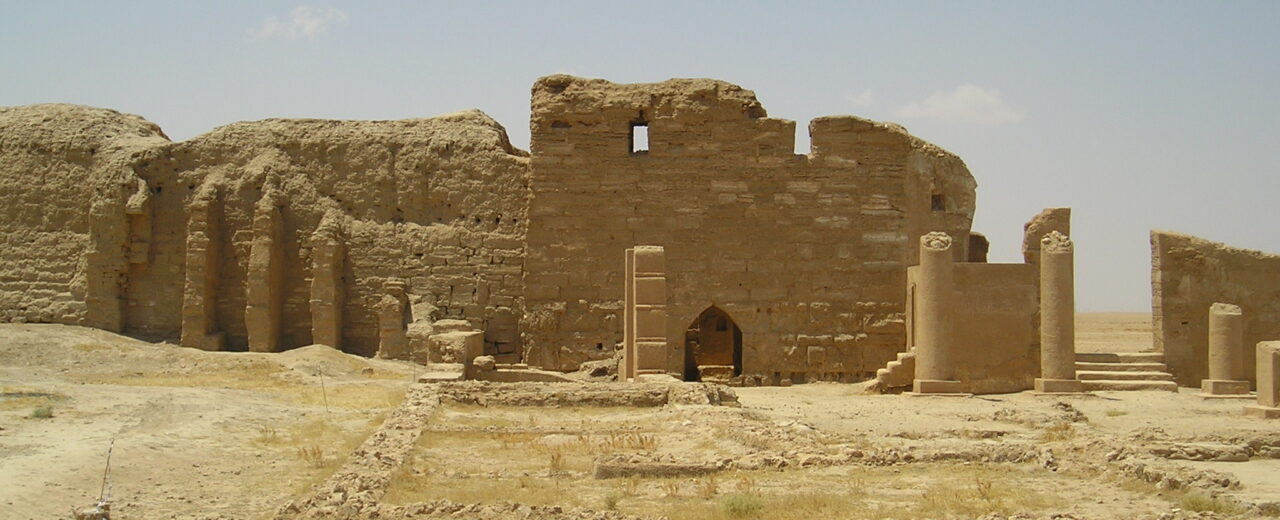
Dura-Europos survives in an unusual way. The city on the Euphrates was not gradually rebuilt into a modern settlement; after its capture in the third century CE, much of it was abandoned. Defensive preparations for the final siege had also buried buildings against the city wall. When archaeologists began excavating in the twentieth century, they uncovered an exceptionally concentrated record of life in a frontier city.
That record is why Dura-Europos matters far beyond military history. Yale’s Dura-Europos research project highlights finds ranging from a painted synagogue and a Christian house church to a Mithraeum and more than 12,000 objects of daily life. UNESCO lists Dura-Europos on Syria’s World Heritage tentative list, emphasizing its strategic position on the route between the Mediterranean world and Mesopotamia.
The site is often summarized as a place of extraordinary “religious tolerance.” That phrase is attractive but too modern and too simple. Dura instead shows how Greek, Parthian, Roman, Semitic and local traditions overlapped in a military and commercial border city. Its buildings, inscriptions and paintings reveal communities living alongside one another, but they do not prove that those communities understood pluralism in modern terms. The strength of Dura-Europos is not that it fits a tidy label; it is that its evidence preserves a complicated urban society at unusually close range.
A city built on a strategic frontier
Dura stood on the west bank of the Euphrates near routes connecting Syria, Mesopotamia, and the Iranian world. Steep terrain protected the river side, while substantial walls defended approaches from the desert plateau. Its position supported military control, agriculture in the river valley, and movement along one of antiquity’s great corridors. The city was never merely an isolated desert outpost.
The name preserves more than one political identity. “Dura” derives from a Semitic word associated with a fortress, while “Europos” was the Greek name used for the Hellenistic settlement. Modern scholarship combines them to identify the archaeological site. That hybrid label suits a place whose population repeatedly adapted imperial institutions without losing local languages, cults, and building traditions.
From the Seleucids to the Parthians
A Macedonian colony was established at Dura around 300 BCE during the early Seleucid period, traditionally associated with Seleucus I Nicator. The precise circumstances of foundation and the relationship to any earlier occupation are less certain than older summaries imply. The settlement adopted a grid plan and Greek civic forms while remaining embedded in the Euphrates region.
Parthian power reached Dura around the late second century BCE. For nearly three centuries the city developed within the Arsacid world, where Iranian rulers governed a culturally diverse empire. Greek remained important in inscriptions and administration, but local Semitic names and religious practices flourished. Parthian Dura was not culturally sealed from Rome; it occupied a border zone in which merchants, soldiers, families, and artistic styles crossed political lines.
Rome Takes a Frontier City
Roman forces occupied Dura during the eastern campaigns of Lucius Verus in the 160s CE. The city became part of Rome’s defense system facing Parthia and, after 224, the more centralized Sasanian Empire. A garrison expanded inside the walls, and military construction reshaped several urban blocks. Units represented at the site included Roman legionaries, auxiliary troops, and archers with connections to Palmyra.
Roman rule did not make Dura a miniature Rome. Soldiers bought locally made pottery, worshipped in regional sanctuaries, and lived among civilians whose customs reflected centuries of Euphrates history. Latin appears in military contexts, but Greek and varieties of Aramaic remained prominent. The archaeology therefore undermines a simple model in which conquest replaces local culture. Imperial institutions were layered onto a community that kept translating them into its own environment.
Daily life in a multilingual city
Inscriptions, papyri, parchments, and graffiti from Dura preserve Greek, Latin, Palmyrene Aramaic, Hatran or related Aramaic forms, Middle Persian, Parthian, and Hebrew. Not every language was used equally or at the same moment. Greek served widely in civic and documentary life, Latin marked parts of the army, and Semitic languages connected residents to communities across Syria and Mesopotamia.
This evidence makes Dura a rare laboratory for studying language in practice. A person’s name, military unit, legal document, and prayer could point toward different identities without contradiction. Modern labels such as “Greek,” “Roman,” “Syrian,” or “Persian” are useful, but they become misleading when treated as exclusive ethnic boxes. Frontier life produced overlapping loyalties, and the surviving writing shows people choosing languages for particular audiences and purposes.
What Everyday Objects Reveal
Dura preserved objects that are scarce at wetter Roman sites: wooden equipment, leather, textiles, painted shields, documents, and fragments of clothing. One famous find is a curved wooden Roman shield, often described as the only substantially surviving example of its particular semi-cylindrical type. Military equipment appeared beside cooking vessels, tools, toys, jewelry, account texts, and personal letters.
These finds shift attention away from generals and emperors. Repair marks show that possessions were used rather than displayed as museum pieces. Graffiti record names, calculations, dedications, and casual acts of writing. Houses reveal alterations made across generations. The city’s value lies not in a single treasure but in associations: objects, rooms, streets, and dated deposits can be studied together to reconstruct how soldiers and civilians worked, worshipped, traded, and shared space.
Religious life without a modern label
Dura contained sanctuaries for gods identified with Greek, Roman, Syrian, Mesopotamian, and Iranian traditions. Archaeologists uncovered temples connected with figures such as Artemis, Atargatis, Adonis, Zeus Theos, and the Palmyrene gods, as well as a Mithraeum, synagogue, and Christian building. The concentration is extraordinary because a relatively small walled city preserves so many religious environments from the same broad period.
It is tempting to call Dura a model of modern tolerance. The evidence supports coexistence, interaction, and artistic borrowing, but it does not prove equal rights or an absence of conflict. Ancient religious identities worked differently from modern denominations, and institutions could overlap with family, profession, language, and military unit. Dura is most revealing when diversity is treated as lived negotiation rather than a slogan about harmonious multiculturalism.
The Painted Synagogue
The synagogue was enlarged and decorated in the mid-third century, shortly before the city’s fall. Its assembly room carried extensive paintings of biblical narratives and figures, including Moses, David, Samuel, and scenes connected with the Exodus and the Temple. The paintings survived because the building lay near the western wall and was intentionally filled as part of Roman defensive construction.
The discovery transformed scholarship on ancient Judaism. Older generalizations assumed that Jewish opposition to images prevented large-scale figural art in sacred settings. Dura demonstrated that at least one community commissioned an ambitious biblical program. It does not prove that all late-antique synagogues looked similar, nor does it erase debates about the commandments against images. It shows diversity within Jewish visual culture and warns against turning later practices into universal ancient rules.
The Christian Building and the “Oldest Church” Claim
A nearby building contained an assembly space and a smaller room with a masonry basin, usually identified as a baptistery. Its paintings include a shepherd carrying a sheep, women approaching a structure, healings, and a scene commonly interpreted as Jesus and Peter walking on water. The complex was in use by the middle decades of the third century and preserves some of the earliest surviving Christian art attached to an identifiable worship setting.
It is frequently called the world’s oldest known house church, supposedly converted from a domestic residence around 232–233 CE. Recent Yale-led architectural reanalysis has challenged the confidence of that reconstruction, arguing that later renovations obscured the building’s earlier form and that it may not have functioned as a typical private house immediately before conversion. “Earliest securely identified Christian worship building” is safer than claiming the first church ever built, most of which would leave little recognizable evidence.
The Mithraeum and Soldiers’ Networks
The Mithraeum began within a remodeled structure and was expanded more than once. Inscriptions connect an early phase with Palmyrene archers serving Rome. The sanctuary included benches, painted decoration, dedications, and imagery associated with Mithras, a god whose mysteries spread through military and commercial networks across the Roman Empire.
Dura’s evidence complicates the stereotype of Mithraism as a standardized military cult exported unchanged from the western empire. Local patrons, languages, and artistic choices shaped the sanctuary. Its community was linked to Roman service, yet it also belonged to the religious landscape of Syria. Like the synagogue and Christian building, the Mithraeum demonstrates how a transregional tradition took material form through the particular people who used one urban room.
The final siege and the evidence underground
During the reign of Shapur I, Sasanian armies attacked Roman territories in the east. At Dura, defenders strengthened the vulnerable western side by constructing an enormous earthen embankment inside the wall. Buildings along that line—including religious and domestic spaces—were filled with soil and debris. The work sacrificed valuable property to brace the fortifications against assault and undermining.
This emergency measure unintentionally preserved walls and paintings. The archaeological sequence shows planning under threat, but it cannot reveal every decision or identify all residents who remained. The final siege is usually dated around 256 CE, though the precise chronology and the identification of Dura in some written sources continue to be discussed. What is secure is that Sasanian forces captured the Roman-held city and that sustained urban occupation ended soon afterward.
The Siege Mines Beneath Tower 19
The most dramatic evidence came from tunnels near Tower 19. Sasanian attackers dug beneath the fortifications, probably intending to collapse them. Roman defenders responded with a countermine. Excavators found the remains of at least nineteen Roman soldiers and one Sasanian in the underground complex, along with equipment and evidence of intense burning.
Interpreting the sequence requires reconstruction from disturbed deposits recorded during 1930s excavation. One influential analysis argues that the Sasanians detected the Roman countermine, arranged bodies to form a barrier, and burned sulfur and bitumen or naphtha so that choking gases were drawn toward the Romans. The physical layout and chemical residues make deliberate toxic smoke plausible. They do not preserve an ancient description of the tactic, and scholars still debate details of how the men died and were positioned.
Was This the First Chemical Warfare?
Headlines often call Dura the earliest archaeological proof of chemical warfare. The phrase is useful only with qualifications. Ancient authors describe smoke, pitch, sulfur, and noxious substances used in sieges before and after Dura. What makes the site unusual is the combination of tunnels, bodies, burned materials, and a defensible mechanism for concentrating toxic fumes in an enclosed space.
Whether this should be labeled “chemical warfare” depends partly on a modern category unknown to the combatants. The evidence supports an intentional smoke weapon more strongly than an accidental tunnel fire, but it does not establish every step with certainty. Comparisons with later incendiaries such as Greek fire should also avoid assuming one secret recipe traveled unchanged across centuries. Siege engineers repeatedly exploited combustion, airflow, and toxic materials in different contexts.
Capture, Deportation, and Abandonment
Archaeology indicates that the Sasanians took Dura, but it does not provide a complete narrative of the city’s last hours. There is no secure evidence for a volcanic-style instant death of the whole population. Many civilians may have left before the assault; survivors may have been killed, enslaved, deported, or resettled. Sasanian armies elsewhere under Shapur I are known to have moved captives, but Dura’s individual fates remain largely anonymous.
The conquerors did not restore the city as a major permanent center. Limited activity may have continued briefly, yet Dura was soon abandoned. Windblown sediment accumulated, and the defensive fill sealed key buildings. This is why the “Pompeii” nickname misleads. Preservation resulted from abandonment, aridity, collapsed architecture, and wartime engineering—not from one natural event that captured a complete social moment.
How archaeology rediscovered Dura-Europos
British troops encountered painted remains at Dura in 1920. French investigations led by Franz Cumont followed in the early 1920s. From 1928 to 1937, major campaigns were conducted by Yale University and the French Academy of Inscriptions and Letters, with Mikhail Rostovtzeff providing intellectual leadership and field directors including Clark Hopkins. Their work uncovered much of the material that made the site famous.
The excavators worked rapidly by modern standards and sometimes prioritized monumental or painted buildings over less spectacular contexts. Documentation was impressive for its era but incomplete, which is why archives, photographs, field notes, and stored artifacts continue to yield new interpretations. Finds were divided under the antiquities arrangements of the time, with major groups going to Damascus and Yale. That history created invaluable collections while also reflecting the unequal institutional power of early twentieth-century archaeology.
Why Old Excavation Archives Still Matter
Reanalysis can change conclusions without a new trench. Digital projects at Yale bring together photographs, plans, objects, and excavation records that were separated for decades. Researchers can test room sequences, reconstruct wall paintings, identify overlooked artifacts, and reconsider the assumptions of original excavators. The recent debate over the Christian building’s domestic phase emerged from precisely this kind of archival and architectural work.
The process demonstrates that archaeology is not a fixed list of discoveries. A label placed on a plan in the 1930s can shape generations of interpretation, especially when the object is famous. Returning to primary documentation does not diminish the original excavation; it reveals uncertainties hidden by confident museum captions. Dura’s evidence is unusually rich, but its meaning depends on how carefully scholars distinguish field observations from later reconstruction.
Why the site remains vulnerable
The Syrian conflict exposed Dura-Europos to catastrophic looting and damage. Satellite images and heritage reports documented dense fields of illegal excavation pits, vandalism, and the use of heavy machinery. UNESCO reporting described organized digging involving armed groups and local people living under severe economic pressure. Portable antiquities stripped from their contexts lose much of their historical information even if they later reappear on the art market.
It is difficult to quantify precisely what percentage of the site was destroyed, and dramatic numbers should not be repeated without a clear survey method. The confirmed scale is grave enough. Looting damaged unexcavated neighborhoods that might have answered questions about ordinary residents rather than famous sanctuaries. Mines, political insecurity, and restricted access have also limited systematic assessment. Preservation now requires Syrian expertise, international documentation, trafficking controls, and long-term stabilization rather than archaeological tourism.
Why Dura-Europos resists simple labels
Dura-Europos survived because a siege forced Romans to bury parts of their own city and because abandonment spared the remains from later rebuilding. Its streets preserve an ancient borderland in which empires competed but cultures did not remain neatly separated. Greek civic traditions, Parthian history, Roman military power, local Syrian life, Jewish art, Christian ritual, and multiple polytheistic cults occupied the same urban fabric.
The site’s greatest lesson is methodological. Painted walls confirm religious creativity, but not universal tolerance. Tunnels support a toxic-smoke hypothesis, but not every sensational detail. The Christian building is exceptionally early, but its “house church” origin is being reconsidered. Dura-Europos is more valuable when stripped of superlatives, because the evidence is already extraordinary: a community on the Euphrates whose objects, languages, faiths, defenses, and modern losses reveal how complex the ancient world actually was.
Sources and further reading
This article was reviewed against institutional, academic, or primary-source material. These links are provided so readers can check the evidence and explore the subject in greater depth.
- Yale University Art Gallery – Dura-Europos: Excavating Antiquity
- Yale University Press – The Discovery of Dura-Europos by Clark Hopkins
- UNESCO World Heritage Centre – Dura Europos tentative-list entry
Related reading on Top History Facts: Library of Ashurbanipal and Behistun Inscription